Showing posts with label Tourism. Show all posts

March 23, 2016

New signs will boost Wellington County identity

As published in The Erin Advocate

Erin will be getting some fancy new signs at its borders, as Wellington County tries to offer a friendlier welcome to visitors.

A new signage strategy called This Way to Wellington was approved by County Council last month. It was developed with local focus groups and a public survey by Stempski Kelly Associates, the same consulting firm that is doing Erin’s Riverwalk Feasibility Study.


The Wellington County Coat of Arms


The signage is expected to cost at least $200,000 over the next three years.

New “gateway” welcome signs will replace the simple blue ones, informing drivers on major roads that they are entering Wellington County. They will be 2.7 metres (9 feet) wide with a curved top, and Welcome to Wellington County in large letters. The background is blue, with images of growing grain, and the County Coat of Arms inset.

In case you have not paid much attention to the Coat of Arms, which is at the centre of the County logo, it features Arthur Wellesley, the First Duke of Wellington, holding a sword and riding a white horse. Below that is a red cross dividing a blue background with five white dots in each quadrant, surrounded by golden sheaves of wheat. The motto is VISION VALOUR.

The welcome signs will have the name of the local municipality, such as Erin, in the lower right corner on a grey background. They are intended to complement existing local welcome signs.

Erin will get two primary signs, which means they will be mounted in an attractive rock landscaping. One will be on County Road 124 as drivers enter from Caledon, and the other will be on Trafalgar Road as drivers from Halton Hills cross the county line in Ballinafad. Each installation will cost about $6,000.

Secondary welcome signs will be the same size and design, but simply mounted on posts, and will cost $3,500 each. When the project is complete, Erin will have one of these on County Road 125 just north of Acton at the Halton Hills border, and another on Trafalgar Road north of Hillsburgh, at the East Garafraxa Township border.

There are 62 roads entering the county, but the smaller ones will not get signs. There will be 13 primary signs and 18 secondary ones.

There will also be directional signs of the same style near Erin village and Ballinafad, pointing towards other destinations. There would only be 18 of these throughout the county.

Another type of sign is called “Pay-to-Play”, meaning that businesses will pay a proposed annual fee of $250 to have their attraction featured. The number of these has not been determined, but each will cost $2,500. They provide classy-looking tourism promotion to local towns, without cluttering up the countryside with a wide variety of signs.

March 02, 2016

What are the top things you’d like to see in Erin?

As published in The Erin Advocate

The list could be quite long, but let’s start with the top three. What things would you like to see in Erin? The question is being asked by Robyn Mulder, the Town’s Economic Development Officer.

Of course, we already have some great stores, restaurants and services, but more economic activity is clearly needed. There has been some gloom and doom talk lately due to a number of vacant storefronts, especially Mundell Lumber.

We’ve been suffering from a lack of new population and affordable housing, which is impacting businesses, schools and non-profit organizations. The community remains very attractive and resilient, though and I believe that moderate growth will resume in the next few years.

Some new businesses are moving into downtown Erin village. Mejores Foods is selling meats, cheeses, baking supplies and bulk foods. Brighten Up Toys and Games has expanded its educational camp facilities.

A Benjamin Moore Paints outlet has opened at Decor Solutions. The Busholme Inn is being renovated and will reopen soon. Snowberry Botanicals has moved in beside Treehaven Natural Foods, offering floral arrangements and bouquets, plus event planning and rentals.

The former Renaissance location will soon have a store called Epiphany – a second location for Laura Demers who has operated the Epiphany store in Elora for the last five years. It is a boutique specializing in affordable clothing, plus accessories, books, cards and gifts.

I’ve been hearing rumours of new developments at the old Guardian Fiberglass plant, and the old elementary school, so some good news would be welcome at those locations.

Erin needs a full-fledged trail system to help attract visitors and residents to our stores and natural areas. We have some good trails now, but a riverside boardwalk in Erin village and a trail around the Hillsburgh pond would be huge steps forward.

A retirement home would be a perfect fit, and more children in the community would be a welcome boost to the daycare / nursery school sector.

There have been efforts to create an outlet for reusable household goods (similar to Wastewise in Georgetown), and I remain hopeful that it will happen some day. It would be nice to have electronics and sporting goods stores, but we need the right population and market conditions to make them financially viable.

In 2012, I proposed building a Big Shamrock, a huge, green icon of our identity that could be known around the world – in the same way that the Big Nickel has put Sudbury on the map. Read more by Googling: erin “big shamrock”.

Revitalizing our commercial areas with more of what people want and need all year round will add value to the “buy local” proposition. Progress will be built on confidence in the town’s future, so it is in everyone’s interest to be salespeople for the community – building it up and talking it up.

“I’m focusing on small, independent businesses,” said Mulder. “The biggest part of my job is connecting with people.” You can call her with your comments at 519-855-4407 ext. 241, email robyn.mulder@erin.ca, or drop in for a chat at the Town office.

It was a big step for the Town to hire someone with the expertise to help retain existing businesses and recruit new ones. The least we can do is tell her what we want.

February 03, 2016

Mayor’s Breakfast good for information and connections

As published in The Erin Advocate

The Mayor‘s bi-annual breakfast meetings can be useful not only to business people, but to anyone willing to get up early for an update on activities at the Town and County, and a chance to talk to other people who care about local affairs.

Al Alls hosted one at David’s Restaurant on January 19, including presentations by Economic Development Officer Robyn Mulder, her Wellington counterpart Jana Burns and County Warden George Bridge.

The mayor covered a few highlights of recent Town activities, such as digging out soft spots and old corduroy logs during reconstruction of 17 Sideroad, replacing rotted boards at Hull’s Dam and installing new boards at the Hillsburgh arena – which could become a sledge hockey centre.

He took the opportunity to publicly introduce two new members of Town staff, Michael Tapp (IT Systems Administration) and Carol House (Chief Building Official), and to remind people that the Town would like to hold a major celebration for Canada’s 150th birthday in 2017.

He stressed the importance of getting the Wastewater Environmental Assessment done during this term of council, and of implementing the Momentum Economic Action Plan to build up the commercial and industrial tax base.

“We need to kickstart this community and get it going,” he said. “The Town is open for business.”

Warden Bridge said Wellington is actively promoting local benefits to potential new residents.

“We want make sure people understand that they can do everything they can do in the big city, and have a quality of life they will never have the big city.”

He said rural areas and small towns need access to reliable, high speed internet, especially for high-tech farms and home-based entrepreneurs. The Western Ontario Wardens’ Caucus is working on a $287 million project called SWIFT, to build a fibre optic cable backbone that would enable private firms to deliver the service more economically.

They’re hoping for $100 million from the federal government and $50 million from the province, plus major private sector investment to make the plan a reality. He points out there are 3.5 million people living to the west of the GTA-Hamilton area who don’t get enough support from senior governments. He said municipal property taxes cannot bear the cost of needed improvements, so major infrastructure funding is needed.

Robyn Mulder said that she would be producing a monthly Business Newsletter for Erin. There is a section of the Town website, erin.ca, dedicated to economic development, with links to various reports and initiatives.

For example, business respondents are needed for the EmployerOne Survey, by the Workforce Planning Board of Waterloo Wellington Dufferin. It will analyze hiring trends and recruitment strategies, to provide guidance to schools, community partners and government on the local labour market.

Jana Burns highlighted some County initiatives, including Global Talent Attraction, which helps businesses access the people they need from the “talent pool”. That’s one part of the Business Retention and Expansion project, which this year will focus on the downtown retail sector.

Burns also highlighted the promotion of events, especially the 2016 International Plowing Match and Rural Expo, to be held September 20-24 in Harriston. It will bring in about 75,000 visitors, an opportunity to promote Wellington’s assets, including food and entertainment.

They continue to promote the Taste•Real initiative, with the Source It Here food networking event February 8 at the Ignatius Jesuit Centre near Guelph.

The County is also working on a visitors map, a signage strategy, live & work bus tours, an Agri-Food Forum on international trade, and has released a Welcome to Wellington video that features Erin.

December 02, 2015

New walking trail reveals heritage of downtown Erin

As published in the Erin Advocate

A self-guided tour of the Victorian architecture in Erin’s historic downtown district is now available, with brochures provided in many local shops.

The Heritage Walking Trail takes less than an hour to complete, starting at the Founding of Erin historical plaque on the east side of Main Street near the West Credit River.

It is a joint project of the Town’s Trails and Heritage Committees, with support from the Wellington County Planning Department.

The brochure has two maps, one of the downtown core from Centre Street to Water Street, and the other showing the network of village trails and greenspaces, from the Elora Cataract Trailway to the Water Tower Trail. It can be downloaded as a PDF file from the Trails section of the Town website.

There are photos and information on 17 points of interest, plus codes that people can scan with their smart phones to get more details on-line. Erin’s mill history is highlighted on a sign at McMillan Park. On the west side of Main Street, the tour diverts to Riverside Park, which has a sign with even more information on local history and natural features.

I have a personal interest in the current project, helping plan it over the last few years with Steve Revell and Bill Dinwoody of the Trails Committee, and doing much of the design, writing and photography. This year, the Heritage Committee got involved and pushed the project to completion, with the support of Chair Jamie Cheyne, Councillor Jeff Duncan, Economic Development Coordinator Bob Cheetham, County Planner Director Gary Cousins and the BIA.

It is all a continuation of work done previously. In 1985, signs were created for downtown shops with historical information on the buildings, and many are still in place. In 1994, the Village of Erin published a Walking Trails brochure, with the help of Tim Inkster of The Porcupine's Quill, identifying the downtown business district as The Heritage Trail.

Trails support the principles of the Wellington County Active Transportation Plan, which encourages people to get out of their cars and get moving under their own power. This is good for fitness, good for the environment, good for local business and good for educating people about heritage and nature. As former trails volunteer Frank Smedley liked to say, “It’s all good.”

For economic development, trails promote a positive image for the Town as a desirable destination. Having a public network, with brochures and signs, gives visitors some well-defined choices.

The network so far includes the Elora Cataract Trailway, the Woollen Mills Trail, the Rotary Trail, the Water Tower Trail and Riverside Park. It could be expanded with a Riverside Boardwalk, a link through the Stanley Park area and a Height of Land trail extending from the water tower.

When we have new housing subdivisions, we should incorporate trails as part of the essential infrastructure. Also, Wellington County’s purchase of land surrounding the Hillsburgh Mill Pond opens up possibilities for a new trail in that area.

A Trails Master Plan would identify the type of trails network the Town wants, and how we can go about building it. Fortunately, planning and promotion of trails has become a key part of Erin’s Economic Development Action Plan, and grant money is being sought to make more progress.

September 30, 2015

Hillsburgh pond options to be presented next year


As published in The Erin Advocate

The first Public Information Centre in the Environment Assessment of the Station Street dam and bridge in Hillsburgh will not be held until early next year.

The Town of Erin must decide on rebuilding the bridge, which is now 98 years old, and was identified as in need of replacement as early as 1973. Pond preservation is also a major issue, both in Hillsburgh and Erin village, since the dams not longer meet provincial safety standards.

Just a few miles downstream on the West Credit River, there are similar issues as Credit Valley Conservation studies what to do with the popular dam and pond at the Belfountain Conservation Area. A Public Information Centre on their EA and Management Plan was held last week, with local residents concerned more about visitor flow than stream flow.

The Hillsburgh EA is a $190,000 project, with future work on the bridge, dam and road expected to cost well over $2 million, whether the pond is saved or not. Part of that would include installing infrastructure to service future housing west of the pond, with development fees possibly offsetting the cost.

The road was closed in 2011 due to a failing outlet pipe and emergency work was done in 2012 to make the road safe for traffic.

The start of the EA was announced in November 2014, and a full cycle of seasons was needed to study the plants and wildlife in the pond ecosystem. Triton Engineering is assembling a Background Information Statement, and will prepare an outline of possible options for the Public Information Centre.

The EA is actually the product of a series of studies on factors such as the cultural and heritage value of the pond. The Elora Cataract Trailway runs by it, but recreational usage is very limited since the pond and most of the adjacent land is privately held.

All of the options will be costly, but it will be interesting to see if there is any political support for innovative solutions that benefit fish and the river environment. Or will the Town be content to simply maintain safety and a scenic view?

Construction of a narrow channel to handle the main flow
of the West Credit River is one of several options in a study
of the pond and dam at Belfountain Conservation Area.    
There are some differences with the Belfountain situation, but both have sub-standard dams and sediment-filled ponds. The Belfountain study, available on the CVC website, could provide a preview of some of the issues to be debated here.

What will be the impact on local wells? Are we willing to alter the man-made pond ecosystems that have developed over the past 190 years? Is it better to leave the sediment, dredge it or let it wash downstream? Should we create more usable land by partially filling in ponds? Do we preserve ponds as valuable assets, or let the river gradually return to its natural state, including wetlands.

One of the most interesting options outlined in the Belfountain EA is construction of a by-pass channel that would handle most of the stream flow. The pond would be preserved with a new dam, but it would be “off-line” from the main river – the same concept as at Stanley Park, or the new channel around Wolf Lake at Terra Cotta Conservation Area.

Such a system would provide the colder water temperatures that fish need, and a route for them to swim past the dam. It won’t be the cheapest option, but it might satisfy some of the local concerns while improving the environment.

August 12, 2015

Signage strategies needed for both County and Town

As published in The Erin Advocate

The road signs that tell motorists where they are (and where they could go) do much more than provide information. They help create an image for a community, and can provide an identity boost that builds pride among residents and economic activity for local businesses.

It’s good to see that Wellington County is working on a signage strategy to promote its “brand” – something that other counties such as Huron and Perth seem to have done quite well. It’s harder for a large geographical area to define its unique character (compared to the attractions of a small town), but the tools are simple.

A colourful sign with a consistent, well-designed look should welcome drivers at every entry point to the county. The Town of Erin welcome signs on major roads are excellent. The County signs could be designed to go on the same posts, to make it clear that Erin is part of Wellington, or they could be separate.

Throughout the county, there should also be many more way-finding signs, again with a recognizable design instead of just a place name and an arrow on a blue background. Some of these could be promotional, directing visitors to natural attractions like the Elora Gorge or to commercial hubs like the shopping area of downtown Erin village.

If the County is ready to spend money on signs, Erin councillors and business operators need to speak up about what exactly they’d like to see on those signs. A Focus Group meeting at Centre 2000 on August 5 provided a good opportunity for that. A mid-summer survey had also solicited public opinions on signage, but unfortunately was no longer open when I went to the website after the meeting.

For more information on the Wellington Signage Plan, call the Economic Development Office at 519-831-2600 x 2611.

Good signs are expensive, but they can also produce a revenue stream – as the provincial government has utilized on the 400 series highways. The County also plans to have signs on which businesses can buy advertising space for their nearby establishments, whether they be restaurants, bed & breakfast homes or zip-line adventures. Conservation authorities could advertise recreation areas and the Towns could advertise its parks and trails networks, or even its industrial zones.

I would much rather see well-controlled advertising on public signs than purely commercial signs on public property (or right next to it).

The Town of Erin, as part of its new Economic Development effort, could have its own sign strategy – not to duplicate the County effort, but to give priority to local attractions, both commercial and non-profit. These would be functional, but also send a more subtle message – letting visitors know that we are confident and organized in promoting ourselves. Here are just a few sign ideas:

• Ban all private signs from the public lands surrounding selected major intersections. Reducing the clutter will give a much better impression to visitors.

• Formally request that the Ministry of Transportation have more directional signs naming Erin on area highways. For example, drivers on Highway 10 in Caledon could see a sign indicating that Erin is to the west, and not just Guelph.

• Have more signs directing drivers to the various hamlets within the Town of Erin – this would be educational even for existing residents.

• Have signs indicating the river or creek that is being crossed. This is an excellent orientation tool, which the province used to use on its highways. Maybe we could leverage some funding from Credit Valley Conservation for such a project.

• Let’s let everyone know that Erin village, Hillsburgh and Orton are stops on the Trans Canada Trail, an important route for hiking, cycling and snowmobiling. It should be a big deal.

June 10, 2015

Erin in top 100 of Canada’s Best Places to Live

As published in The Erin Advocate

High income, low crime and low unemployment have teamed up with a strong arts and sports culture to place the Town of Erin at #76 on the MoneySense list of Canada’s Best Places to Live.

This is the first time Erin has been included in the magazine’s annual ranking of 209 municipalities. Orangeville is another new arrival, coming in at #97, and it seems we live in a good neighbourhood. Veterans of the list include Caledon at #56 this year, Centre Wellington (Fergus-Elora) at #52, Halton Hills at #21 and Guelph at #15.

Of the 209 places listed, Erin scored in the top 25% for income, employment, arts and sports activity and lack of crime.

It scored lower in the categories of affordable housing, healthy population growth (only 1.3% in five years), access to health care, low taxes, good weather, and ease of walking, biking and taking transit. The report says 3% of Erin residents use public transit to get to work.

Many Canadians say the place they live is the best, but MoneySense writer Mark Brown says the list is not about civic pride. “The purpose is to take an objective look at the communities across the country and identify the ones where residents can thrive,” he said.

The statistics were provided by Environics Analytics, Statistics Canada, Environment Canada and IHS Automotive. Points were awarded to communities using weighted categories: Weather - 10%; Commuting - 11%; Wealth - 28%; Demographics - 17% and Other (including crime, amenities, healthcare, culture and taxation) - 35%.

Boucherville, Quebec (south of Montreal) came in #1, while Calgary, a former #1, slipped to #19. Other highlights include Burlington #3, Oakville #6, Stratford #7, Waterloo #16, Toronto #35, Kitchener #40, Hamilton #41, Milton #57, Mississauga #61 and Brampton #154.

The median annual household income in Erin is listed at $105,809, with average discretionary income of $58,112 and an average household net worth of $784,001.

In comparison, households in the Town of Caledon are said to have median annual income of $95,118, with discretionary income averaging $61,238, net worth at $926,552, property valued at $621,859 and property taxes at $3,414.

The value of an average Erin resident’s primary real estate is pegged at $576,460, with the property tax averaging $3,306. What that tax figure includes, and for what year, is not stated, but it does not line up with the Town’s numbers.

After passage of the 2015 budget, the Town of Erin calculated that a home assessed at $400,000 would generate about $1,150 in Town taxes, $2,596 in County taxes and $780 in School taxes, for a total of $4,526. That’s up 2.22% from 2014.

Erin is not on any of the specialty lists published by MoneySense, including Canada’s Richest Cities, based on Household Net Worth. Caledon places #9 on that list with households averaging $926,552. That’s similar to places like Oakville, Vaughan, Richmond Hill and Aurora, but far short of West Vancouver, #1 with households averaging $3,152,364.

Halton Hills has the distinction of being #9 on the list of Best Places to Raise Kids. It has an average monthly daycare cost of $1,222, with 62.6% of families having children, 20.6% of the population under age 15, and a crime rate that has dropped 32% in five years.

Other interesting facts about Erin from the profile:

• Population: 11,282.

• Unemployment rate: 2.98%.

• Crime Rate per 100,000 people: 2,636 (down 23% in the last 5 years).

• Violent crime severity index: 15.8 (compared to Halton Hills at 20.1, Guelph at 42.5 or Brampton at 51.3).

• Average income tax for a person earning $50,000: $8,571.

• Vehicles 2012 or newer: 17.9% (Luxury vehicles 2012 or newer: 1.3%).

• People walking to work: 2.6%.

• People employed in arts and recreation: 2%.

• Medical doctors per 1,000 people: .98.

• Owned homes: 94.8%.

• Climate: 750 mm annual rainfall, 105 days with maximum temperature over 20°C, 7.7 days over 24°C.

January 21, 2015

Gourmet groceries at new downtown restaurant

As published in The Erin Advocate

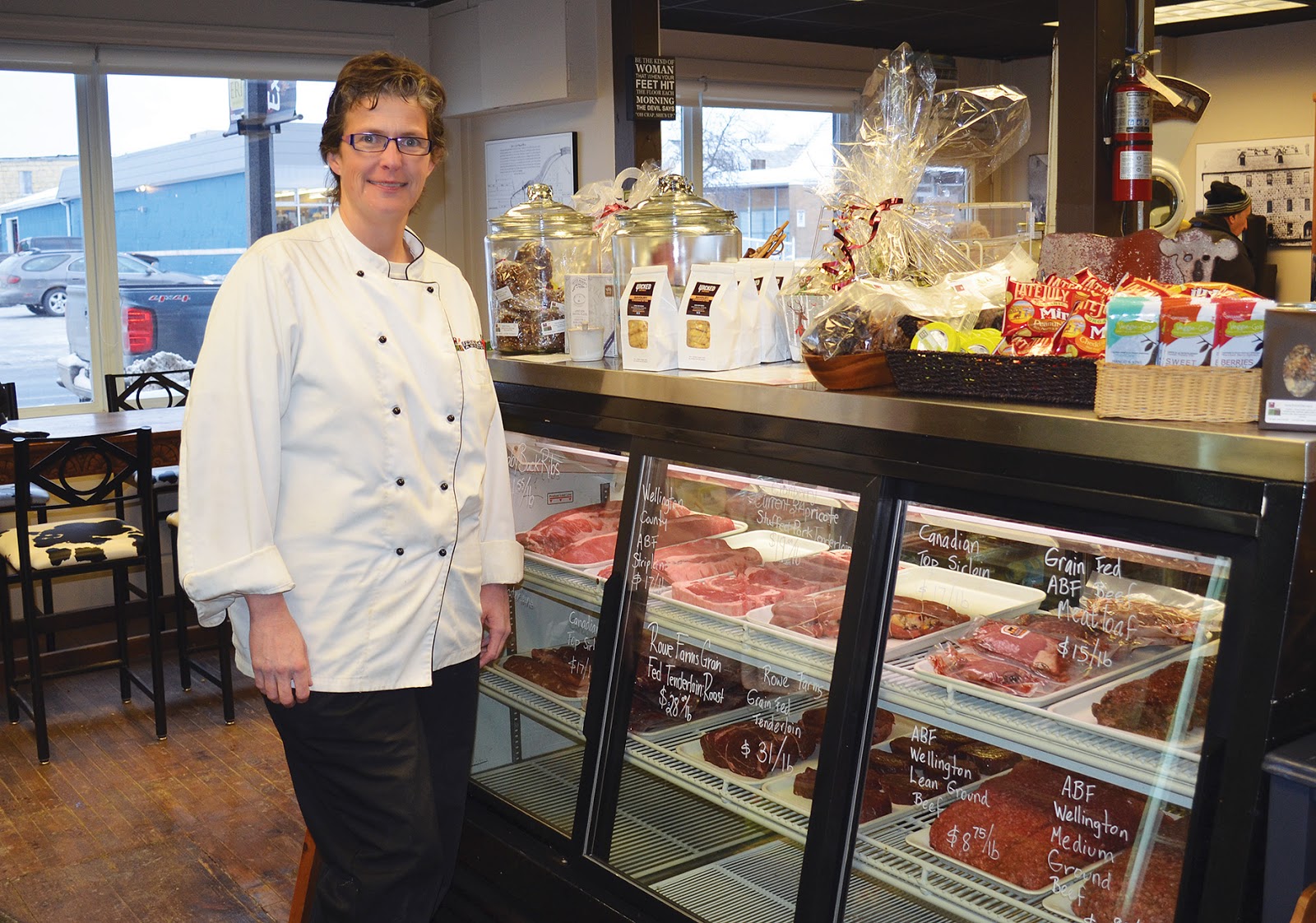
Chef Pam Fanjoy has taken an opportunity to combine her passion for local food with an interest in local history by opening the Mill Run Eatery on Main Street in downtown Erin village.

It is part gourmet grocery store, with some products not normally available in a small town, and a 14-seat breakfast-lunch restaurant that offers Sunday brunch and features a large community table.

Located in the building vacated by Carver’s Block, the Mill Run is two doors up from The Friendly Chef Adventures (formerly What’s Cookin’), which Fanjoy started just a year ago. The locations are on either side of Erin’s historic millrace, which once diverted water from Hull’s Dam on Church Blvd. to the mill behind Budson Farm and Feed, running directly under Debora’s Chocolates.


“I was concerned as a new business owner that Carver’s Block had closed, and I saw an opportunity to expand,” said Fanjoy, whose motto is, “Eat well with friends.” She says the new location has been doing OK even though they haven’t got a sign up yet.

Her primary business was already expanding and in need of more space. In addition to prepared foods, gift baskets and kitchen-related products, Friendly Chef Adventures is now fully licensed and serving lunch, providing catering, offering cooking classes and renting out space for parties.

The Mill Run Eatery has its restaurant seating by the window, then inside are displays that include a selection of cheeses and fresh meats. Each Friday, they bring in a different supply of fresh seafood for the weekend. There are also sections for frozen foods, and fresh produce such as lemon grass.

“I asked the community what they wanted,” said Fanjoy, who is a partner in the Taste•Real initiative for Guelph and Wellington, promoting the benefits of local, organic products. Information on events and incoming specials is available at www.thefriendlychef.ca.

The décor pays homage to Erin’s village history, with a large historical downtown map showing the millrace and photos of four mills from the 1800s. The location even has a trap door leading to the old water route.

While premium offerings do cost a bit more, Fanjoy said she has making an effort to offer people choices and to keep prices reasonable.

The Mill Run sells the Planet Bean line of coffee from Guelph – Fair Trade and Certified Organic – ready to drink or as beans. They have been carrying products from Everdale Farm near Hillsburgh, and meat from Wellington County farms that do not use hormones and antibiotics to enhance growth.

Packaged products include Roasted Chickpeas, Bomba Rice, Soup Girl mixes, 00 Pasta Flour, Smoked Paprika Powder (spicy or mild), and there are natural soda drinks with flavours like Blackberry-Pomegranate-Ginger and Pineapple-Coconut-Nutmeg.

Bottled products include All-Natural Mayonnaise, Rice and Fig Balsamic Vinegar, and various oils – Almond, Sesame, Hazelnut and Walnut.

The eatery is open every day from 9 am to 5 pm, except Friday when they are open until 6 pm. Sunday Brunch ($12.50 for adults, $10.50 for kids) is served 9 am to 2 pm.

December 24, 2014

Town seeks Economic Development volunteers

As published in The Erin Advocate

Erin’s new Town Council is appealing for participation from all sectors of the community as it establishes an Economic Development Committee.

Bob Cheetham, the Town’s Economic Development Coordinator, presented the Terms of Reference (TOR) to councillors on December 16, and they gave unanimous support.

“This has got to work,” said Councillor Matt Sammut. “I’m really hoping our community steps forward and we get some really good economic minds that are passionate about this. We need our economy to not only stabilize, but revitalize.”

The committee will help create an action plan and be dedicated to the “economic well-being and future prosperity of the community”. Principles will include enhanced quality of life and “responsible and sustainable growth”.

Councillor Jeff Duncan noted that the local economy consists of residents and businesses, not the Town.

“The government can’t make this stuff happen,” he said. “We can facilitate and try our best to get things to happen, but we really do need some good people to really drive this and make it successful.”

Councillor John Brennan, who has represented Erin at the Wellington County Municipal Economic Development Group and Hills of Headwaters Tourism, said the timing is right for this initiative, with opportunities to leverage funding from various sources.

“What starts out as a relatively modest investment by the Town grows into something that can really make some great change. We’re never going to get a better opportunity,” he said.

Specifics of the mandate include marketing the Town as a destination, enhancing growth in specific sectors, identifying new trends and looking for partnerships.

Cheetham said the TOR follows the general principles of several others he has been worked on, and of earlier consultations in Erin. Calls for expressions of interest will be advertised in local media, and the TOR is available at www.erin.ca.

“The make-up of the committee is sectoral, with broad-based representation from the community, which is important if you are going to have good collaboration and a bottom-up approach,” said Cheetham.

Although he’s only been on the job for a month, he says, “This is a community with a heart. I’ve seen that. It’s got all kinds of potential. The assets are there. They just need that vehicle to move them forward. And we’ll be coming back to the rest of you in the community to be part of that.”

Mayor Al Alls noted that County Councillor Pierre Brianceau has a seat on the County Economic Development Committee and that the new Warden, George Bridge is a strong supporter of the process.

Members will be appointed to the Town committee by a vote of council. Prospective members will fill out an application by January 15, where they will indicate their interests, experience and priorities. Those will be reviewed by Town staff, who will make recommendations at the next council meeting on who should be appointed.

Initially, one member of council will be appointed as the committee chair. The normal term of committee membership will be three years. The meetings will be open to the public.

The committee will have no binding authority, but will advise and assist council. They will report to Chief Administrative Officer Kathryn Ironmonger or her designate. They will normally communicate to council through staff, but may appear before council as a delegation.

They will be expected to seek consensus and normally the majority opinion would be communicated to council. On matters of significant disagreement, the chair will have the option of reporting minority positions to council.

The committee will have up to 14 members and the Town hopes to include representatives of commercial and industrial businesses, the Chamber of Commerce, the Business Improvement Area, agriculture, the equine sector, recreation, culture, tourism, education, health care, information technology, social services and youth (18-24).


November 26, 2014

Caledon Tourism Study has ideas for Erin

As published in The Erin Advocate

If Erin wants to generate more tourist dollars, maybe it should borrow Caledon’s new Tourism Study. By replacing the word Caledon with Erin, we would be well on our way to our very own tourism strategy.

As Erin’s former CAO Frank Miele once said, “We don’t have to re-invent the wheel, especially when resources are very, very minimal.”

I’m just kidding about copying the report, of course. But since the Town of Erin is probably not ready to hire a consultant to create a local tourism plan, maybe our new council and anyone thinking about serving on the Economic Development Committee could get a few ideas by visiting www.caledon.ca/tourismstudy.

Caledon spent $40,000 on this project, with $15,000 covered by a provincial grant from the Rural Economic Development Program. Caledon has a population of 60,000, compared to Erin’s 11,000, and spends money on projects that we could never dream of.

Still, tourism could be chosen as one of our priorities. With Bob Cheetham being hired recently as Erin’s first Economic Development professional, we can expect a more organized approach on various initiatives.

It’s fine to support and get some help from larger entities including Wellington County, Hills of Headwaters Tourism, and the provincial agencies for our area, Central Counties Tourism and Huron-Perth-Waterloo-Wellington.

But we can’t expect them to do our job for us – aggressively promoting Erin and figuring out how to make it a more attractive destination for people. If council sets tourism enhancement as an important goal, it should be worthy of some investment.

The Caledon study says the Town should enable an “appropriate scale of tourism by enabling the natural evolution of tourism opportunities principally through private capital”.

According to the Ontario Ministry of Tourism, Culture and Sport, every 1,000 visitors is expected to generate $108,000 in visitor spending and $38,000 in labour income, generating one additional job.

The study recommends full collaboration and consultation with tourism organizations, conservation authorities, business operators, land owners and community members. It promotes “Geo-Tourism” that enhances the geographical character of a place – its environment, culture and heritage.

It seeks a balance between benefits for existing residents and tourists, and promotes a strategy of measuring visitation, maximizing opportunities for each season of the year and a focus not just on the number of visits, but on their economic yield. The key to higher yield is more overnight stays.

Municipal leadership is recommended in promotion and marketing of local assets, targeted provision of incentives, signage, wayfinding and visitor information within the town and infrastructure development, maintenance and enhancement. When deciding how to spend the capital budget, the tourism value of the project should be a factor.

Specific initiatives can include development of festivals, art events, sports events, culinary events and farm events, the attraction of specific groups such as cyclists, hikers, horse riders, and promotion of more “fixed roof accommodation” (Bed & Breakfast and Motel/Hotel units). The rehabilitation of gravel pits is also important.

Erin should also look at the extensive work done by nearby Towns in the area of trails. I may be somewhat biased on this point after being involved with the Erin Trails Committee, but there is no doubt that a well-developed network of public trails would be a valuable asset for residents, visitors, prospective residents and prospective business investors.

Caledon is supporting development of a Credit Valley Heritage Tourism Trail. Erin could do the same, looking to see what attractions can be promoted on the West Credit River as part of this inter-regional project.

Erin has a huge potential to develop public land and trails in the interests of local business, heritage, recreation and education – not to mention protection and enjoyment of our natural environment. Let’s look at what our neighbours are doing and get in the game.

October 29, 2014

Erin should promote its Greenbelt identity

As published in The Erin Advocate

Erin should aggressively promote itself as a destination within Ontario’s Greenbelt, and express support for the protection it provides when the legislation is reviewed next year.

Local politicians were distressed ten years ago when the province decided to include the east side of the Town, including Hillsburgh and Erin village, in the 1.8 million acre Greenbelt.
Faced with loss of local control over development, they expanded the urban boundary by 300 acres in the north of Erin village, exempting it from the Greenbelt.

In other parts of the Greater Toronto Area, developers are trying to chip away at the Greenbelt to get more land for housing, while environmentalists are trying to expand the Greenbelt through river valleys to ensure long term protection for what has become known as our “natural heritage”.

Here in Erin, we still have plenty of green space, and more acres of urban land for housing development than we can actually use, given the small size of our river. Apart from development issues, the Greenbelt represents a marketing opportunity that we can use to target city dwellers to want to escape, even just for a day.

Part of that is the Greenbelt Route, a cycling route from the Niagara River to Rice Lake (south of Peterborough) that will be launched next year. It is mainly on existing roads, but a key section is the old rail line of the Caledon Trailway running 36 km from Terra Cotta through Inglewood and points north-east.

Every trail needs side loops to make excursions practical and interesting. Erin already has the Trans-Canada Trail (the Elora Cataract Trailway), so it is well positioned to take advantage of that need.

Erin’s rolling countryside is already popular with cyclists, but what if we were to advertise the “Erin Loop”? I’m sure we could pay a consultant to come up with a catchier name, but the idea would be to encourage groups of cyclists to use Erin as the home base for excursions.

They can show up on a weekend morning and have breakfast here. They can cycle down Winston Churchill, and possibly spend time at Terra Cotta Conservation Area. Just south of there, they pick up the Caledon Trailway, travel to Inglewood, then turn north on signed bike routes to get to the McLaren Road entrance of Forks of the Credit Provincial Park.

The Park has many bike trails and it also provides direct access to the Trans-Canada Trail, looping them back to Erin where they can shop and go out for dinner.

At a recent seminar, Shelley Petrie of the Friends of the Greenbelt charitable foundation said the Greenbelt protects a critical mass of farmland from urban sprawl and provides connected lands that allow wildlife to migrate.

“It’s about the rural economy and recreation plays into it,” she said. “It’s about sustainability for the entire region. It’s taken 30 years to get here, but over time, people’s values started to be reflected in these plans – to protect the beauty of nature, to protect local food production, to have a livable region. For the entire farming sector, this is a hotbed from a jobs and economy point of view.”

She said alliances between farmers and environmentalists are needed as the Greenbelt is reviewed. Key discussions will not only be about whether to expand Greenbelt boundaries, but the impact of highway development (which drives urban sprawl), protecting water resources, dealing with contaminated soils (perhaps with a Clean Soils Act) and possibly adding a protected “Foodbelt” zone of agricultural land just outside the Greenbelt.

These are all issues that could affect Erin’s future, so we should be paying attention. Here are a few websites for additional information: greenbeltalliance.ca, walkandrollpeel.ca, greenbelt.ca and greenbeltleaders.ca.

October 22, 2014

Gravel pit may become conservation area

As published in The Erin Advocate

A plan to donate 120 acres of land for a possible conservation area and sports park just north of Hillsburgh was presented to Erin Town Council by Strada Aggregates on October 7.

The firm will continue to extract gravel from its Hillsburgh Pit for the next three to five years, said Controller Grant Horan, but they are planning to rehabilitate the site on Eighth Line at 27 Sideroad and donate it to Credit Valley Conservation (CVC) and/or the Town of Erin.

Mayor Lou Maieron suggested that the firm make the donation, instead of possibly filling in the pond there, as a way to restore a natural area at the headwaters of the West Credit River, close to the Caledon Mountain Trout Club.

“We are the only municipality in the watershed without a conservation area,” he said. “It’s a good opportunity, a win-win-win for the environment, the Town and Strada.”

Horan said the mayor’s idea was “to establish a joint venture between the Town and the CVC that would offer the community a sports complex facility, including soccer fields and ball diamonds, as well as hiking trails and natural areas.”

In exchange, Strada Aggregates is seeking consent to develop four residential building lots on 27 Sideroad, away from the stream and prime natural land, as well as a tax receipt for the donation.

In a letter to Strada, CVC Manager of Land Planning & Management Eric Baldin welcomed the plan as a strong contribution to the community, saying CVC is always looking for beneficial uses for retired pits.

“This site provides a great opportunity to restore and enhance the natural heritage features and functions in this area,” he said. “CVC has technical expertise that could be helpful.”

The site would not necessarily become a conservation area. It is an opportunity for trails, a constructed wetland and retention of stormwater, as well as an attraction for tourists.

Maieron is suggesting that most of the land, including the pond and stream, become a conservation area, but that the Town get 40 acres of relatively flat land to develop for recreation.

Several years ago the Town purchased land near Barbour Field for future recreational use, but that land could be declared surplus and sold once the Strada lands are ready, he said and the proceeds of perhaps $300,000 used for another project, such as the sidewalk to Tim Hortons.

Strada had approval in 2006 to extract an estimated 1.6 million tonnes of aggregate below the water table. An estimated 450,000 tonnes were excavated in Phase 1, ending in 2008. A 30-acre expansion was planned, but after further study, and discussions with the Ministry of Natural Resources (MNR), the expansion was withdrawn. The MNR will now work with Strada on a revised rehabilitation plan, while extracting the remaining 750,000 tonnes of gravel.

“Strada is committed to a best restoration and management plan that will achieve a goal of maximizing biodiversity value while minimizing maintenance costs,” said Horan.

August 25, 2014

Pan Am Games an opportunity for tourism

As published in Open for Business Magazine – Dufferin County

Headwaters Tourism is urging businesses and residents to provide visitors with an enthusiastic welcome to “Horse Country” – especially when they arrive next summer for the Toronto 2015 Pan Am Games.

“We need all of our community members to be tourism ambassadors, so we actually have a culture of hospitality when visitors arrive from around the world in our area,” said Hills of Headwaters Tourism Association (HHTA) Executive Director Michele Harris.

The equine industry is already recognized as a prime driver in the regional economy, with marketing that includes Dufferin, Caledon, Erin and King Township, but when the Pan Am Games Equestrian Competition is held locally, promotional efforts will move into high gear.

The Caledon Equestrian Park in Palgrave will handle the dressage and show jumping events. It is being renovated with the help of $6.8 million from the federal government.

Will O’Wind Farm in Mono will host thousands of spectators for the one-day cross-country competition. The 5-kilometre championship course will have 30-35 jump efforts, such as water features, drops and log jumps.

“The Town of Mono is excited to welcome the world to our community, and showcase the best of rural Ontario,” said Mono Mayor Laura Ryan. “Hosting the cross-country equestrian event at Will O’Wind will further position our region as a centre of equine excellence in Headwaters Horse Country and provide a lasting legacy for our community.”

The Toronto Pan Am Games will be bigger than the Vancouver Olympic Games, with 20,000 volunteers helping to host the 7,600 athletes coming to Southern Ontario. The television audience is estimated at 380 million households.

“We have a tremendous story to tell,” said Harris, stressing the need to put the equine brand on the area and create a “Pan Am Legacy” to produce lasting benefits in other sectors of the economy.

“Often it doesn’t take a whole lot to up the ante and become a destination. We need you all to spit and polish your door handles. We want to push memorable experiences for visitors. They experience the competition, and then what?”

The Headwaters Pan Am Strategy says, “The Games will provide opportunities for us to highlight the other visitor experiences available in the region, that make Headwaters one of the province’s most sophisticated rural tourism destinations, just a short drive from the country’s largest urban centre.”

Specific initiatives will include prominent signage on area roads. There will be promotion of local food, arts, culture, trails and heritage locations. Contests will be held to choose a signature equine image, a signature food and a signature drink for the area.

“It’s not just what people experience while they are here, it’s also what they get to take home,” said Harris. “I’d like them to have the recipe to take home, so they’re always thinking about Headwaters, and have a reason to come back.”

Even businesses that do not rely primarily on tourists – gas stations, for example – can ensure that staff members make a good impression on visitors. Headwaters will have an ambassador training program available for front-line staff throughout the region.

“We need to promote a culture of tourism,” said Harris. “It’s all about importing money to our community, and those dollars circulate in our own economy.”

Headwaters is one of the most concentrated equestrian regions in Ontario, with premier horse breeding farms, coaching and training facilities, riding schools, boarding stables, equestrian ranches, suppliers (including farriers, veterinarians, feed, bedding and tack shops) and a range of equestrian events.

HHTA also wants to boost the equine export market, working with Equine Canada to bring in people from around the world to see what local breeders have to offer.

“We’ve had to become a destination marketing organization,” said Ron Munro, Chair of the HHTA, at a Tourism Symposium for local businesses and organizations held in March at the Best Western Inn & Suites.

“We’re here to help you re-invent yourselves. If you want people to come these days, you have to have an experience. It has to be worth their while to leave the comfort of their living room.

“We’re taking all the experiences that we can get in our region, and trying to knit them together to give people a compelling reason to get out of the house, go somewhere and experience something.”

HHTA does not have a budget for major advertising, but provides extensive information at www.thehillsofheadwaters.com, and helps coordinate the efforts of local businesses through working groups. It cooperates with Central Counties Tourism, the agency that markets a broad zone that includes the Headwaters communities, plus the Regions of Durham and York.

July 30, 2014

BIA to get tourism boost

As published in The Erin Advocate

The Business Improvement Area (BIA) has been given permission to reorganize its budget, in order to take advantage of provincial funding for tourism advertising.

Town council will allow the Erin village association to allocate $10,000 to a program in which Central Counties Tourism may provide matching funding for advertising to draw visitors from other areas to Erin. Overall spending by the BIA will not increase.

The provincial agency is responsible for tourism promotion in a broad area north of Toronto, including the Headwaters Tourism communities of Erin, Dufferin, Orangeville, Caledon and King.

June 11, 2014

Council considers tough stance on graffiti

As published in The Erin Advocate

Property owners will have to clean up graffiti at their own expense if Town Council approves proposed revisions to the Property Standards Bylaw.


One of the new sections of the bylaw says: “All property including buildings, fences, and other objects shall be kept clean of objectionable markings, graffiti and other defacements at all times and shall be restored, resurfaced and coordinated to the exterior finish of the object.”


Consistent with all aspects of the bylaw, this measure is intended to ensure that the condition of a property does not cause harm to the community – especially the appearance of the downtown shopping and tourist area.


Mayor Lou Maieron said forcing property owners to spend money on a clean-up could be controversial, since they are the victims of a crime.


Councillor Barb Tocher said if someone wanted to paint a mural on the exterior of their own building, the Town could be in the difficult position of having to decide whether it was an acceptable display of art.


The full text of the proposed bylaw is available at www.erin.ca, in the June 3 council agenda, pages 21-54. Discussion of details and passage of the bylaw could happen at the council meeting on July 22.


The bylaw operates with the backing of provincial laws, including the Building Code and the Fire Code, and is enforced by the Town’s Property Standards Officer. It covers a wide range of issues about what is expected of the public in the care and maintenance of their properties.


It includes provision for a Property Standards Committee that would hear and rule on appeals from property owners who may disagree with an Order to Comply. Further court appeals are also possible. An individual convicted of not complying with a final, binding order could be fined up to $50,000 on first offence, and up to $100,000 for subsequent offences. The amounts are doubled for corporations.


The bylaw covers the exterior and interior of buildings, including standards for cleanliness, room layout, the condition of walls, floors, stairs, doors, windows, heating, air conditioning, electrical, ventilation, lighting, plumbing, water and sewage.


Yards “shall be kept clean and free of litter, rubbish, waste, salvage, refuse, decaying, or damaged trees, branches and limbs, animal excrement, excessive growth, objects or conditions that might create a health, fire, accident hazard or unsightly condition.”


Grass and weeds must be kept shorter than eight inches. Living grass or other ground cover is required to prevent erosion “and so as to be in harmony with the neighbouring environment.” Garbage receptacles must have tight fitting lids. Vehicles may not be parked on the lawn.


Machinery and building materials cannot be stored outdoors unless needed for immediate use. Firewood is not to be stacked in front or exterior side yards “unless in the opinion of the Officer it does not have an adverse visual impact on the neighbourhood”.


Updates have been recommended by staff after reviewing property bylaws in other towns. Some are clarifications about existing rules, but there are several new sections in addition to the graffiti provisions.


The surfaces of walkways and driveways are to be “non-organic ground cover”, with no ponding of storm water, no unsightly appearance, free of garbage, safe to use and with no nuisance to other property.


Fences, retaining walls and sheds need to be appropriately maintained with paint, preservative other weather-resistant material, unless they are designed to be enhanced by the lack of such treatment.


Outdoor lighting should be of a low-intensity nature, directed to minimize glare and undue intrusion of light on nearby homes and streets.

April 16, 2014

Storm couldn't ruin great Snowroamers season

As published in The Erin Advocate

Heavy snow made it an excellent winter for the Hillsburgh Snowroamers this year, even if the heavy ice made for some intense weeks of work.


“The season was fantastic – normally we’re happy to get 6-8 weeks,” said Snowroamers President Gord Wiesner.  Instead of finishing before the March Break, riders could use the local trail system until the end of March.


Two years ago there was so little snow, there was no season in the Erin area.


Things got off to a rough start this year when the Christmas ice storm brought thousands of branches crashing down, making trails impassible.


Credit Valley Conservation (CVC) did not have staff available to clear the Elora Cataract Trailway, so the Snowroamers got out their chainsaws, even arranging emergency training so more people could help with the cleanup.


For several weeks the cutters and safety spotters were out working, with risks from falling ice and bent trees. Volunteers put in more than 550 hours and got the main line open by January 19.


“It is a testament that they are a well-organized, tenacious, hard-working group, ready to overcome any obstacle to enjoy the sport they love,” said Wiesner.


Snowmobile riders actually pay CVC for the right to use the trail, and the grooming work that they do makes the trail easily usable for hikers, dog walkers and skiers.


It can cost up to $260 to buy an Ontario-wide season’s permit, depending on the age of your sled. Local clubs get revenue from the permits, and their mandate is to reinvest that back into maintenance and upgrading of trails.


The Hillsburgh club owns various equipment, including a $130,000 grooming machine. Over the years they have put thousands of dollars into projects like bridges, culverts and signage.
In the fall they start marking trails on private land, then do preliminary grooming before opening, normally after Christmas. After the season, stakes and signs are removed.


The club works hard to maintain good relations with landowners, though Wiesner said it can be difficult getting all riders to stick to the trails. Their network extends from Brisbane up to Dufferin County Road 109, and west towards Belwood.


The club gets involved in the community, putting on an event for the Special Friends Club that provides members with rides and a campfire with refreshments.


The local traffic generated by snowmobile trails also provides a lift for the economy, with money being spent on restaurant food, gas, oil and parts.


Wiesner said the province-wide impact is about $1 billion per year, though the number of riders has declined substantially in the last 10-15 years. It is not just because of warmer winters, but the cost of insurance for associations and individual owners has been increasing.


April 02, 2014

Jo Fillery hired as tourism promoter

As published in The Erin Advocate

Erin’s Jo Fillery has been hired to promote tourism in the Hills of Headwaters area – something she’s been doing on her own time for years.


The former owner of What’s Cookin’ recently sold her business in downtown Erin village. It is now operated by Chef Pam Fanjoy as The Friendly Chef Adventures.


“I’ve been a cheerleader for the town as a volunteer,” said Fillery, who has served with the Hills of Headwaters Board of Directors, the Erin Business Improvement Area (BIA) and the Town of Erin Economic Development Committee.


“I have worked 15 years looking for ways to grow our product.”


Now she’s working as the Headwaters field representative for Central Counties Tourism, which is responsible for marketing a broad zone that includes the Regions of Durham and York, plus the Headwaters communities of Erin, Dufferin County, Orangeville and the Town of Caledon.


“Nothing better than getting paid for a passion,” said Fillery. She will be visiting local businesses, working on ways to attract more visitors.


Branding the area as part of a vibrant “Horse Country”, and riding the wave of publicity that Pan Am equestrian events will bring to the Hills of Headwaters next year, were key initiatives discussed at last week’s Tourism Symposium in Orangeville. 


Central Counties sponsored the gathering of business people, tourism officials and municipal funding partners – Councillor John Brennan was there on behalf of the Town of Erin.


“We’ve had to become a destination marketing organization,” said Ron Munro, Chair of the Hills of Headwaters Tourism Association (HHTA). “We’re here to help you re-invent yourselves. If you want people to come these days, you have to have an experience. It has to be worth their while to leave the comfort of their living room.


“We’re taking all the experiences that we can get in our region, and trying to knit them together to give people a compelling reason to get out of the house, go somewhere and experience something.”


The equine industry is already recognized as a prime driver in the regional economy, with marketing that includes King Township, but with the equestrian competition of the Toronto Pan Am Games coming here in 2015, promotional efforts will move into high gear.


The Caledon Equestrian Park in Palgrave will handle most of the events. It is being renovated with the help of $6.8 million from the federal government. It was announced in January that the Town of Mono’s Will O’Wind Farm will host the cross-country competition.


HHTA also wants to boost the equine export market, working with Equine Canada to bring in people from around the world to see what local breeders have to offer.


“We have a tremendous story to tell,” said HHTA Executive Director Michele Harris, stressing the need to create a “Pan Am Legacy” to produce lasting benefits in other sectors of the economy.


“We need you all to spit and polish your door handles. We want to push memorable experiences for visitors. They experience the competition, and then what?”


Specific initiatives will include prominent signage on local roads and promotion of trails and heritage locations. Contests will be held to choose a signature equine image, a signature food and a signature drink for the area.


“It’s not just what people experience while they are here, it’s also what they get to take home,” said Harris. “I’d like them to have the recipe to take home, so they’re always thinking about Headwaters, and have a reason to come back.”


HHTA and Humber College will also be training members of community organizations to promote the region.


“We need all of our community members to be tourism ambassadors, so we actually have a culture of hospitality when visitors arrive from around the world in our area,” she said.


Apart from equine and the Pan Am preparations, HHTA is promoting experiences in four other strong sectors. There is a series of culinary tourism events based on local food, starting with the current Taste of Maple project.


The arts, culture and heritage sector also drives economic development, and will continue to be promoted, along with an array of festivals, fairs and other special events. Then there is the attraction of outdoor sports, especially cycling tourism, and nature recreation – balancing the need to protect natural areas with the desire to show them off to the world.

December 18, 2013

Proposed Bell tower shocks neighbour

As published in The Erin Advocate

A farmer operating a vacation business that relies on the beauty of the Erin countryside is quite alarmed at the prospect of a new Bell Mobility tower nearby.

Keith Lamont of Thistlestone Farm, on the Fourth Line south of County Road 50, learned last April about an agreement to erect a 61 metre (200 foot) tower right next to his property. He voiced his objections at a public information meeting December 3 in the Erin council chambers.

“I am stunned – they never approached me,” said Lamont. “It is quite ludicrous. Communities have needs too.”

Joel Swagerman of the consulting firm Fontur, working for Bell Mobility, said notifications for consultation can only be sent out after an agreement has been worked out with the owner of a selected location. Landowners can earn substantial revenue by allowing a tower on their property.

Anyone with concerns about this tower must send in their comments to Bell Mobility by December 23, and they will include them with their submission to Industry Canada. While the information meeting took place in the presence of Erin town councillors prior to their regular meeting, they have no authority regarding communications towers and made no comments.

“This has become a stressful experience,” said Lamont, who believes the visual impact of the tower puts his vacation business in jeopardy. “No one concerned has even visited us.”

With his website, www.thistlestonefarm.com, he promotes not only his family’s sheep farm operation, but encourages Farm Stay Vacations. The property has various ponds, trails and boardwalks.

“We have renovated two homes to attract visitors from the Bruce Trail, international ag visitors, naturalists, birders and livestock seminars sanctioned by OMAFRA etc. All these visitors will be staying in accommodation under the shadow of a multi-legged tower.”

Swagerman said several sites were considered in the area, and this is considered the best, providing coverage while meeting the required distance away from wetlands. The Grand River Conservation Authority has issued Bell a permit to use the land for a tower.

“It meets the environmental criteria – we understand that this area is quite sensitive,” he said. “There are concerns that Industry Canada does not necessarily agree are relevant to the proposal – these would be health concerns and property values – that’s just the way they work.”

“All I can counter with is the visual distraction,” said Lamont. “All I can hope for is that someone will agree that we are impacted.”

He asked if there is any possibility of screening the view of the tower to reduce its impact. Swagerman said the planting of trees could be considered, and noted that relocation of the tower within the chosen property could still be considered by Bell Mobility and the landowner in the coming months.

One of Lamont’s supporters said: “This is going to be a substantial aesthetic and financial loss, because his property will be devalued because of that tower. Why should he have the burden of all this, if the other guy gets the financial benefits?”

Community objections to new towers have become frequent news. Last month, loud protesters at a Stewarttown information meeting prevented a Rogers representative from making a presentation on a new cell tower. Complaints there included health fears due to the tower signal, reduced property values, visual distraction and lack of public notification.

Swagerman said the Erin tower is part of a program to expand broadband wireless services (internet data and voice) to underserviced areas. Bell Mobility was issued the area by the Canadian Radio-television and Telecommunications Commission CRTC, and asked to find an appropriate location for a tower within an 800 metre radius.

“The goal of the program is to even it out so the rural areas get improved service, on an equal basis to the urban areas,” he said, noting that residents within a three to five kilometre radius would be able to receive a wireless internet signal.

October 16, 2013

Fair always bigger and better

As published in The Erin Advocate

“Erin Fall Fair, which is usually looked upon in this vicinity as the event of the season, was held on Thursday and Friday last. The exhibits in every department of the Show were excellent, the total number of entries far exceeding anything in the past.”

That’s a front-page snippet from the Erin Advocate a century ago, showing the newspaper’s support for the event. It is no mean feat to produce a fair that is bigger and better than all those that have gone before.

In my spare time, I like to read the 1913 issues of The Erin Advocate, to see what was going in the days when horses still pulled buggies and cutters, farming drove the economy and no one dared to print bawdy sayings on T-shirts.
A picture postcard of George Wheeler, with his son Norman on his knee and his other son Albert driving, from the booklet Erin Fall Fair...since 1850, by June Switzer, published in 2000. Postcards were a popular item in fairs in the early 1900s. The booklet is available at the Erin library.
By then, the fair already had quite a history. Mr. G. Awrey of Elora, 85, attended for the 60th consecutive year in 1913. Are there any today who can claim a similar record?

The fair that year had about 2,660 entries. There was an “immense” show of homemade butter, including 50 lb firkins (casks), and over 30 entries vying in the 5 lb category.

The Erin Advocate’s Prize for the Largest Pumpkin Pie was won for the third time by Mrs. J. Small. The editor said it was largest pie he had ever seen – 18 inches across, and the office “devil” said, “It was a peach”.

The large classes of light and heavy horses “would be hard to beat anywhere”, and included some “nobby turnouts”. (Nobby is a complimentary adjective, of Scottish origin, meaning high class and stylish.)

“We had almost forgotten to mention the show of eggs in the Hall, which were the most uniform in size that we have ever seen.”

Of course, a large gathering can attract some unwelcome guests, including a professional pickpocket who stole large sums from several patrons. “The afternoon being wet, everybody crowded into the Hall, which gave the light-fingered gent a grand opportunity to get busy.”

Also, some exhibits didn’t make it back to their owners. “The parties who carried off a pair of dressed ducks and ten pounds of butter will please settle for the same and avoid further trouble.”

Entertainment was provided by the Laurie brothers performing Scotch songs and dances, and by the Fergus Band, said to have given general satisfaction. “The members of the Band are all a gentlemanly lot, and did not stint their music.”

The Advocate printed the names of a hundred or so visitors and those with whom they stayed. They also listed all the 1st, 2nd and 3rd Prize Winners’ names, starting with R. McEnery with the top brood mare, and ending a full page of type later with the photography award going to G.A. Matthews.

The dimensions of the newspaper in those days was 14.5 inches wide and 20.75 inches deep, more than double today’s page size. A one year subscription to the Advocate was just one dollar, but not everyone was paying: “If you are owing one, would you without further notice forward it to us. We would like to be able to buy about three tons of coal this winter.”

E. Barbour had the fattest sheep at the fair and Jas. Milloy had the best Berkshire Boar. Township pupils in Form IV (Grades 7-8) competed in the Penmanship Classes, with W.J. Russell producing the best copy of the Lord’s Prayer.

And speaking of old-style education, here’s a note received by a teacher in the region: “Dear Mis. You writ me about whippin Sammy. I give you permission to beet him up any time he wont learn his lesson. He is jest like his father and you hev to beet him with a club to lern him enything. Pound nolege into him. Don’t pay no attention to what his father says. I will handle him.”

In the week prior to the fair, a challenge had gone out to see if anyone could beat   Alex McArthur’s potato, which was 13.5 inches by 17 inches and weighed 2 lb 5 oz. Township Treasurer W. Wheeler came in with the winner, at 3 lb.

And of course there was plenty to eat. Mr. Bush, proprietor at the Globe Hotel across the street, opened up an extra dining hall upstairs, while Mrs. Walker and Mrs. Leitch served meals to many.

“The ladies of All Saints church availed themselves of Mr. Island’s large store [pianos, stoves and Singer sewing machines] where excellent meals were served. There was no need of any person going hungry, for there was an abundance for all.”