Showing posts with label Bridges. Show all posts

March 29, 2018

Town gets $1.5 million for Hillsburgh bridge project

The Town of Erin has received a $1.5 million provincial grant that will cover more than half the cost of rebuilding the Station Street bridge in Hillsburgh.
The total cost of the project, which includes rehabilitation of the millpond dam, is estimated at $2.5 million. Design work will be completed this year, with tendering expected in the fall and the start of construction in the spring of 2019.
“The significant repairs being done to the structure will be of added value to the town as we continue to grow,” said Mayor Allan Alls.
Wellington County owns the water control structure in the 
Hillsburgh millpond dam, while the Town of Erin owns
 the earthen berm that supports Station Street.

Gooderham and Worts built the dam that created the 
Hillsburgh millpond in the early 1850s, with a new mill that 
shipped grain to what is now Toronto’s Distillery District. 
The Station Street bridge was built in 1917.
The Ministry of Agriculture, Food and Rural Affairs approved the grant through the top-up component of the Ontario Community Infrastructure Fund (OCIF). The town applied for $1,576,988 in July last year, but the grant was not approved until the Minister of the Environment and Climate Change gave the project the green light.
“The OCIF grant is great win for the Town,” said CAO Nathan Hyde. Erin has been turned down for OCIF grants in recent years. The program provides long-term funding for small, rural and northern communities to develop and renew their infrastructure. 
The project was the subject of an environmental assessment that recommended preserving the millpond. Town council and Wellington County backed the EA result, but it was challenged by Credit Valley Conservation and others who preferred either decommissioning the pond, or creating a smaller, off-line pond. 
Town council was prepared to go ahead with the project without a grant, and had arranged $2.5 million in debt financing. Mayor Alls said he expects that debt will still be used to cover the balance of the cost.
He said the town might be able to reduce the cost of the project if sections of the dam’s foundation can be re-used. Construction will have to be timed to avoid disruption of trout hatching.
The bridge was built in 1917 and was first identified in 1971 as being in need of replacement. Although the dam had repairs and reinforcement after an outlet pipe failed in 2011, forcing temporary closure of the road, the province is insisting that the risk of failure be brought up to modern standards.

July 15, 2015

Major expenditure needed to replace one-lane bridge

As published in The Erin Advocate

One-lane bridges need to become a thing of the past, especially when they carry substantial high speed traffic between communities – and sooner rather than later if they’re falling apart.

That’s the case with the bridge on Winston Churchill Blvd. just north of 27 Sideroad (Highpoint Sideroad on the Caledon side). It was built in 1920, rehabilitated in 1950, and now handles an average of 2,400 vehicles per day. A recent inspection report found it to be in “very poor condition” and recommended a new two-lane bridge “to improve public safety”.

People who use the road regularly to travel between Erin and Orangeville have learned how to judge the speed of oncoming traffic to see who will have to slow down and who will get to go first. But for those unfamiliar with the road or not paying attention, a one-lane bridge creates the need for an unexpected quick decision, which can be more difficult at night.

Winston Churchill is the boundary road for Caledon on the east (in Peel Region) and Erin on the west (in Wellington County). Further south, it is considered a Regional Road, with the Region and County sharing the costs, but this bridge, which crosses a tributary of Shaw’s Creek, is in a section where the local Towns are responsible.

There’s no detailed cost estimate yet, but Transportation Engineer Hilda Esedebe, of the consulting firm McIntosh Perry said a full replacement with two lanes could cost about $1.5 million.


At a recent Public Information Centre in Alton, as part of an Environmental Assessment (EA) now being conducted by the Town of Caledon, she said the reconstruction is planned for next summer and that the Town of Erin is expected to contribute 50% of the cost. The existing bridge has an estimated remaining service life of six years.

Erin Mayor Al Alls said that while it is normal to share costs for boundary roads, Erin has not been formally asked to participate. He expects to discuss the matter soon with Caledon Mayor Allan Thompson.

Erin has, however, included the project in its 5 Year Capital Plan for 2016, with an amount of $680,000. Like most of the 55 other items on the Roads list, the Winston Churchill bridge is “unfunded”, with no grants allocated and no reserve funds set aside. The draft plan provided to council last January showed $21.8 million in Roads infrastructure needs over five years, with $17.4 million unfunded.

The bridge will be discussed in the 2016 budget process, when council decides how much it is willing to borrow and which projects will make the cut.

Of course, the costs for Erin and Caledon could be greatly reduced if they were shared with all taxpayers in Wellington and Peel – but the bridge could collapse while waiting for such good news. Caledon has been lobbying Peel to take over this section of Winston Churchill (north of Beech Grove Sideroad) as a major arterial route, and similar discussions are ongoing at County Council. Erin will take any road uploading it can get. If upper tier municipalities take over a road, they are legally obliged to take over any debt payments related to its improvement.

The EA for the Winston Churchill bridge considered the lower-cost options of doing nothing, of closing the bridge permanently or of leaving it at one lane. Rehabilitation of the existing deck and foundations could last 20 years, and a new one-lane deck on rehabilitated existing foundations could last 50 years. The recommendation is an entire replacement with two lanes, expected to last 75 years.

The updated design would mean lower maintenance costs, a wider span that would improve river flow, and roadside barriers and railings that meet modern safety standards.

December 03, 2014

Looking for clues in the funding puzzle

As published in The Erin Advocate

Is Erin truly being cheated in the financial shell game operated by the Ontario government with its municipalities, or are we just feeling hard done by when money is dangled before us, and then snatched away?

The complexity of the system makes it difficult to tell, so the best we can do is look for clues.

The latest disappointment at Town Hall is the denial of two grant applications: $1.8 million from the $50 million competitive section of the Ontario Community Infrastructure Fund (OCIF) for the Daniel Street Infrastructure Renewal Project, and $1.6 million from the Small Communities Fund for the Station Street Rehabilitation project.

Senior governments like to take credit for offering millions of dollars in funding, but when more than 350 municipalities in Ontario want a slice of the pie, the odds of getting a large piece are slim. They’ve told us our projects were not deficient, but won’t say how they were ranked, only that “other applicants with highly critical projects had more challenging economic conditions and fiscal situations.”

Seems it doesn’t pay to keep your debt low. The province is saying that with Erin’s assessment and average income, it can well afford to pay (that is, borrow) for the things it wants. Financial Analyst Larry Wheeler called the criteria “absurd”, in a report to council.

“Being a municipality on the fringe of the GTA brings with it two hugely detrimental characteristics when it comes to winning prospective provincial and federal grant funding: i) Erin household income almost 60% higher than the provincial median, ii) Erin weighted assessment per household 94% higher than the provincial median,” he said.

“Infrastructure funding is not a social welfare program, so why therefore is ‘household income’ being used as a key determining factor? It is paradoxical that ‘weighted assessment’ is being used to steer and channel infrastructure funding in the opposite direction to where it is most crucially required.”

This competitive situation is just one piece of the funding puzzle. Here are a few other recent examples.

• Erin will get $179,100 over three years from the non-competitive section of the OCIF, according to a complex formula to divide up $50 million.

• Erin will get unconditional Ontario funding of $585,800 in 2015 through the regular Ontario Municipal Partnership Fund (OMPF). That is up $2,200 over 2014, but way down from the $654,000 we got in 2012. The province is eager to point out that while it is reducing that funding overall, it is busy “uploading” various costs to the provincial level including Ontario Works benefits, Disability Support, Drug Benefits, and Court Security.

The Town of Erin has never paid for these services, but the uploading will provide $4.8 million in savings for Wellington County next year, the equivalent of 4% of all municipal property tax revenue in the County. That will more than offset the reduction of the County’s OMPF grant from $3.6 million to $2.9 million.

For OPP service, Wellington expects to save more than $2 million per year under a new billing system that is based more on actual calls for service.

Erin residents and politicians need to find out just how much of these County savings will trickle down locally. Let’s hope they are not all siphoned off to pay for hospitals that we don’t use.

It is not surprising that Erin councillors have been treating Town taxes and County taxes as a package deal. The County is so well off financially that it should be able to adopt minimal tax increases – allowing the Town room to tax for what it needs while keeping the overall increase reasonable. Or perhaps the County could do some uploading of its own, essentially paying for more of what the Town now covers.

In a report to council, Director of Finance Sharon Marshall highlighted a statement in a recent letter from the Minister of Finance Charles Sousa and Municipal Affairs Minister Ted McMeekin concerning the upload savings for upper tier governments like Wellington County:

“It is important to acknowledge that in two-tier systems, the removal of these costs off the property tax base benefits all local taxpayers including those residing in lower-tier municipalities. We encourage upper and lower tier municipalities to engage in discussions to ensure that the savings resulting from the uploads benefit their shared taxpayers in the most effective way possible.”

June 25, 2014

Environmental assessment to start on dam

As published in The Erin Advocate

The Town will hire Triton Engineering to do an Environmental Assessment of the Station Street dam and pond area, but possible reconstruction of the bridge and dam will not happen until after the study is complete in January of 2016.

Road Superintendent Larry Van Wyck said the long time frame is needed to gather all the necessary data. He recommended Triton because of their familiarity with issues in that area of Hillsburgh.

Council will ask the Ministry of Natural Resources for an extension of its deadline (originally June 1, 2014) for the Town to apply for permission to do the actual reconstruction.

The Town did emergency repairs to the deteriorating structure in 2012, and there has been ongoing debate about whether to retain the 19th Century mill pond.

Council has allocated $190,000 in its 2014 budget for the environmental assessment, but the full project is expected to cost well over $2 million.

May 21, 2014

Reserves help Town save for major upgrades

As published in The Erin Advocate

It may not come as a shock that the Town’s property tax increase has been held to a modest 3% during a municipal election year, even while capital spending is up by 30% – an extra $1 million compared to last year.


A municipal budget is a complex puzzle, including money held in reserve for major projects. Residents may be unhappy about which projects get top priority, but the debates and decisions about spending are at least done with public scrutiny.


 Yes, taxes are high, but that is primarily the price of living in a small Town with a very small industrial and commercial tax base. And yes, the Town could find ways to be more efficient, but that would not solve the main problem: not enough income to satisfy the demands of the provincial government and of residents.


It doesn’t really matter if improvements occur in an election year, as long as they get done. If voters want to toss out the current councillors, it’s going to happen whether or not any given road is paved. New councillors will have the same money to work with, and will discover that slashing spending is easier said than done.


The use of reserves is a tool that enables the Town to save up so that major jobs can be done with less borrowing. There are formal Reserve Funds in separate accounts, many of which are required by the province, such as Development Charges, Cash in Lieu of Parkland and the Federal Gas Tax Reserve Fund. Other informal Reserves remain within the general funds, but are still earmarked by council for specific purposes.


The Town started the year with about $5.4 million in Reserves and Reserve Funds. The 2014 budget will draw out $2.1 million for capital and operational uses, but transfer in close to a million, leaving a balance of $4.2 million. Finance Director Sharon Marshall estimates that an additional $200,000 to $300,000 will flow into Reserve Funds this year due to new houses being built, and lots being created.


The depletion of savings has enabled the Town to keep the tax hike to 3%, or $33 on an average home assessed at $387,750. If they had done the same spending without using reserves, that average tax hike would have been $262, an increase of 24%, Marshall said. Each 1% tax rate increase only raises about $50,000 for the Town.


Reserved money can be for projects considered too expensive to be funded in one year. It can also be money planned to be spent one year, but not actually spent, so it is carried forward for the same project. For example, $181,516 of unused 17 Sideroad reconstruction money was put into the Roads Capital Reserves in 2013, to be withdrawn to help pay for work in 2014.


“Much of the money used in 2014 from Reserves and reserve Funds was originally added to those funds for specific purposes,” said Marshall. Of the $2.1 million to be withdrawn in 2014, $1.5 million was for previously planned projects.


Staff presented a Five-Year Capital Plan last January. While Council did not formally adopt the plan, it did play a role in budget deliberations. Council did approve an Asset Management Plan (AMP) last December (as required by the province for grant applications), with recommendations on funding capital projects.


An article on the AMP is available at www.erininsight.blogspot.ca, and the document is available on the Town website, www.erin.ca. Capital Plans and Asset Management Plans do not bind the Town to projected spending – those final decisions are made in each annual budget.

April 23, 2014

It's not too late for climate change solutions

As published in Country Routes

Measures to counter the damaging effects of climate change can be achieved without catastrophic costs and devastation of the world economy, according to new studies in the debate over global warming.


That’s music to the ears of environmental activists like Erin’s Liz Armstrong, who have pushed for practical climate action at the local level.


She has started a chapter of the Citizen’s Climate Lobby (CCL), designed to influence political decision makers at various levels of government.


Liz Armstrong
Two recent reports from the UN’s Intergovernmental Panel on Climate Change (IPCC) say that while the risk of increasing droughts, floods, crop failures and severe storms due to the carbon from fossil fuels is reaching an alarming level, the ability to do something about it remains well within the reach of national governments.

“It will get worse before it gets better, but it’s not too late, and it is not going to cost the earth,” said Armstrong. “We have to buckle down and steel ourselves to do this. It is the developed countries that are causing the problem. There is no excuse not to act.”


The IPCC report says climate change is “unequivocally” caused by people burning fossil fuels and that it poses a serious threat to peace and stability. Scientists warn that we need to cut greenhouse gas emissions by 40 per cent or more by mid-century to avoid calamity.


“The good news is that it will not cost much compared to the total Gross Domestic Product (GDP), and compared to the cost if we do nothing,” said Armstrong.


Her group is meeting on the first Saturday of each month at Erin United Church, training on how to engage politicians and the public, planning local action and getting updates from CCL leaders. She can be contacted by email: liz@lizarmstrong.ca, and more information is available at www.citizensclimatelobby.ca.


The federal Conservative government has put a lot of energy into oil sands expansion, pipeline plans and energy exports. They have promised tougher environmental legislation, and say Canada is on track to trim greenhouse gas emissions by 17 per cent by 2020 from their 2005 level. But The Toronto Star reports that Environment Canada is less optimistic, saying last fall that at the current rate, we will achieve a mere 0.4-per-cent cut.


The Citizen’s Climate Lobby favours a “Carbon Fee and Dividend”, essentially a carbon tax placed on fossil fuels at their source. This would result in higher fuel prices, but all of the extra money would be rebated equally to Canadians. It would be a market-driven system, benefiting those who use less fuel.

The Lobby also objects to the current distortions in the marketplace, in which taxpayers’ money is used to mask the true cost of energy. A report from the International Monetary Fund (IMF) calculated that Canada provided $26 billion to subsidize the energy industry in 2011, which is $787 per person.


IMF First Deputy Managing Director David Lipton said removing these subsidies worldwide could lead to a 13 percent decline in carbon dioxide emissions. This would reduce global energy demand and strengthen incentives for research and development in energy-saving and alternative technologies.


Canada already has a thriving “green” sector, innovating and making money in areas such as energy, infrastructure, transportation, biorefinery, industrial processes and wastewater treatment.


“Canada’s clean tech sector is now a $11.3 billion industry, it employs more Canadians than aerospace, and has the potential to grow to $50 billion by 2022, representing 2% of the global market share,” said Armstrong, suggesting that subsidies for clean technologies instead of oil would be a better investment for Canada.


A study by Analytica Advisors estimates employment in the clean tech sector could grow from the current 41,100, to more than 75,000 in the next eight years.


“Canadian innovation is helping to clean up contaminated land and water, store energy for use during peak demand, improve efficiencies in solar systems and transform greenhouse gases into stronger concrete to build greener buildings,” says the Citizen’s Climate Lobby, commenting on the study.


“Other countries have taken notice, buying environmentally-friendly Canadian technologies that help reduce and recycle solid waste, improve efficiencies and reduce our reliance on fossil fuel and petro-products. Approximately 74 percent of Canadian clean technology companies are exporters, with 42 percent of export sales going to non-US countries.


“While Canadian clean technology enjoys strong market diversification overseas, it struggles to compete domestically. One challenge is the price of carbon-based energy, which is relatively cheap in Canada compared to many countries.


“At a time when the world is thinking twice about investing in a high carbon future, Canada can ill-afford to put its economic eggs in the oil sands basket. According to the IPCC, the world must keep two thirds of all fossil fuel reserves in the ground to avoid dangerous global warming.


“Canada is at a crossroads. Does it invest in dirty oil and pipelines, and lock the country into a high-carbon economy, or does it focus on transforming its economy, using clean technology to drive innovation and economic growth?”


“Building a green economy will create more long-term jobs,” said Armstrong, who remains hopeful that some of those companies could be attracted to Erin. “Smart municipalities are making plans and looking to the future. Election candidates need to say what type of development they would like to see here in the next 50 years.”


Climate change could mean a low flow of water in the West Credit River at certain times. As a precaution against excessive contamination from treated sewage effluent, a 10% cutback has been made in the maximum number of new residents to be allowed in Erin village and Hillsburgh.


Food is another key aspect, with crop yields and fish harvests declining as the world population increases, making it difficult to sustain a quality, affordable supply.


“This is no longer a picture about poor farmers in some regions being hit by climate change,” said Tim Gore, head of policy for food and climate change at Oxfam. “This is a picture about global agriculture being hit – US, Russia, and Australia – with global implications for food prices.”


A TD Bank report says natural catastrophes will cost Canadians an estimated $21-$43 billion per year by 2050.


“The frequency of weather events has increased,” said lead author and TD economist Craig Alexander. “Storms that used to occur every forty years are now occurring every six years. And because of the composition of Canadian economy and society, we’re ending up with more damaging events.”


He said city dwellers are at the highest risk, and with Canadians becoming wealthier, they have more valuable assets to lose in the event of a catastrophic storm. Repairs after a catastrophe tend to inflate the GDP, masking the costs that are shared broadly via the insurance industry and government relief funding.


The TD report highlights estimates that for every dollar invested in adaptation to climate change prevention, such as severe weather resistant buildings, from $9-$38 worth of costs will be avoided in the future.


“Here in the Town of Erin, we should be cognizant of these predicted increases of weather and climate extremes when planning and building new (or replacing old) infrastructure, housing, roads and bridges, etc., significantly boosting their capacity to withstand more punishing climate stresses than in the past,” said Armstrong.


“All of these suggestions were brought forward in 2011 by Amaranth Mayor Don MacIver, an Environment Canada climatologist who was a member of the IPCC. Our Council (present and future) needs to be aware, and prepared to act on his suggestions and forewarnings.”

January 29, 2014

Station Street referendum gets no council support

As published in The Erin Advocate

A proposal from Mayor Lou Maieron for a referendum question on how to repair the Station Street bridge and dam in Hillsburgh got a resounding “No” from Town Council last week.

Actually, fellow councillors said nothing when he read his motion, meaning that there was no seconder and no debate.

“I have tried, ladies and gentlemen,” said the mayor, crumpling up his motion paper.

He was asking that staff investigate the requirements to add a question to the October 2014 ballot about the controversial bridge and dam, “to provide limited repair options to be considered, so that the voters in the Town of Erin can have a direct voice in a very significant issue with potentially serious financial ramifications for the foreseeable future”.

The cost of rehabilitation, including full rebuilding of the road and bridge, is over $2 million, whether the mill pond is maintained or not. Maieron has suggested the cost could be much lower if the pond is allowed to revert to a river, and a large culvert is used instead of a bridge.

Credit Valley Conservation generally supports removal of dams when possible, but a special committee including local residents has recommended that the pond be maintained. The Town owns the bridge, the road and the earthen berm of the dam, but the pond and the water control structure are privately owned.

The Ministry of Natural Resources has allowed temporary repairs to the earthen berm due to safety concerns, but has demanded that the Town come up with a permanent solution by June this year, including any required environmental assessments.

The Town has failed to get funding from senior governments for the work, and the mayor says it is difficult to ask taxpayers throughout the Town to bear the cost of borrowing $2 million, especially since the pond is surrounded mainly by private property.

This project, which has been on the Town’s priority list for 40 years, will be discussed at budget meetings in March.


Budget deliberations to start with 3% tax hike

As published in The Erin Advocate

Erin CAO Kathryn Ironmonger has directed Town staff to come up with an initial draft budget for 2014 based on a 3% tax increase.

That’s a big change from last year’s budget process, which started with a wish list budget requiring a 32% increase for the Town portion of the tax bill, which was whittled down to a 15% increase.

The first budget meeting is set for March 5 at 7 pm, with presentation of both an operating and capital budget. A public meeting, similar to one held last year, will also be held to explain the budget before it undergoes final changes and approval.

Council also hopes to approve for the first time a Five Year Capital Plan that schedules future major projects according to priority, without approving actual expenditures that are decided year by year.

January 22, 2014

Small towns need consistent funding

As published in The Erin Advocate

Wellington-Halton Hills MPP Ted Arnott has taken up the fight of small municipalities to get adequate funding for infrastructure from the provincial government.

The Progressive Conservative member accuses the Liberals of unfairly cutting back regular funding and making it harder to get grants to cover major projects. He recently wrote to Jeff Leal, Minister of Rural Affairs, about rejection of funding for the Station Street Bridge in Hillsburgh.

“Your Ministry’s decision is completely unsatisfactory,” he said. “There are significant structural concerns with the dam and a hazard assessment identified a high hazard potential should the dam collapse.”

He pointed out that the bridge “has been identified by the Credit Valley Conservation Authority as a safety concern and by the Ministry of Natural Resources as an item the Town of Erin must deal with by June 2014. Town staff have informed me that they are not certain how they will be able to proceed with the project without assistance from your Government.”

The province said other applicants with critical projects had more challenging conditions “as measured by property assessments and incomes”.

Towns that raise taxes and borrow for infrastructure are more likely to get grants, apparently an attempt to keep the provincial deficit under control.

Arnott has also said that cuts to core funding through the Ontario Municipal Partnership Fund (OMPF) amount to “downloading by stealth”. From 2012 to 2014, Wellington and its local municipalities are getting about $1.7 million less, with province-wide funding being scaled back from $598 million in 2012, to $550 million this year and to $500 million by 2016.

The Ministry of Finance says: “The OMPF phase-down was part of the Province’s agreement with municipalities in 2008 to upload social assistance benefit programs as well as court security costs off the property tax base.

“Despite the phase-down of the program, the combined benefit of the OMPF and provincial uploads will continue to increase, with uploads more than offsetting the reduction to the program.”

The uploading of costs benefits the county, but not local governments. Erin’s OMPF allocation dropped by $65,400 in 2013 but only by $3,300 for 2014. Some municipalities in Wellington lost well over $100,000 for 2014, while others had increases.

The Association of Municipalities of Ontario (AMO) says the transition formulas “have not and will not be responsive to changing social service and police costs. The scale of OMPF cuts will be magnified by 2014 OPP wage related cost increases of approximately $25 million in 2014. Tax increases or service reductions are likely in all corners of the province.”

A letter to Premier Wynne from Bill Vrebosch, Mayor of East Ferris (near North Bay), which was included in a recent Erin meeting agenda, expressed disappointment with administration of the $100 million Small, Rural and Northern Municipal Infrastructure Fund.

“We have all put a great deal of effort into this process but obviously the consultations were a complete waste of everyone’s time and energy. We are back to the hat in hand / lottery system for the distribution of funds. This is a total disregard for the input of the municipalities of this province.”


His municipality has reduced its reserves, borrowed money for the first time for roads projects and raised taxes more than the rate of inflation for five years.

“We have been doing all that has been asked of us by the Province and more yet we continue to be shut out of infrastructure funding.

“We are trying our best to be creative and innovative in our approach to our planning in an attempt to become financially healthier and move towards greater sustainability in the future. Now we can say that we, together with AMO and most of the other municipalities, are not even being listened to. We continue to ask for a source of sustainable infrastructure funding for all municipalities.”


December 18, 2013

Province denies funding for bridge replacement

As published in The Erin Advocate

The Town of Erin’s bid for a $2 million grant to help rebuild the dam and bridge on Station Street in Hillsburgh has been denied by the provincial government, citing high property values and average incomes in this area.

A denial letter received last week says more than 350 applications were received from Ontario municipalities under the Small, Rural and Northern Municipal Infrastructure Fund Capital Program.

“Other applicants with highly critical projects had more challenging economic conditions (as measured by property assessments and incomes),” said the letter from the Ministry of Rural Affairs.

Finance Director Sharon Marshall said other municipalities in Wellington County, some with property assessments lower than Erin’s, got similar denials. The exception was an application from the Town of Minto, which was allowed to proceed to the next phase of the grant process.

Work on the Station Street dam, bridge and road is expected to cost more than $2 million, regardless of whether the dam is preserved. The Town thought it had a good chance for funding, since the project affects public safety and is extremely expensive in comparison to other Town projects.

Council has made no decision on the project, but is facing a provincial deadline of next June to complete an environmental assessment and a plan to rehabilitate that infrastructure.

Town needs extra revenue for infrastructure

As published in The Erin Advocate

To build up a war chest of capital funding for roads, bridges, culverts and other facilities, the Town of Erin will need a dedicated stream of revenue for the next 20 years, councillors were told at a special meeting last week.

The money would be equal to an extra 2.5% in local tax revenue every year, above and beyond increases needed to cover other operating costs and inflation. This Capital Levy Increase would be reduced by whatever project grants might be provided by the provincial and federal governments.

As well, to meet the targets, the Town would need to borrow an average of $824,000 each year for the next ten years, according to the Asset Management Plan prepared by Watson & Associates Economists. It is for existing assets only, not new ones that might be needed due to growth.

Council voted to adopt the Plan, which identifies the condition and replacement cost of each major Town asset (not including vehicles), and its level of priority. Such a plan is now required by the province for grant applications.

Ontario currently has the Municipal Infrastructure Investment Initiative (MIII), allocating $98 million in funding to projects throughout the province over three years.

The Plan does not actually bind Town Council to any particular tax increases or borrowing – it is only a recommended strategy. Councillor Josie Wintersinger and Mayor Lou Maieron were not at the meeting, but the Plan was endorsed by Councillors Brennan, Tocher and Callaghan.

“You are approving the concept, but decisions on increases will be made in annual budget deliberations,” said Dan Wilson, Associate Director at Watson’s. “The Plan is very modest in its expectations. If you want more, you’ll have to change the 2.5% dramatically.”

Every municipality has similar issues, with some needing Capital Levy Increases of 1.5% to 6% annually. Wilson warned that debt is just a way of spreading cost over time, and that the Town should not use up its full legal debt capacity.

The levy will accumulate significant funds as each increase becomes part of the base taxation. Marshall said 2.5% of Erin’s tax revenue may amount to $117,500. That is within a 2013 capital budget of $3.35 million, to which local taxpayers contributed $665,000.

The Town has already been using the accumulating levy strategy, collecting an extra $200,000 in taxes in 2012. That tax revenue stayed in the budget, and the Town collected another extra $200,000 in 2013 (total extra of $400,000 for 2013). Marshall is proposing an additional $214,000 next year, effectively bringing the 2014 total to over $600,000 and the three-year total to over $1.2 million.

That is still far less than the optimal funding required to build up reserves and keep capital assets in good condition. Erin taxpayers are only investing about $1 million per year, rather than the $5 million needed, said Wilson. The Asset Management Plan would eliminate this infrastructure funding gap gradually over 20 years.

The Town’s existing assets cost a total of $52 million to build over the last 100 years, but they’ve depreciated about 46% to a net value of $28 million. The total replacement cost in 2013 dollars is $177 million, according to the Plan.

The Capital Levy Increase will be a percentage of progressively larger budgets over the years due to factors such as inflation. The projections are based on base budget growth estimated at 2% annually, and on an estimate that the cost of building infrastructure will rise about 3% annually.

Marshall said closing the gap in 20 years is good compared to some larger municipalities which expect the process to take 40 years.

“This document must be kept up to date to be useful,” said Wilson, noting that revision is already needed since the town failed to get an expected $2 million grant for rebuilding the Station Street dam, bridge and roadway.

Possible construction of a sewer system is not included in the plan. Such a system would be funded primarily by development charges for new subdivisions and by a surcharge on existing urban homes that get the service, as opposed to taxpayers at large. As soon as sewers are built, the Town would be expected to start setting aside money for their repair or replacement many decades in the future.

Similarly, water infrastructure is financed by its urban users, and it is expensive because the number of users is relatively low. Erin’s water system is about ten years ahead of the Town at large when it comes to upgrading its assets, said Wilson.

November 20, 2013

Private money for bridges could be tempting

As published in The Erin Advocate

The Town of Erin should be wary of allowing a private firm to finance and maintain its bridges and other infrastructure. Eventually, however, it may be forced to go that route.

Municipalities have responsibility for bridges, but often cannot afford to repair and replace them. They must go begging for grants, which are subject to political whims and the occasional need to stimulate the economy.

A report released last month from the Ontario Good Roads Association (OGRA) and the Residential and Construction Alliance of Ontario (RCCAO) studied the bridges and culverts of Wellington County.

It estimates that over the next seven years, the county and its local municipalities will have to spend about $132 million for upgrades and replacements. That is $19 million per year, in 2011 dollars, not accounting for inflation. The annual cost should drop to about $11 million after 2020, but only after the massive current backlog of bridge work is done.

There are 635 bridges and culverts in Wellington, with the county owning 194 and local municipalities responsible for the rest. Erin has 48, including 9 bridges and 8 culverts that should be completely replaced by 2015, the report says, with an estimated life cycle cost of $8 million. The Town still has six bridges that were built between 1910 and 1920.

Sticking close to provincial policy, the report encourages the use of Alternative Financing and Procurement (AFP), also known as Public-Private Partnerships (PPPs or P3s).

“The recent positive AFP experience in Ontario should inspire partnerships to be developed with the private sector, the Ontario government, and neighbouring municipalities,” says the report, which will be reviewed by the Town.

“The AFP model brings together private and public-sector expertise in a unique structure that reduces the risk of project cost increases and improves project delivery schedule when compared with traditional project delivery methods.”

Not all AFP experiences have been positive, most famously the Brampton Civic Hospital about 10 years ago, when P3s were new. The auditor general later found that $200 million could have been saved if it had been a public project.

More checks and balances are in place now, but AFP’s still have two major financial drains. Private firms have to pay higher interest rates than governments to raise the required funds, and they have the right and obligation to make a profit. Can these be outweighed by entrepreneurial efficiency, while maintaining high quality? The federal and provincial governments say, “Yes!”

AFPs are attractive to governments because they get a fixed price with delayed payments, and technically are not borrowing as much. But the revenue stream still flows from the wallets of taxpayers. For bridges, the Town would have to make regular payments to the company doing the construction or maintenance.

The strategy remains hotly debated, with opponents citing studies that show higher costs. Part of the confusion comes from the difficulty in putting a value on the risks that are transfered to the private sector.

The Wellington report says most AFP projects are done on time or early, and with cost savings estimates ranging from 13 to 30 per cent. Savings are expected to come from reduced design, pre-engineering and construction management costs, and from bidder innovation and value engineering based on performance-based specifications. Taxpayers would be shielded from cost overruns, and an accelerated schedule could reduce financing costs.

The report also envisions a county-wide consortium of municipalities that would bundle their bridge projects into a long term contract – for example, a 10-year plan to design and build, or a 30-year plan to design, build, finance, operate and maintain.

There would certainly be economies of scale, but Erin would have to make long-term budget commitments. The Town would not control negotiation of the contract, and might not have as much control as it would like over how and when their bridge work is done.

The Town would have to do a Value-for-Money analysis for any type of AFP, and should question all the projected benefits and possible cost savings before making any commitments.

All the province has to do to promote an AFP system is to be stingy with their grants until municipalities get truly desperate, or to favour AFP-based projects in their funding decisions. If it becomes a choice of getting with the program or getting left out in the cold, it’s not really much of a choice.

August 28, 2013

Descendants of pioneer glad to see original dam

As published in The Erin Advocate

The great great great great grandsons of Henry George Trout, the settler who built the dam and sawmill that made a starting point for the village of Erin in 1826, were pleased to see that the dam and pond are still a prominent feature of the downtown area.

George Trout and Edward Hicks of Austin, Texas visited Erin last week on a family vacation, to learn more about the place where their ancestors helped build a pioneer community.

While researching his roots on the internet, George had come across articles on local history that I wrote back in 2009, which mentioned Henry Trout. He contacted me and we arranged to meet for a history chat and tour.

“Learning about your ancestors brings you closer to them, and as you learn more, they begin to feel like your own immediate family,” he said. “Henry was the first ‘engineer’ in the family. I come from a long line of inventors. Of this I am very proud, and to actually see and touch one of the structures built by the man who started it all was very rewarding.”

Edward Hicks, Dana Mundell and George Trout inspect the Charles Street dam, which played a key role in their families’ histories. The 1898 staged portrait below was taken two years after Ben Mundell bought the dam. The power generated by Erin’s dams was a key part of the local economy for over 100 years. 

George and Edward, with spouses Kristen and Sissy, added to their historical experience by staying at the Devonshire House, which overlooks the dam. The original part of the house was built in 1856 by Charles McMillan, brother of Daniel McMillan who built several mills in Erin’s early years.

I introduced them to Dana Mundell who owns the Charles Street dam now – his great grandfather Ben bought it in 1896, along with the mill on the opposite side of Main Street, behind the Mundell store. It’s the last operable mill on the Credit River, which once had hundreds of them.

Dana Mundell (centre) gives Edward Hicks and George Trout
a tour of the historic mill behind his hardware store,
which is powered by the Charles Street dam.
“This is a walk back in time,” said Dana, as he showed them the old machinery and offices of the mill. It was built by Daniel McMillan in 1838 as an oat mill and converted to a planing mill by the Mundells, who still have the old grinding wheels. It is powered by water flowing from the dam, through a flume under Main Street, spinning a turbine that generates 30 horsepower for a mechanical system, operating a series of woodworking machines.

Henry Sr. was born in London, England in 1770 and sailed to the West Indies at the age of 17. He came to Canada as a soldier in 1792 as part of the Queen’s Rangers under John Graves Simcoe. Later he operated a farm, a hotel and a stage coach service in Fort Erie, and ran a ferry service across the Niagara River to Black Rock (Buffalo). He was a British officer during the War of 1812, fighting battles on the Niagara Peninsula.

After the war, with his buildings and businesses destroyed, he apprenticed himself to a millwright and carpenter. Eventually, for his service, the Crown granted him 800 acres of land in Erin Township, between the Eighth and Tenth Lines, at 22 Sideroad. He arrived in the fall of 1821, just a year after the first settlers George and Nathaniel Roszell, about the same time as the McMillans.

In 1826, he and his sons dammed the Credit River and built a sawmill just downstream. That provided the lumber for a comfortable house on the Ninth Line, where he is believed to have died in 1852.
The ruins of the Charles Street sawmill in 1880. It was built by Henry Trout and his sons in 1826, and taken over in 1829 by Daniel McMillan. The Credit River flows right to left in the foreground, and it appears from the scattered logs that the dam had suffered serious damage. Various names are handwritten on this copy of the photograph, including “Chas Trout”, seated on a log, holding what may be a fishing rod. Family members say this could be Charles E. Trout, great grandson of Henry Trout.
I also put George in touch with Alan Kirkwood, who knows a lot about Erin’s history and genealogy. The Kirkwoods were one of the early pioneer families, with Margaret Kirkwood marrying Henry Trout’s son, also named Henry, in 1827.

The family’s initial sawmill business, which included a store that traded in potash for soap making, did not last long. It was taken over by William Chisholm, who sold it to Daniel McMillan in 1829. But Trout family members remained active mill workers.

Henry Sr., known as Squire Trout, was appointed clerk and tax assessor at the first township council meeting in 1824. He was also appointed magistrate, since he was well educated and respected, and he later was captain of a militia company.

“He was a local magistrate out in the woods,” said Alan. “He didn’t farm much.”

Alan took our guests to the Trout lands, and to the Lang Cemetery and several other cemeteries. They were unable to locate Henry’s grave site, but they did see a McKee grave. About 1849, Henry sold his farm to Sam McKee, who had married his daughter Charlotte, and they cared for him there until his death.

The family line of eldest sons that leads to Texas includes millwrights and machinery designers working in the Norval area, Meaford, Collingwood, Peterborough and Milwaukee. George’s great grandfather Walter C. Trout moved to Lufkin, Texas to take over a foundry and machine shop, and later created the design for the counterbalanced oilfield pumpjack.

There are no known photos of Henry Trout Sr., but many details of his life and the society of early Erin are contained a book published in 1916 by one of his grandsons, William Henry Trout. This book is available as a free PDF download at www.archive.org. In future columns, I will provide some excerpts, to give some flavour of the early times, and the adventures of this ambitious family.

July 03, 2013

Train display recreates Credit Valley landscape

As published in Caledon-Erin Sideroads

The locomotive glides smoothly through the hills of Caledon, hauling a precious cargo of memories along the banks of the Credit River.

The model Credit Valley Railway display that Steve Revell has built in his garage captures an era when trains were still a vital service for passengers and businesses in Caledon, Orangeville and Erin – complete with people, cars and the Niagara Escarpment terrain.

A model train crosses the river on the Credit Valley Railway, approaching Forks of Credit Station just east of Belfountain, headed for Orangeville. Just to the north at Cataract, a branch line was opened in 1879, providing rail service to Erin, Hillsburgh, Orton, Fergus and Elora. Those rails were lifted in 1988 and it is now the Elora-Cataract Trailway.
Steve bought his first train set when he was 12, with earnings as a paper boy, though the hobby was soon surpassed by his interest in cars and girls. After he got married, his wife Donna knew of his previous interest, and bought him a train engine.

"That led to a railroad, in our first apartment, taking over the dinette," said Steve. "In our second place it took over a bedroom, and in our third place it took over the basement."

After moving to Erin in 1986, it was decided that no cars would occupy the double garage. It was to become the stage for an extravagant train and miniature landscape creation that would encompass Steve's interest in history, trains, classic cars and the natural environment.


Steve shows off his multi-level model train display, which has scenes from the 1950s depicting the industrial section of old Brampton, rural Caledon and the town of Orangeville.

"I use inexpensive materials and recycle them," said Steve. The viewing platforms are built out of bi-fold doors, and the hills and valleys out of foam and paper towel.

Basswood bark can be made to look like limestone outcroppings. Weeds and pickled lichen come in handy for greenery, though they can be improved with glycerine and green dye. And whiskers no longer needed by his cat serve as fishing poles for little people by the river.

He has built in "O" scale, which is 1/48 of actual size. A figure of six-foot-tall person is 1.5 inches tall, and rail cars are big enough to look inside. He has separate sets of trains, so he can portray the 1950s, 1960s or 1970s.

He uses old photos of historic buildings to learn their details, and if they still exist, he'll show up with a tape measure to make sure he gets the dimensions right.

"It's almost finished," he said, showing off the barn he had just added to his countryside. More than just an ongoing project, the display has become a meditative place, where the hum of remote-control engines helps him reflect on his explorations of the real world.

"It's a very soothing sound. I've been here. I've hiked here. I've explored these buildings. I've seen trains climbing these grades. It's re-creating good times."


Living in Mississauga and Brampton he was always close to the Credit Valley Railway, which had been part of the rail boom of the late 1800s, so it was an obvious choice for an ambitious modeler and history teacher.

"It goes through some of the most beautiful scenery in Southern Ontario," said Steve. A walk in his garage proceeds from Orangeville, though Cataract and Forks of the Credit, and into the industrial area of Brampton. It is something he has created for his own enjoyment, and he does not offer public tours.

Steve retired from the Peel Board of Education in 2002, after 17 years at Alloa Pubic School and 14 at Caledon Central Public.

"I'd take kids out for hikes to Cataract, through the Forks park, down to Forks of the Credit, and then up the escarpment," he said. It's a nature walk, a taste of local history and a lesson on the evolution of Canada's economy.

One of the many quarries in the Forks area that provided business for the CVR, and distinctive pink sandstone for construction of the Ontario Legislature building.
"Through the Credit Valley, you have the farms, the quarries, the bricks, the mills, the logging, the power generation. It's Ontario history, the succession of it, and that's why I love the Elora-Cataract Trailway."

Steve was part of the group that worked with conservation authorities to establish the trailway. He has also chaired the Erin trails committee, helping build the Woollen Mills Trail and expand the local hiking network.

"I always felt that I was fortunate, and that I should be giving back," he said.

He has a favourite bit of poetry by Alexander McLachlan (also known for an ode to Erin founder Daniel McMillan), who in 1874 wrote of the railway:

"And from Chinguacousy's fertile plains
We hear the thunder rally,
To open up wealth's thousand veins,
Throughout the Credit Valley."

Figures of Steve playing with a cat beside the tracks, along with his father Gerry and daughter Peggy. The train display allows him to enjoy his interest in vintage car models.
Rail fans have a fascination with the human drive to harness technology, undertaking high-risk ventures and altering the environment in hopes of making a profit. In an era without trucks and good roads, trains provided an efficient alternative to boats for the movement of freight, providing access to inland areas of Southern Ontario.

In the 1870s, entrepreneur George Laidlaw built the CVR to compete with established rail lines. He had a $3,000 per mile government subsidy and huge investments from businesses and municipalities wanting reliable transportation. Wellington County pledged $135,000 and Peel $75,000.

"The CVR was already in serious financial trouble by the time it reached Erin in 1879," said Steve, in a booklet on Erin history he published in 2007.

Fraxa Junction, north-west of Orangeville.
"The arrival of the railway did facilitate travel to the outside world, but for the village itself the railway was more of a convenience than a stimulus for economic growth. Passenger service was limited after the Crash of 1929 and abandoned in 1958."

The CVR had a line west from Toronto to St. Thomas, a branch north from Streetsville to Orangeville and later to Georgian Bay, plus the Elora sub-branch.

The business collapsed under heavy debt in 1883, with its valued routes scooped up by Canadian Pacific, but the culture of the project is still admired.

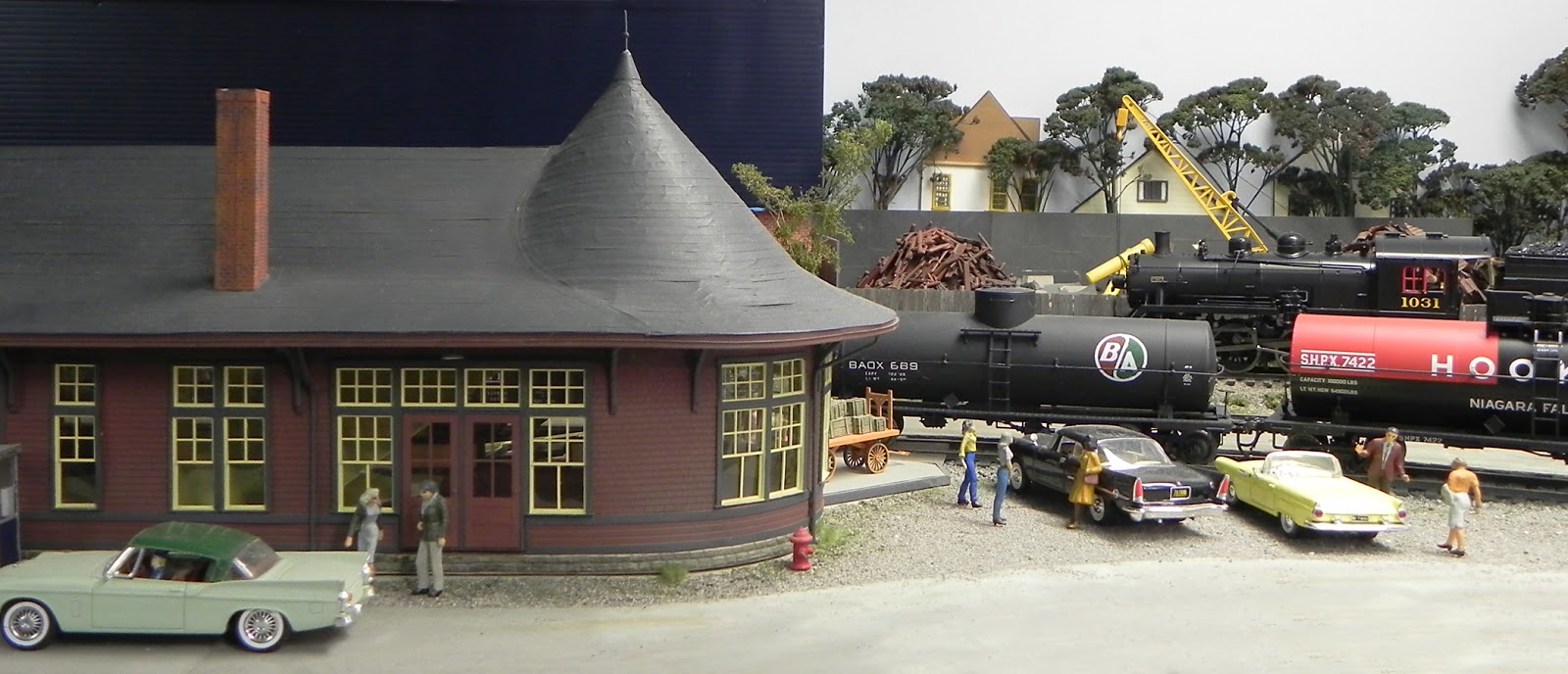
A model of the old Orangeville station with its distinctive "witch's hat" turret and pointed roof as it looked in the 1950s. The real building was sold and moved in the early '80s, becoming a restaurant in downtown Orangeville.
Freight continues to move up and down the valley on the local CVR route, now used by the 55-km Orangeville Brampton Railway. The Credit Valley Explorer offers scenic train tours out of Orangeville and spectacular bridges remain as monuments to a bygone era.


December 26, 2012

Cedar Valley bridge top priority for grant

As published in The Erin Advocate

Town council has voted to put the bridge just east of Cedar Valley at the top of its priority list for a new provincial grant program, overturning a staff plan to seek funding for Hillsburgh's Station Street bridge and dam.

The Town had recently been turned down in an application to a federal infrastructure funding program, to cover $1 million of the Hillsburgh project, which has a total estimated cost of $2.6 million.

But a new provincial funding opportunity arose last month through the Municipal Infrastructure Investment Initiative (MIII), with 90% funding of projects, and a maximum of $2 million. About $90 million will be available across Ontario over the next two years. Council had to pick its top priority immediately, since initial applications are needed in early January.

The Cedar Valley bridge project, at a cost of $663,671, was initially the second priority for Town staff, with a potential grant of $597,303. The current bridge is seriously deteriorated and has a load restriction. It is on Station Street (Sideroad 24), the same road as the Hillsburgh project (known as the Station Street Dam).

Council decided that issues concerning the Hillsburgh dam, including preservation of the mill pond, will be discussed at a public meeting on January 29, 7:30 p.m., at the Hillsburgh Community Centre.

The staff report on the Hillsburgh project noted that the MIII program will give consideration to projects that address a "health and/or safety problem". The Ministry of Natural Resources wants the dam upgraded to be capable of withstanding a Regional Storm Event.

"The main objective is to address the most critical roads, bridges, water and wastewater projects," said Town Financial Analyst Larry Wheeler.

"The safety of property and residents downstream is of course in jeopardy and this project  remedies both the potential liability and safety concerns," the report said.

The Cedar Valley project also has a safety component, since it is 2 km west of the new fire hall and ambulance bay.

"In the event this bridge deteriorated to the point that it was deemed to be impassible, particularly by heavy emergency vehicles, then the health and safety of rural residents and residents of the hamlet of Cedar Valley would be in jeopardy."

Mayor Lou Maieron was reluctant to seek funding for a project that had recently been turned down for a grant.

"Maybe it would make more sense to go for the medium priced project, with a better shot of achieving it," he said. "Unfortunately, it's a bit like gambling."

He also speculated that the chances of getting the $2 million grant were low because the project is the subject of local controversy, and because the Liberal provincial government may want to spread the available funding among a large number of municipalities. He noted that Erin tends to support the Progressive Conservatives.

"Without sounding too political, we are in a chronically blue municipality, and it's not a blue government," he said.

Councillor Barb Tocher argued that the Hillsburgh project fits the grant criteria "perfectly", and she was supported by Councillor Deb Callaghan in opposing a motion to give the Cedar Valley bridge top priority. In a recorded vote, the motion was passed, with Councillors Jose Wintersinger and John Brennan and Mayor Maieron in favour.

The mayor also noted that while council approved temporary work to make the Hillsburgh dam safe for traffic, it has not decided what to do as a permanent solution. The Ministry of Natural Resources (MNR), in allowing the temporary work, ordered the town to upgrade the dam within two years.

"The opportunity for funding is putting the cart before the horse," he said.

Councillor Wintersinger was not optimistic about getting the $2 million grant, though she also believes the Town cannot afford to do the project itself.

"I know what the MNR said, but you can't get blood out of a stone," she said. "I would ride along and see what happens."

The smaller Cedar Valley project is still larger than the entire section of the town's 2012 capital budget that is funded by local taxes. If funded independently by the Town of Erin, it "would result in many critical capital projects being delayed for years," the report says.

The cost of the Hillsburgh project "would be almost five times as large as our entire 2012 tax funded capital budget, which of course is overwhelming."

While Cedar Valley requires a simple bridge replacement, the Hillsburgh project could include not only a new bridge, but reconstruction of the road eight metres wide, with curbs, gutters and storm sewers. The earthen dam would be upgraded to current engineering standards, and a sidewalk could be installed from Trafalgar Road to the Elora Cataract Trailway.

There could also be a water main and sanitary sewer pipe to serve future residential development.