April 29, 2015

Erin backs Blue Dot campaign for environmental rights

As published in The Erin Advocate

It was an easy decision for Town Councillors to declare Erin as a Blue Dot community, in support of David Suzuki’s bid to guarantee environmental rights in Canada’s constitution. It will not oblige them to spend money or doing anything different.

The real debate will be within the federal and provincial governments, which would have to endorse any change to the Charter of Rights and Freedoms.

“I love this town – every part of it is bordered by rolling hills, woodlands, farms and waterways,” said resident Gerry Walsh, requesting council’s support at the April 21 meeting. “Together, everyone in our Town can declare this basic human right – to breathe fresh air, drink clean water and eat healthy food.”

Erin is the fourth municipality in Ontario to commit to these principles. So far, most of the support has been in British Columbia. Mayor Al Alls has promised to express his support for the Blue Dot Movement in a letter to Premier Kathleen Wynne.

Supporters of the Blue Dot Movement celebrate after Erin Town Council
 passed a declaration in favour of a constitutional right to a healthy environment.
Left to right: Joanne Kay, Myrtle Reid, Gerry Walsh and Don Chambers.
    
Details of the campaign are available at bluedot.ca. Suzuki supporters hope to build grassroots pressure from local communities to support a Charter amendment. That would require the official support Parliament plus seven provinces, representing more than 50% of Canada’s population.

It is a very ambitious and idealistic plan, since senior level politicians will no doubt consider the many court cases that it will take to define citizens’ rights on air, water and food. Imagine the impact if anyone in a big city could claim a legal right to breath air unpolluted by cars and factories. Who would pay the cost of bringing clean drinking water to all First Nations communities or making good food available to everyone now living in poverty?

I did not get the impression that Town Council was signing up for a revolution. But faced with climate change, dwindling oil, over-population, erosion of our natural heritage and unsustainable consumption, that’s what we’re talking about.

At its core, the environmental movement is promoting a new culture with different expectations. Green policies may save money in some areas, but will require radical changes to our economy in the areas of transportation, energy generation, food supply, housing, health care, taxation and environmental protection.

“It reminds me of the industrial revolution,” said Walsh. “This is the next phase we’re moving into. Some people are going to suffer and some people are going to benefit, but we have to move forward.”

Efforts to enshrine environmental rights in the constitution were unsuccessful when the Charter was negotiated 35 years ago, but they are definitely worth advocating again. More than a hundred countries have them in their constitutions, resulting in progress rather than chaos.

Enforcement of legal rights will always be problematic, but in general, if a country enshrines its goals, they are more likely to be at least partly achieved.

It is important to remember that Charter rights are not absolute, but are subject to “such reasonable limits prescribed by law as can be demonstrably justified in a free and democratic society.” This puts issues in the hands of politicians, the law-makers, which is quite proper. Some would argue that environmental rights could be expanded by the courts under the Section 7 right to “life, liberty and security of the person”, or by direct reference of a question from a government to the Supreme Court.

Judges, however, should not be creating major changes to the Charter of Rights. The most legitimate process is the more difficult one. If a political consensus for environmental rights can be built throughout the country, with sustainability as a widely accepted priority, a formal constitutional amendment will become a logical final step. That consensus does not yet exist, but it is interesting to see the construction work going on in our own town.

In the meantime, environmentalists need to continue doing what they do best – convincing the public and elected representatives to support policies that will help us weather the coming storm.

April 22, 2015

Improvements for end-of-life health care

As published in The Erin Advocate

The certainty of eventual death may bind us all together, but thinking about how and where we would prefer it to happen is a difficult process. Actually discussing our choices for end-of-life health care with family and friends is even harder.

The Waterloo Wellington Local Health Integration Network (WWLHIN) Board of Directors has approved an investment of $1.2 million over three years to help individuals create a personal Advance Care Plan (ACP) – while they are still capable of doing so.

Health care workers will be trained to give patients and families an opportunity to consider what medical and social care a person would prefer, or refuse, during a crisis or period of time when death is expected. An ACP is a holistic record of a person’s needs and wishes, in a standardized format that is consistent with Ontario law.

“Improving end-of-life care is a significant priority,” said WWLHIN Chair Joan Fisk. “One of the key components of improving this care is engaging more residents in a conversation about their end-of-life care wishes.”

The initiative will be led by the Hospice of Waterloo Region, but apply to all of Wellington County as well.

According to a 2013 survey, 55% of Canadians had never had a discussion with a family member, doctor, lawyer, friend or financial advisor about their end-of-life care preferences.

“We know that when asked, many residents would prefer to die at home surrounded by their loved ones rather than in hospital,” said Bruce Lauckner, CEO at the WWLHIN.

“Unfortunately, this isn’t happening as often as it could. Improving Advance Care Planning practices in Waterloo Wellington will help more residents experience the end-of-life care that best matches their wishes.”

While a majority of people say they want to die at home, about 70% die in a hospital.

Dying at home may appear preferable, but in some cases it is not practical for providing the care and comfort that a person may need. Hospices can provide a good alternative, but there are only 271 hospice beds in Ontario. The Auditor-General says 1,080 are needed.

Clearly, as part of its mandate, the LHIN is spending money in hopes of saving even more. Dying in a hospital is an expensive process, and as the baby boom goes bust, there will be a huge strain on the health care system.

According to a report by Health Quality Ontario, by 2026, the number of Canadians dying will increase by 40%, to 330,000 every year. Of hospitalized Canadian elderly, 70% reported wanting comfort measures rather than life-prolonging treatment, but more than two-thirds were admitted to intensive care units.

The Auditor-General recently reported that palliative care costs $1,100 per day in an acute-care hospital bed, $630 to $770 daily in a palliative-care unit, $460 in a standalone hospice, and about $100 when at-home care is provided.

The process of dying will never be an easy one, but it is within the capacity of our health system to provide consistency in the provision of high quality palliative care for everyone who needs it, and better support for families in their time of need.

April 15, 2015

Ravenscroft a whirlwind of devious deceptions

As published in The Erin Advocate

At first, when presented with a comic gothic murder mystery, one might be tempted to keep track of all the plot details, in hopes of predicting who dunnit.

However, in the current production of Ravenscroft by Erin Theatre at Centre 2000, it soon becomes apparent that the entertainment lies in the lies, and that the truth has only a bit part.

Set in the parlour of a 1905 Yorkshire manor house, the play features a huge staircase that is central to the story, in an attractive set designed by Susanna Lamy. Original music by Howard Lopez creates the mood very well.

The action is a series of interviews by Inspector Ruffing, played with most suitable exasperation by Chris Reid, trying to extract the truth about two mysterious staircase deaths from the five resident females. The process drives him to drink, an unfortunate encounter with an urn and a most unlikely romance.

The plot is like a machine, swapping all manner of crazy stories in and out of the limelight as the women try to convince the inspector that there were no murders, or if there were, they were done by someone else. In an effective bit of staging, characters not involved in the current scene do not exit, but sit in an elevated row of chairs like an audience, reacting to the play.

The motives for the ladies’ webs of lies include the usual suspects: money, jealousy, arrogance, tensions between the upper and lower classes, insecurity, visions of ghosts, callous disrespect for police authority, protecting little children, the need to escape into bizarre fantasies, and above all, to avoid talking about sex (and cross-dressing).

Laura Schnablegger plays Marcy, the beautiful governess who is the prime suspect in the death of a manservant who had been making advances on her (and as it turns out, everyone else). She has the confidence to drive the action in its required circles.

Director Kathryn DeLory has clearly urged her cast to keep up a brisk pace, which is quite essential. At times, though, they go so fast that they’re tripping on their words. They need to keep up the energy, but slow down just enough to get the lines out cleanly.

Part of the difficult challenge presented by Don Nigro’s script is that it is mainly words about things that might have happened in the past. There’s many a witty aside, but little in the way of current action.

This is allayed somewhat by the antics of the subservient servant Dolly, played delightfully by Denise Rowe with lots of facial expressions and physical stage business as she struggles to reveal her story.

At the April 9 performance, Assistant Stage Manager Angela Gibson did an admirable job as the domineering servant Mrs. French, filling in for Carol McCone Day who was ill.

Carol Beauchamp is very good as Mrs. Ravenscroft, who embodies many a cliché about the upper classes – aloof, conniving, lecherous, abusive to the servants and preoccupied with keeping up appearances.

Paulina Grant shows considerable skill in the role of Gillian Ravenscroft, a teenager who appears to have lost touch with reality, but who is actually quite devious and knows more than she lets on.

So if you go to see Ravenscroft, don’t be expecting a mystery built on revealing the truth, but rather one that has fun with the notion that the truth is boring, elusive and quite possibly irrelevant.

Performances continue Thursday and Friday at 8 pm, and Saturday at 2 pm and 8 pm. Tickets are $20 – call 905-873-686, or go to erintheatre.ca for more information.

April 08, 2015

Singer’s stories bring underworld memoir to life

As published in The Erin Advocate

I’m reading a book called Davy the Punk, a tribute to a famous Toronto bookie, published by Porcupine’s Quill in Erin.

It was written by his son Bob Bossin, one of the founders of Stringband, an independent group that had its heyday in the 1970s with songs about Canada and issues of politics and the environment.

“Bob is a great political singer-songwriter,” says Erin’s Jay Mowat, who knew Bossin from the folk festival circuit.

Bossin retells stories about his dad, and by his dad, some of which are probably true. Davy the Punk was a Jewish bookie who ran a horse racing wire in the 1930s and ‘40s, broadcasting information to other bookies using the telephone system.

He was a “bookie’s bookie” who connected Toronto’s underworld to the North American betting racket and later ran a talent agency that brought in big name performers.

Davy the Punk is about anti-Semitism in Canada, the mob and the colourful characters that played their parts on the flip side of Toronto the Good.

Tim Inkster of Porcupine’s Quill was acquainted with Bossin when they both freelanced for the Varsity newspaper at the University of Toronto in the late 1960s.

“I was a bit of a fan of Stringband, and especially their big hit, Dief Will Be the Chief Again,” said Inkster. The 1974 song was a jowl-in-cheek tribute to former Prime Minister John Diefenbaker, based on a comment made by Bossin’s buddy Bob Rae after watching Muhammad Ali regain his boxing title.

Stringband never had a deal with a major record label or much play on commercial radio, but developed a loyal following through performances. They were also known for their independent methods, including an early form of crowdfunding – soliciting donations from friends and fans to finance an album in 1977.

Porcupine’s Quill has developed a national reputation for publishing memoirs and was in a good position to present Bossin’s stories (and historical photos) in an attractive format. The book came out last year and they have just completed the first reprint. For more information, go to davythepunk.com or porcupinesquill.ca.

I am about halfway through the book so far and it is quite engaging – a mix of family history, horse racing, the scramble to prosper in hard times and a culture in which criminals could earn public respect. It is about corruption in business, law enforcement and politics – and the crusaders who were determined to stamp out the evils of gambling.

Bossin has done his research and included many factual details about organized crime and Toronto’s sporting scene, but readily admits that he cannot be certain about how much his dad may have embellished the truth. It doesn’t really matter though, since it is a story about storytelling. The outrageous tales give the book some real sizzle.

More than 10 years ago, Mowat made a contribution to a fundraising effort for a Stringband album. In thanks, Bossin promised him a performance, but they were never able to arrange it, until now.

I’m looking forward to Bossin’s touring one-man show, coming to David’s Restaurant in Erin on Saturday, April 25, at 8 pm. The Winnipeg Free Press calls it “humorous and sentimental”, and Eric Stein of the Ashkenaz Festival in Toronto says, “Bob’s intelligence, erudition and folksy charm combine in an intimate musical theatre experience.”

Tickets are $20 and can be obtained by calling Mowat at 519-833-3383 or emailing info@willowcreekonline.ca. The price does not include dinner, but reservations can be made for dinner before the show by calling 519-833-5085.

April 01, 2015

Atheist provocative, but unconvincing

As published in The Erin Advocate

Professor Douglas Cowan came to Erin last week to speak about atheism, preaching to a congregation much larger than any church in town could attract.

The former United Church minister, who teaches religion at the University of Waterloo, was invited to the popular Extended Learning Opportunities lecture series at the Legion Hall.

Why Atheism Matters was entertaining and thought provoking, but ultimately unconvincing. Regarding the big question, he argues that the burden of proof lies with believers.

“If you want me to believe in your invisible friends, the onus is on you to prove it,” he said.

Of course, no one is obliged to prove anything. The fact that something cannot be scientifically proven with available data does not mean it is untrue. In earlier times, we couldn’t understand how blood kept our bodies functioning, but we knew it did.

Progress is possible in both religion and science. Religion is an easy target for critics, since it is riddled with elements of violence, arrogance, greed, coercion and genocide.

Same with the bible, criticized for being contradictory and unbelievable on a literal level, not appreciated as a diverse collection of literature that attempts to make sense of the relationship between God and humans.

With glee, Cowan quotes Steven Weinberg: “For good people to do bad things, that takes religion.” That’s not entirely true, just as religion is not a necessity for doing good. But even the criticism that religion rightly deserves is a condemnation only of the evil or misguided humans that have abused it, not of a God who does not step into make everything right.

Cowan conveniently ignores all the good done in the name of God, and the substantial joy and consolation that spiritual practices provide. To characterize billions of people as delusional based on the extreme views of radical religious leaders is unfair, deliberately ignoring evidence that spirituality is a basic need for many people.

As a minister and professor, of course, Cowan would know all this. He chose to give a provocative presentation rather than a balanced one. He claimed his right to be offensive, which is probably better for book sales.

About a quarter of all Canadians profess no religion, but relatively few care enough to be atheists. Most of this group are either disillusioned with organized religion, totally private with their beliefs or just don’t feel the need. That is their right, but it does not diminish the creator.

This Friday, my parish will pray for atheists. Of course, they might find this amusing or condescending, but I mention it to make a point, which Cowan ignored – that many Christian churches no longer claim that their way is the only pathway to salvation. The prayer says:

“Let us pray also for those who do not acknowledge God, that, following what is right in sincerity of heart, they may find the way to God himself.”

So, is my need to praise God a weakness, a genetic flaw dating back to cave-dwelling days? If so, I’m willing to accept it along with all my other weaknesses, in order to remain open to the healing power of divine grace. It is a way of thinking that I impose upon no one, and harms no one.

People are truly different. Everyone deserves a home in terms of their way of thinking, where they can share with people of like mind. The fact that I have embraced a faith passed on from previous generations of my family does not mean I have done so blindly.

No one is in a position to control or pass judgment on another person’s thoughts, but society does need to guard against harmful actions that can emanate from beliefs. Cowan said matters of faith should not be considered off-limits for public discussion, and on that we agree.

Fortunately, we live in a country where freedom of belief is balanced with protection of the rights of others. Open debate and criticism are accepted, helping protect against abuses of power and making sure that people have choices. I see atheists in that context and I am glad to live with them in mutual respect.

March 25, 2015

New photo gallery puts focus on Erin

As published in The Erin Advocate

Perhaps it is a short attention span that has led me to try a lot of different things, without becoming an expert at any of them. The pursuit of variety makes life interesting, of course, but still I envy people who can concentrate their efforts and be very successful.

I got a film camera as a present for my fifth birthday, a simple plastic box with a lens, and my friends thought I was a bit strange, going around the neighbourhood in Welland taking snapshots of trees and flowers.

Well, I’m still doing that with the Town of Erin as my neighbourhood, and while the quality has improved slightly, I’m just figuring it out as I go along. I’ve realized that if you wait for perfection, you’ll be waiting forever, and if you don’t share what you’ve got, you miss an opportunity to have some useful fun.

Putting stuff out there for the public has been central to my careers as a writer and graphic designer. The 345 columns I’ve written for the Advocate in the last 7 years are republished on a blog: erininsight.blogspot.ca. They are fully searchable, organized by date and topic.

Some articles have photos with them, but until recently the content was 99% words. In January I started a new section within the blog called Somewhereinerin. It is a gallery of photos I’ve taken in the Erin area (plus a few vacation sunsets). Just click on the tab at the top of the home page to take a look.

At first, I was trying to post a new photo every day, until I discovered just how difficult that is while trying to make a living doing other things. A few new ones every week is more realistic.

Of course, I’m not the first photographer to take an interest in Erin. I admire the professional work of Martin Lamprecht (featured on the new Town of Erin website), Tristan Clark who does local news and portrait/wedding photography, and former Advocate photographers Sandra Traversy and Jill Janson, all of whom have web sites.

Whenever I post an article or a photo, I’ll normally send out a tweet – a very small sound in a noisy world – in an attempt to spark some interest and link readers to the blog. You can follow me on Twitter using @ErinWriter, and sign up as a follower on the blog.

Part of the blogging game is to drive traffic to your site, in order to sell products or make money from advertising. My blog, however, is more of a community service than a business, especially since I can’t be competing with The Advocate while working for them.

Still, I thought I’d try putting non-local ads on the blog, to see if they would generate some income. It’s easy to sign up with Google. They put a constant rotation of ads onto the blog that are somehow linked to the content, but you really only make money if people actually click on them.

I’m not much of an ad clicker and it turns out that my readers are not either. After ten weeks, I’ve made a total of $4.85, and they don’t send you anything until you hit the $10 mark.

With an average of more than 80 visits to the blog every day, I thought I might do better than that, but I had no illusions about hitting a jackpot. Still, you never know. Maybe a photo or story will go viral some day. Maybe I should learn how to shoot video.

The curious thing about traffic to the blog is that while the content is all about Erin, most of the visitors are not from Erin. Of the 86,200 all-time visits, less than half are from somewhere in Canada.

The topics obviously have a broad appeal, since I’ve had 20,000 visits from the US, 7,000 from Germany, 3,300 from Russia, 3,000 from France, 2,300 from Ukraine, 1,400 from the United Kingdom, 601 from China and 460 from Saudi Arabia. Go figure.

March 18, 2015

Let’s not be too efficient in setting Town budget

As published in The Erin Advocate

There are lots of good things happening in the budget process upon which Erin town councillors have embarked, but there are some areas where caution and a bit more time are required.

Council members are getting along with staff and each other. Mayor Al Alls is working cooperatively with CAO Kathryn Ironmonger to make sure council business flows smoothly. There’s a positive atmosphere at the Town office, which is refreshing news for all concerned.

Staff have impressed council by presenting a pre-trimmed budget, including only the top priority projects that can be accomplished with a moderate tax increase. Instead of chopping away through five or six grueling budget meetings, the plan is to wrap this thing up in two sittings – a five-hour one last week and the second March 24 at 10 am.

Council has to decide what to add back into the budget, how much to borrow, how much to pull from reserves and ultimately how much to tax. The choices are important, but if they agree with the priorities in the plan set before them, relatively simple.

In considering new debt of $1 million, council was wise to request a report on debt ratios and servicing costs. They’re also thinking of pulling a million and a quarter from reserves, so they need to be confident that such a move will not create problems in the future.

In its key role of setting policies and priorities, council needs to ensure that debates over difficult choices happen at public meetings and that the public has adequate opportunity to understand and comment. Here are some suggestions to improve the current budget process:

Have a public meeting where people can comment on the operating budget, just as they appreciated doing on the capital budget. At the very least, don’t just present a slide show to explain the budget, then approve it the same day. Give them a couple of weeks to digest it and possibly appeal for changes.

Don’t schedule all two of the budget reviews and the final approval for daytime meetings. The most important issues should get some exposure at evening meetings.

Schedule budget meetings so that each department head can appear before full council to state their priorities and answer questions. Fire Chief Dan Callaghan and Interim Water Superintendent Joe Babin had other obligations and could not attend the meeting where their budgets were discussed. What if councillors were considering a change to one of those budgets and needed to know the implications?

With only two budget meetings, players are left out. Councillor Matt Sammut, who ran on a platform of fiscal responsibility, was away for the first meeting and Councillor John Brennan, the voice of experience from recent councils, will be away for the second. Having three or four shorter meetings could lessen this impact and allow time for comprehension and possible amendments.

Finally, council and staff should be careful with the use of “working groups”. These are private meetings of senior staff with the mayor and one other councillor. (Having three council members at a non-public meeting would violate the Municipal Act.)

Essentially, we have two out of five politicians present at what would normally be a staff meeting. This is not necessarily a problem. Discussing strategy on Town issues is beneficial, but there should never be even the appearance that final decisions are being made behind closed doors, or that staff being given clear direction by other than the full council.

These meetings have been used to discuss the fill bylaw and for preliminary cutting of departmental budgets and community grants.

Last week, Councillor Jeff Duncan objected when full council was asked to endorse the pared-down list of community grants without ever seeing it. The problem was quickly resolved, but it illustrates the need for traditional separation of duties: staff make recommendations and council gets enough information to make final decisions.

Perhaps working groups should be treated more like subcommittees, with clear terms of reference and a report with recommendations or options that full council could debate.

March 11, 2015

Erin’s aging water tankers bump fire insurance costs

As published in The Erin Advocate

Shopping for insurance is already an annoying ordeal. Discovering that you have to pay extra because your fire department’s tanker trucks are more than 20 years old makes it very annoying.

It’s a confusing business, since companies may offer highly competitive rates for some types of coverage while charging more for others. So-called “quick” quotes over the phone can turn into hour-long inquisitions about your house and driving habits. I gave up on two quotes from call centres when they wouldn’t call me back later.

My broker (who actually answers the phone) found me a deal with a new company that was going to save me many hundreds of dollars. But when I reviewed the details, it was based on having fire hydrant protection. I told her that I live in a rural area with no hydrants, but that I have the protection of tanker shuttle service.

Firefighters can set up a water reservoir at my house in the event of a fire, with two tanker trucks taking turns filling it up. The insurance industry considers this the equivalent of a hydrant for fighting a fire.

My broker tried to confirm that the Town of Erin provides this service, but found nothing. A phone call to the Town revealed the bad news: last year, Erin lost its Superior Tanker Shuttle Accreditation because two of the trucks are more than 20 years old. The trucks are working fine and providing the protection, but the service no longer qualifies residents for a better insurance rate.

“We are getting calls about this every week,” said Fire Chief Dan Callaghan. “Many residents have a 15% increase.”

This issue does not affect urban residents with hydrants. It applies to rural residents who live less than 8 km from a fire hall, by road. Those further away would not normally qualify for the insurance discount in any case, but check your policy, since company standards vary.

For “superior” accreditation, the one that counts for insurance, Erin Fire must demonstrate to Fire Underwriters Survey that they have the training and two qualified trucks to shuttle water to a test site. They must pump at least 950 litres of water per minute continuously for two hours, filling tankers from hydrants, ponds or the seven underground fire reservoirs in the area.

Erin has three tankers, with model years 1990, 1994 and 2009. In the past there was no fixed cut-off date, but council learned in 2013 that tankers over 20 could no longer be used for the test. In 2014, Erin’s accreditation slipped to “standard” when the second tanker passed the limit. An extension of the cut-off was possible if the Town committed to buying a tanker within an agreed time frame.

A new tanker would cost at least $250,000, but it is only one of the budget priorities that have been delayed. The department is still hoping to replace a 1986 pumper-rescue truck, which would cost twice as much as a tanker.

“Where it is on the list, council will have to decide, but they are determined not to keep passing the buck forward,” said Mayor Al Alls. Each department head has been asked to look at what can be cut in their budget and the current operational review may make additional recommendations about priorities.

Councillor John Brennan said the tanker purchase must be “weighed in conjunction with other pressing needs”. He said accreditation was a factor in 2014 budget discussions.

“Council did not make it such a priority as to be fully addressed in that budget for a variety of reasons and I'm not sure the short time frame of the impending loss of accreditation was fully understood.”

March 04, 2015

Parents apply pressure for Brisbane safety zone

As published in The Erin Advocate

With heavy traffic on County Road 124 and dozens of cars forced to park on the shoulders, parents of students at Brisbane Public School have mounted a strong campaign to get Wellington County to establish a 40 kilometre per hour safety zone.

A delegation made up of Parent Council Chair Rachel Ingram, School Trustee Kathryn Cooper and Town Councillor Matt Sammutt appeared as a delegation to the County Roads Committee last month, armed with a petition from 325 parents and a traffic study that highlights the risks at the Brisbane site.

Sammut said committee members were “extremely positive” about the idea of a safety zone, but that County staff were resistant to the idea of trying to slow traffic to 40 kph in an area where the speed limit has already been reduced from 80 to 60 kph. Parents also want a flashing amber sign in each direction to warn drivers of the safety zone, at a cost of $7,900.

The speed limit would be lowered only during school transition times, 8 to 9:30 am and 2:30 to 4 pm. Instead of approving the proposal, the committee sent a recommendation to the full council that staff should review all schools on County roads and report back to the committee.

Sammut said that if the eventual decision is to install flashing signs, but leave the speed limit at 60 kph, “It would be better than nothing, but parents would be extremely upset.”

Traffic problems at the school have increased since the addition of junior kindergarten and all day (every day) kindergarten, pushing the school population to 416. With little parking available on site and no room for expansion, parents must park on both sides of the former Hwy. 24 roadway during drop-off and pick-up times. The school is served by 17 buses, and vehicles parked on the side of the road create visibility problems.

The traffic passes at a rate of one vehicle every five seconds in the morning (slightly less in the afternoon), with more than 18% of them being trucks, according to the traffic study.

As a parent, Sammut decided to get involved after witnessing a near miss between a small child and a truck. He said a safety zone would only cost drivers a few seconds of time, but provide a great benefit to the school community.

In October, parents met with school, board and county staff to demand action. Mark Bailey, Chair of the Upper Grand District School Board, told the county in December that many drivers do not obey the speed limit, with some exceeding it by more than 25 kph.

“The high traffic volume and speeds make it dangerous for children and their families,” said Bailey, asking the county to move quickly to establish a safety zone.

Ingram told the roads committee that there has been at least one accident at the site this year, and that the county could face a liability problem if there is an injury. According to criteria published by the Transportation Association of Canada, Brisbane definitely qualifies for a safety zone, the delegation said.

They provided research showing widespread use of 40 kph school safety zones, including urban areas such as Guelph, and at rural schools in Peel Region.

“The County has a duty to provide safe roads around schools, especially elementary schools,” said the delegation during their presentation. “Be proactive before a tragic accident occurs.”

Clearly, the situation cannot be allowed to continue. If common sense does not prevail at County Council, the school board will have to re-organize its services to relieve the pressure. But even with a smaller school population, a safety zone would still be the right thing to do at this site.

February 18, 2015

County tax share continues to grow

As published in The Erin Advocate

Steady increases in property values have been a bonus for Erin residents when they want to sell their homes, but when county tax taxes are calculated, there is an extra price to pay for living close to the Greater Toronto Area.

Wellington County recently approved a tax increase that averages 2.8%, meaning an extra $18 for every $100,000 of a home’s assessed value. If all property values were increasing at the same rate, we would all pay an extra 2.8% in county taxes, but that is not the case.

The County has never reported the tax impact split by municipality in the past, but I asked Treasurer Ken DeHart to crunch the numbers.

“An average residence in the Town of Erin will experience a 3.1% increase due to the change in property assessment being higher than the County average,” he said.

Tax bills will vary based on individual properties, but the average assessed value of an Erin home was up 3.8% last year, compared to an average of 3.4% countywide. By provincial law, assessment determines the share of property taxes – the County and the Town have no authority to change the system.

Paying .3% above the county average may not seem like much, but over the years the differences in assessment have become quite dramatic, and Erin is not the highest. The average single family detached (SFD) home in Erin has gone from $444,572 in 2013, to $463,933 in 2014 and $481,394 in 2015.

The average SFD home assessment for Wellington County in 2015 was $372,956. Here are the averages by municipality: 
Puslinch - $644,852; 
Erin - $481,394; 
Guelph-Eramosa - $450,361; 
Centre Wellington - $342,817; 
Mapleton - $308,628; 
Wellington North - $221,778 and 
Minto - $202,304.

It is important to remember that assessment growth does not directly result in tax increases. But with the county deciding it needs to collect $84.5 million in taxes this year (as part of a $185.8 million total budget), assessment determines the relative share for each taxpayer.

People are often shocked at how much money the county spends. In 2014 Wellington collected $12.5 million from Erin, 55.2% of total taxes. The Town of Erin collected $5.5 million (24.4%), while schools got $4.6 million (20.4%).

County roads and bridges make up the largest part of Wellington’s budget, but many expenses can be traced back to the downloading of the 1990s, when the provincial government forced counties to take over the cost of some major services. Those still account for more than $40 million on the annual tax levy.

The big-ticket items include:
• Rural OPP service ($17.3 million), 
• The Farm Tax Rebate ($10.6 million), 
• Social Housing ($4.3 million), 
• Land Ambulance ($4 million), 
• Former Provincial Highways ($3.7 million), 
• Social Services and Childcare ($1.8 million) and 
• Public Health ($2 million).

The relatively low amount of taxes paid on farmland, 25% of the regular rate, is a particular issue for municipal taxpayers. Farmland qualifies for the Farm Tax Rebate if it is actually farmed, generating at least $7,000 in gross income per year.

The rebate used to be paid by the province and shared through income taxes. When it was shifted to municipalities, provincial grants were supposed to cover the cost. Actual grants cover less than half, however, leaving county taxpayers to cover the balance. The net cost is $487 per household.

February 11, 2015

Food strategy discussion at Family Farm screening

As published in The Erin Advocate

The creative ways in which small family farms can prosper in an era of industrialized agriculture will be the topic of a film screening and panel discussion hosted by Transition Erin.

The showing of the CBC-sponsored documentary The Family Farm will take place at 7 pm this Friday, February 13, at the Legion Hall on Dundas Street East. Admission is free.

Created by Ari Cohen, the film explores the farm-to-table process through the lens of Canadian small farmers and identifies the systemic barriers they face in running a profitable farm.

“There’s got to be a better way of growing food, something that makes us feel responsible and proud of what we’re doing,” said one farmer in the documentary.

“We’re a dying breed,” said another. “The corporate farm is slowly taking us over and there doesn’t seem to be too much concern about it. It’s not only the production of food, but we are looking after the environment and the land. When it gets into corporate hands, things get lost.”

Discussion after the screening will centre on how a coordinated plan for a sustainable food system can be promoted in Erin and Guelph-Wellington.

“These are creative times for farmers, and I’m surprised at how many young people are involved,” said organizer Jay Mowat. “If you get out to the farmers’ markets, you’ll get to know the person who is selling you your food. Family farms can still be made profitable.”

The panelists will include Mark Skinner, Manager at Everdale Organic Farm, Matt Setzkorn, Executive Director at Ontario Farmland Trust and Pam Fanjoy, Owner of The Friendly Chef Adventures and the Mill Run Eatery in Erin.

The event is co-sponsored by the Guelph-Wellington Food Round Table (www.gwfrt.com), which seeks to build up production, distribution and consumption of local food. The group hopes to increase self-sufficiency, reduce impact on the environment and preserve rural communities. They support the Community Gardens Network and initiatives such as Taste Real and the Collaborative Regional Alliance for Farmer Training (CRAFT).

The other sponsor is the Guelph chapter of the Ontario Public Interest Research Group (www.opirgguelph.org), part of an international network on social and environmental issues, founded by activist Ralph Nader.

It is difficult to adopt a conserving farm lifestyle in today’s society, and a variety of projects plus outside jobs are often needed to ensure year-round income.

In some ways, the challenges of farmers are similar to those of many other small businesses. But it other ways they are unique, because of the demanding way of life, the close connection with the power of nature and the proud tradition of public service.

Family farms remain an important part of Canada’s economic backbone, and they play a role in ensuring the survival and well-being of local communities and environments. It is a heritage worth preserving, both with government policy and our consumer dollars.

February 04, 2015

Pond drainage needed for Round Goby eradication

As published in The Erin Advocate

The Round Gobies of Hillsburgh have caused quite a stir among fisheries biologists and may soon find out just how unwelcome they in the Credit River watershed.

The Ministry of Natural Resources and Forestry (MNRF) considers the problem so severe that they have a plan to apply piscicide – a poison that would kill off every gill-breathing animal in six ponds and a short section of the West Credit River near Hillsburgh.

If the plan goes ahead this spring, they would draw down the water levels and use electrofishing to stun and capture quantities of desirable fish, which could be returned to the water once the poison is gone. Lower pond levels would allow the operation to be done with less of the chemical, called Rotenone.


Round Goby (neogobius melanstromus) arrived in the Great Lakes about 25 years ago, thanks to ships from the Black Sea. In 2013 some were dumped in Hillsburgh, probably from a bait bucket.

Since then they’ve been doing what comes naturally – feeding aggressively on diverse aquatic food supplies and spawning several times a year. Their ability to dominate the local environment qualifies them as an Invasive Species.

Since they became established in Lake Erie they have eliminated nearly all of the small bottom dwelling fish, such as darters and sculpins, which were once found there. They’ve also caused significant damage to the nests of Smallmouth Bass by consuming their eggs and young. They like to feed on zebra mussles, another invasive species.

They have advantages over some other fish, since they are able to survive in lower-quality water and have a sensory system that helps them gather food more aggressively.

At a public meeting last fall at the Hillsburgh Fire Hall, MNRF said if the Round Goby is not “controlled”, it is a major threat to native fish, including Brook Trout and other salmonids.

According to their presentation, “Downstream movement of goby to more suitable habitats could negatively impact the fish community of an additional 80+ km of the Credit River, which contains recreationally and economically important fisheries.”

MNRF had hoped to carry out the eradication last fall. It is now planned for the spring, but a final decision has not been made. They have promised to keep the community informed.

“MNRF will continue to work with landowners to secure permission to access properties for monitoring and treatment,” said Management Biologist Art Timmerman, in a letter sent to residents and Town Council.

Rotenone is the only registered piscicide in Canada, to be used as a “fisheries management tool”. It is a natural substance extracted from the roots of tropical plants, and only affects gill breathers.

MRNF says there will be no accumulation in the aquatic environment, no effect on birds or other wildlife and no threat to public health. They said this preferred option is “safe and effective, with immediate results at moderate cost.” Dead fish would have to be collected before the ponds are refilled.

Rotenone breaks down quickly in the water. All residue would be gone in one to four weeks, and oxidizing agents could be added to neutralize any downstream impact, MNRF says.

Round gobies have not been found upstream or downstream from Hillsburgh, probably because they prefer the relatively warm environment of the ponds, but once their population increases, they are likely to spread.

The ponds could be restored to their pre-treatment levels and restocked with native fish, depending on the preferences of the landowners.

The long-term future of the main Hillsburgh pond and the Station Street dam are currently being studied in an Environmental Assessment.

January 28, 2015

Steen’s milk discontinued, but many choices available

As published in The Erin Advocate

The Steen’s brand of milk products is no longer available on store shelves, but local consumers still have many choices – including Jersey milk from Miller’s Dairy in Creemore, sold in returnable one-quart glass bottles.

Fred Steen started Steen’s Dairy in 1944. It became a major independent brand in Southern Ontario, with the Steen’s Dairy Bar known as an icon of Erin village. Unable to expand at its downtown location, it formed a partnership with the Organic Meadow farmers’ co-op, and in 2010 shifted production to a new plant in Guelph.

“Organic Meadow has been proud to partner with Steen’s Dairy to offer consumers access to both organic (Organic Meadow) and local (Steen’s) dairy offerings,” said Michelle Schmidt, Marketing Manager at Organic Meadow.

“Last year, we made some strategic changes to our business, specifically the elimination of our in-house distribution service, that we had used to primarily service local customers carrying the Steen’s brand. And so while Steen’s dairy products continue to be available (primarily through food service channels), by and large, they are no longer readily accessible on retail store shelves.”

Erin outlets do not appear to be carrying any Organic Meadow milk, but shoppers still have a variety of options. The Beatrice brand is available at some convenience stores, along with Lactancia, while Valu-Mart carries mainly the Neilson brand, with a small quantity of PC Organics.

Foodland in Hillsburgh sells Sealtest and Natrel, but in December after Steen’s was discontinued, they brought in Miller’s milk. That dairy uses bottles that only people of a certain age will remember – one-quart returnable glass, now with a refundable deposit of $2.00. The company also distributes half-gallon glass bottles to some outlets.

“The reaction of people has been very good,” said Foodland owner Mary McArthur. “It’s more of a country item.”

At $3.19 plus deposit for 946 ml, it won’t be practical or economical for families that consume lots of milk. But for low volume households, it creates a new option in a marketplace that for many decades has been quite homogenized.

Since 1965, under the milk system organized by the Dairy Farmers of Ontario, milk from various farms is routinely pooled for efficient processing and marketed under major labels. Organic milk and other specialties are kept separate.

More than 90% of milk is from Holstein cows, with only 4% from Jersey cows. Now the industry is encouraging on-farm microdairies, partly due to consumer demand for local food, enabling Millers to offer pure Jersey milk. It comes from a purebred Jersey herd of 120 milking cows that has been tended at the same farm, by the same family, for 50 years.

“People want to know where their food comes from and we want to make that personal connection,” says the Miller family on their website.

After buying a bottle of Jersey milk, I did an informal taste test. The new milk tasted slightly different from regular milk, but was quite satisfying. It had a richer feel, even though it comes with the standard butterfat content levels – skim, 2%, whole (about 3.25%), 10% cream (half & half) and 35% whipping cream.

All the feed for the Miller herd is grown on the farm where they live. The milk is pasteurized, but not advertised as organic. The glass bottles keep it extra cold, naturally slowing down its aging process.

According to the American Jersey Cattle Association, Jerseys have a 20% lower carbon footprint, and their milk offers higher nutritional value, providing 15-20% more protein, 15-18% more calcium, 10-12% more phosphorus and higher levels of vitamin B12, compared to most milk on the market.

January 21, 2015

Gourmet groceries at new downtown restaurant

As published in The Erin Advocate

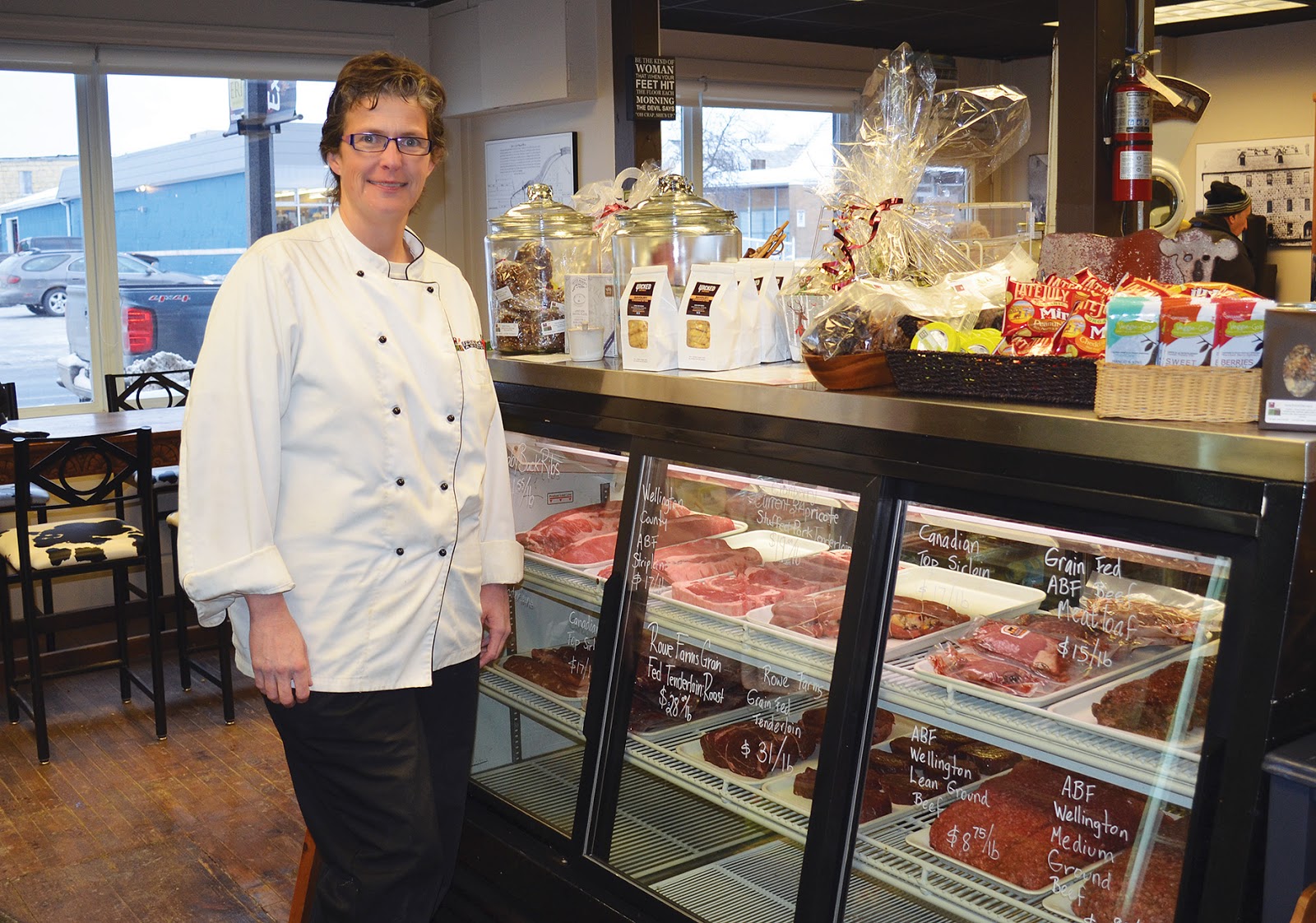
Chef Pam Fanjoy has taken an opportunity to combine her passion for local food with an interest in local history by opening the Mill Run Eatery on Main Street in downtown Erin village.

It is part gourmet grocery store, with some products not normally available in a small town, and a 14-seat breakfast-lunch restaurant that offers Sunday brunch and features a large community table.

Located in the building vacated by Carver’s Block, the Mill Run is two doors up from The Friendly Chef Adventures (formerly What’s Cookin’), which Fanjoy started just a year ago. The locations are on either side of Erin’s historic millrace, which once diverted water from Hull’s Dam on Church Blvd. to the mill behind Budson Farm and Feed, running directly under Debora’s Chocolates.


“I was concerned as a new business owner that Carver’s Block had closed, and I saw an opportunity to expand,” said Fanjoy, whose motto is, “Eat well with friends.” She says the new location has been doing OK even though they haven’t got a sign up yet.

Her primary business was already expanding and in need of more space. In addition to prepared foods, gift baskets and kitchen-related products, Friendly Chef Adventures is now fully licensed and serving lunch, providing catering, offering cooking classes and renting out space for parties.

The Mill Run Eatery has its restaurant seating by the window, then inside are displays that include a selection of cheeses and fresh meats. Each Friday, they bring in a different supply of fresh seafood for the weekend. There are also sections for frozen foods, and fresh produce such as lemon grass.

“I asked the community what they wanted,” said Fanjoy, who is a partner in the Taste•Real initiative for Guelph and Wellington, promoting the benefits of local, organic products. Information on events and incoming specials is available at www.thefriendlychef.ca.

The décor pays homage to Erin’s village history, with a large historical downtown map showing the millrace and photos of four mills from the 1800s. The location even has a trap door leading to the old water route.

While premium offerings do cost a bit more, Fanjoy said she has making an effort to offer people choices and to keep prices reasonable.

The Mill Run sells the Planet Bean line of coffee from Guelph – Fair Trade and Certified Organic – ready to drink or as beans. They have been carrying products from Everdale Farm near Hillsburgh, and meat from Wellington County farms that do not use hormones and antibiotics to enhance growth.

Packaged products include Roasted Chickpeas, Bomba Rice, Soup Girl mixes, 00 Pasta Flour, Smoked Paprika Powder (spicy or mild), and there are natural soda drinks with flavours like Blackberry-Pomegranate-Ginger and Pineapple-Coconut-Nutmeg.

Bottled products include All-Natural Mayonnaise, Rice and Fig Balsamic Vinegar, and various oils – Almond, Sesame, Hazelnut and Walnut.

The eatery is open every day from 9 am to 5 pm, except Friday when they are open until 6 pm. Sunday Brunch ($12.50 for adults, $10.50 for kids) is served 9 am to 2 pm.