January 28, 2015

Steen’s milk discontinued, but many choices available

As published in The Erin Advocate

The Steen’s brand of milk products is no longer available on store shelves, but local consumers still have many choices – including Jersey milk from Miller’s Dairy in Creemore, sold in returnable one-quart glass bottles.

Fred Steen started Steen’s Dairy in 1944. It became a major independent brand in Southern Ontario, with the Steen’s Dairy Bar known as an icon of Erin village. Unable to expand at its downtown location, it formed a partnership with the Organic Meadow farmers’ co-op, and in 2010 shifted production to a new plant in Guelph.

“Organic Meadow has been proud to partner with Steen’s Dairy to offer consumers access to both organic (Organic Meadow) and local (Steen’s) dairy offerings,” said Michelle Schmidt, Marketing Manager at Organic Meadow.

“Last year, we made some strategic changes to our business, specifically the elimination of our in-house distribution service, that we had used to primarily service local customers carrying the Steen’s brand. And so while Steen’s dairy products continue to be available (primarily through food service channels), by and large, they are no longer readily accessible on retail store shelves.”

Erin outlets do not appear to be carrying any Organic Meadow milk, but shoppers still have a variety of options. The Beatrice brand is available at some convenience stores, along with Lactancia, while Valu-Mart carries mainly the Neilson brand, with a small quantity of PC Organics.

Foodland in Hillsburgh sells Sealtest and Natrel, but in December after Steen’s was discontinued, they brought in Miller’s milk. That dairy uses bottles that only people of a certain age will remember – one-quart returnable glass, now with a refundable deposit of $2.00. The company also distributes half-gallon glass bottles to some outlets.

“The reaction of people has been very good,” said Foodland owner Mary McArthur. “It’s more of a country item.”

At $3.19 plus deposit for 946 ml, it won’t be practical or economical for families that consume lots of milk. But for low volume households, it creates a new option in a marketplace that for many decades has been quite homogenized.

Since 1965, under the milk system organized by the Dairy Farmers of Ontario, milk from various farms is routinely pooled for efficient processing and marketed under major labels. Organic milk and other specialties are kept separate.

More than 90% of milk is from Holstein cows, with only 4% from Jersey cows. Now the industry is encouraging on-farm microdairies, partly due to consumer demand for local food, enabling Millers to offer pure Jersey milk. It comes from a purebred Jersey herd of 120 milking cows that has been tended at the same farm, by the same family, for 50 years.

“People want to know where their food comes from and we want to make that personal connection,” says the Miller family on their website.

After buying a bottle of Jersey milk, I did an informal taste test. The new milk tasted slightly different from regular milk, but was quite satisfying. It had a richer feel, even though it comes with the standard butterfat content levels – skim, 2%, whole (about 3.25%), 10% cream (half & half) and 35% whipping cream.

All the feed for the Miller herd is grown on the farm where they live. The milk is pasteurized, but not advertised as organic. The glass bottles keep it extra cold, naturally slowing down its aging process.

According to the American Jersey Cattle Association, Jerseys have a 20% lower carbon footprint, and their milk offers higher nutritional value, providing 15-20% more protein, 15-18% more calcium, 10-12% more phosphorus and higher levels of vitamin B12, compared to most milk on the market.

January 21, 2015

Gourmet groceries at new downtown restaurant

As published in The Erin Advocate

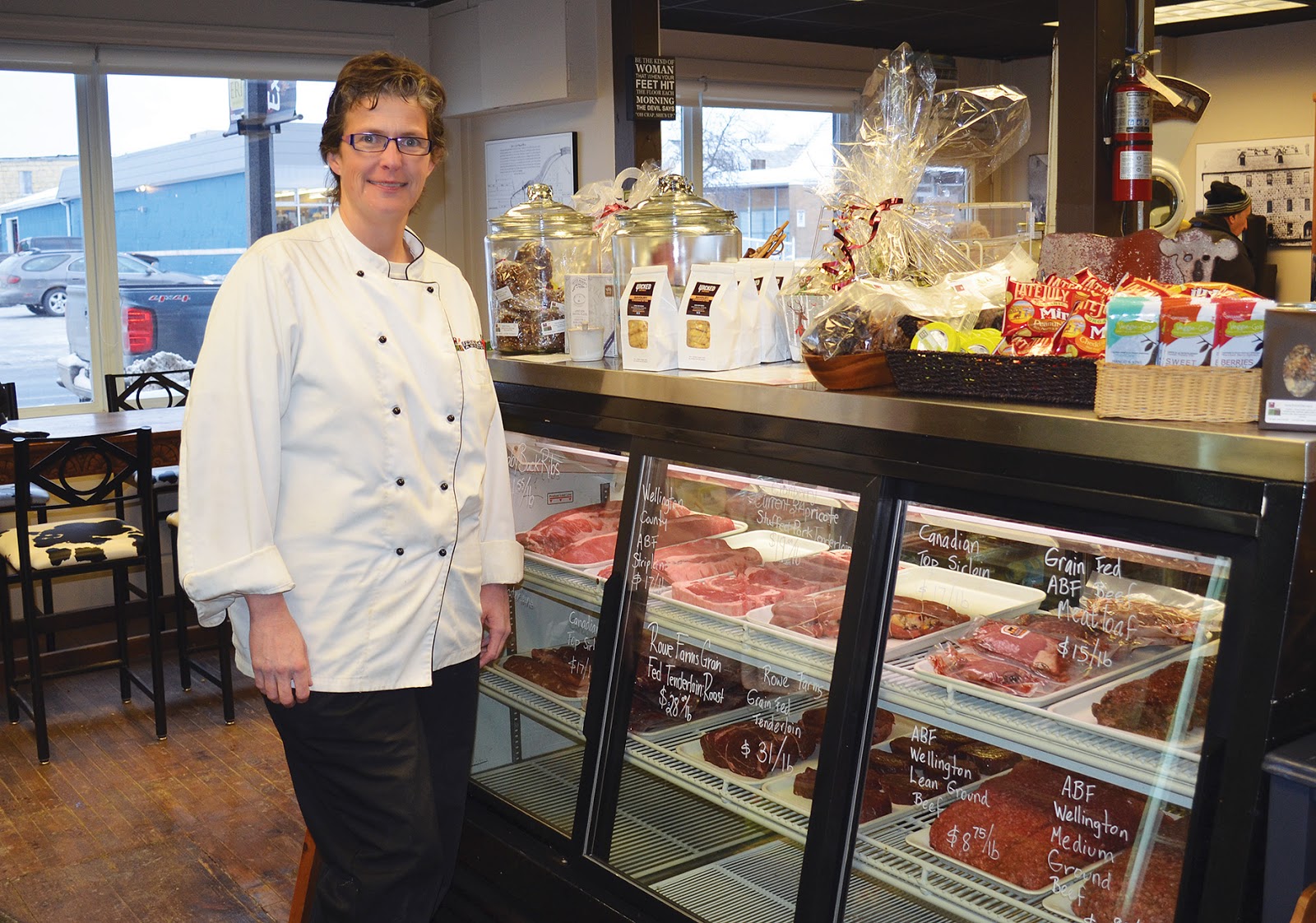
Chef Pam Fanjoy has taken an opportunity to combine her passion for local food with an interest in local history by opening the Mill Run Eatery on Main Street in downtown Erin village.

It is part gourmet grocery store, with some products not normally available in a small town, and a 14-seat breakfast-lunch restaurant that offers Sunday brunch and features a large community table.

Located in the building vacated by Carver’s Block, the Mill Run is two doors up from The Friendly Chef Adventures (formerly What’s Cookin’), which Fanjoy started just a year ago. The locations are on either side of Erin’s historic millrace, which once diverted water from Hull’s Dam on Church Blvd. to the mill behind Budson Farm and Feed, running directly under Debora’s Chocolates.


“I was concerned as a new business owner that Carver’s Block had closed, and I saw an opportunity to expand,” said Fanjoy, whose motto is, “Eat well with friends.” She says the new location has been doing OK even though they haven’t got a sign up yet.

Her primary business was already expanding and in need of more space. In addition to prepared foods, gift baskets and kitchen-related products, Friendly Chef Adventures is now fully licensed and serving lunch, providing catering, offering cooking classes and renting out space for parties.

The Mill Run Eatery has its restaurant seating by the window, then inside are displays that include a selection of cheeses and fresh meats. Each Friday, they bring in a different supply of fresh seafood for the weekend. There are also sections for frozen foods, and fresh produce such as lemon grass.

“I asked the community what they wanted,” said Fanjoy, who is a partner in the Taste•Real initiative for Guelph and Wellington, promoting the benefits of local, organic products. Information on events and incoming specials is available at www.thefriendlychef.ca.

The décor pays homage to Erin’s village history, with a large historical downtown map showing the millrace and photos of four mills from the 1800s. The location even has a trap door leading to the old water route.

While premium offerings do cost a bit more, Fanjoy said she has making an effort to offer people choices and to keep prices reasonable.

The Mill Run sells the Planet Bean line of coffee from Guelph – Fair Trade and Certified Organic – ready to drink or as beans. They have been carrying products from Everdale Farm near Hillsburgh, and meat from Wellington County farms that do not use hormones and antibiotics to enhance growth.

Packaged products include Roasted Chickpeas, Bomba Rice, Soup Girl mixes, 00 Pasta Flour, Smoked Paprika Powder (spicy or mild), and there are natural soda drinks with flavours like Blackberry-Pomegranate-Ginger and Pineapple-Coconut-Nutmeg.

Bottled products include All-Natural Mayonnaise, Rice and Fig Balsamic Vinegar, and various oils – Almond, Sesame, Hazelnut and Walnut.

The eatery is open every day from 9 am to 5 pm, except Friday when they are open until 6 pm. Sunday Brunch ($12.50 for adults, $10.50 for kids) is served 9 am to 2 pm.

January 14, 2015

Bioswales and rain gardens reduce stormwater impact

As published in The Erin Advocate

Credit Valley Conservation is urging municipalities and landowners to use techniques that allow more rainwater to soak into the ground, instead of simply dumping it into the closest stream.

It’s part of a trend called Low Impact Development (LID) that sees the asphalt and concrete surfaces of urban areas as a threat, leading to excessive sediment and chemicals in waterways.

“We want to reconnect the natural hydrological cycling within our urban areas,” said Cassie Corrigan, a CVC Water Resource Specialist, at a workshop last fall.

Biorention planters and swales allow
more rainwater to soak into the ground.
Photo courtesy of CVC.
Some measures can be required by planning regulations, while others are optional. Not every municipality is forcing developers to incorporate LID features.

“If a developer isn’t forced to do it, they’re not going to do it,” said Corrigan.

LID practices do not just apply to new housing developments. They can be used when roads are reconstructed, when parks or commercial zones are improved and when buildings are retrofitted.

Grants are sometimes available to offset the added costs of LID and municipalities can offer incentives through their water rates to encourage property owners to make specific changes.

In practice, LID starts by dealing with some of the rain where it lands, installing permeable paving, directing residential downspouts away from driveways and sewers, harvesting rainwater for other uses (such as water gardens or flushing toilets) and installing vegetation-covered green roofs on suitable buildings.

The risk of flooding on streets and properties can be reduced with bioswales – the new name for shallow grassy ditches. Other strips of land engineered with good drainage and a variety of low-maintenance plants, shrubs and trees are called rain gardens or bioretention swales.

These slow the run-off and filter out pollutants from roads and parking areas. They improve stream habitat and ease the burden on municipal infrastructure, extending its life and reducing the investment needed to build and maintain the system.

The goal is to allow as much water as possible to infiltrate the ground or evaporate before it ends up in a storm sewer, with the benefit of adding attractive greenery to urban areas.

Even where underground servicing is needed, it may be possible to use perforated pipes that allow some of the water to return to the ground.

Flood control still requires the use of ponds, which can be either dry or partially filled between major storms.

These are not ideal, however, since the discharged water is warmer than normal and not completely filtered, and there can be a build-up of sediment. Vegetated wetlands can also be created, though these have the potential of increasing phosphorus in the discharge.

Former Town of Erin Water Superintendent Frank Smedley said in 2012 that LID would not be suitable for the planned Solmar subdivision north of Erin village, due to the high groundwater and low permeability of the soils in the area.

For case studies, guidelines and more information on Low Impact Development, go to www.bealeader.ca.

January 07, 2015

$5 garbage bag surcharge would improve waste habits

On the bulletin board by my desk, I’ve just posted the Garbage, Recycling and Programme Information Calendar from Wellington County Solid Waste Services.

Having grown tired of calendars with cute animals, race cars and scenic outhouses, I can now gaze upon images of garbage trucks, swamplands being preserved, composting in action, pre-paid yellow garbage bags and employees doing their jobs with enthusiasm.

County staff appear to have good reason to be cheery, since their Human Resources Department recently won an “Oscar” in its profession. At a prestigious gala, Wellington was the winner of the Best Health and Wellness Strategy award from KPMG.

Initiatives have included tree planting, a ping-pong tournament, hockey and soccer teams that challenge other municipalities, fitness events, lunch time education on personal health, a Wellness Fair, mental health training and retirement readiness workshops.

I am always happy to read about my tax dollars being put to good use, but I would be just as glad to read the news in black and white, rather than in expensive colour publications and advertising.

The County has been politically and environmentally correct by printing their 36-page calendar booklet on 100% post consumer paper fibre. In the spirit of waste reduction, however, I suggest that the booklet is a luxury that most taxpayers would prefer to do without.

When I want to download the waste calendar, or read about what is allowed in my blue box, I will go to www.wellington.ca. When I want to learn how to keep re-usable materials out of the waste stream, I will go to the Recyclopedia page at www.wellington.reuses.com.

To be notified about a change in my garbage collection day, I’d rather sign up for an email or text message service.

Also, to promote frugality and waste reduction, I propose that the price of large yellow garbage bags be raised by $5, from $1.75 to $6.75 – on one condition.

A portion of the revenue would be used to cover the actual costs of collecting garbage and recyclables, but all of the excess money would be returned as an annual equal payment to each household in the pick-up areas.

By raising the price and providing an equal payback to each household, Solid Waste Services would expand a key benefit of the user pay system, as outlined in their calendar:

“It encourages diversion. The more residents reduce, reuse, recycle and compost, the fewer garbage bags they need to buy. It gives residents some control over how much they want to spend on their garbage each week.”

With a $5 surcharge per bag, it would cost $27 to put out four large bags. With pickup every two weeks, that would total $702 per year. The annual rebate would certainly be less than that.

A household that put out one bag every two weeks would pay only $175.50 a year, and could expect a rebate that would be higher than that – unless everyone cut back to one bag.

It would be a bit like the Carbon Fee and Dividend system that has been proposed to reduce gasoline consumption. You actually pay people to change their wasteful ways.

Of course, if we all become super waste reducers, garbage bag revenues will decline – and it is still going to cost about the same to drive garbage trucks up and down the roads. Maybe then we can switch to once a month rural pick-up, and urban folks can learn how to get by with pick-up every two weeks.

Erin Radio is back in town

As published in The Erin Advocate

After a brief stay in Fergus, the Erin Radio studio is back on the Main Street of Erin village, with a team dedicated to local programming.

“We’re starting fresh and getting back to our roots,” said Ronia Michael, who took over as Chair of the CHES-FM Board of Directors last week.

Weekday content will include popular music and community information, but they are planning to have more specialized shows with local hosts, guests and musicians in the evenings and on weekends. There is a new website, erinradio.org, and an Erin Radio 88.1 Facebook page.

The radio station still broadcasts at 88.1 FM from the Erin water tower, as it continued to do when production was shifted last year to Centre Wellington Community Radio in Fergus as a way to cut costs.

The Fergus group, which operates The Grand FM 92.9, had come to the rescue of the Erin operation in 2012, investing in equipment, operating a local studio as the Headwaters New Mix, adopting a more commercial style and hoping to tap into more of the Orangeville market.

With lack of advertising revenue from Erin and the recent refusal of the CRTC to allow an additional transmitter in Orangeville, the Fergus group was not willing to continue. They have returned the station to some of the people who founded it in 2006.

“It was great to build a station, but we couldn’t make it work,” said Chair Larry Peters. He has resigned from the board along with Scott Jensen and Vic Folliott. “It’s community radio, but you have to run it as a business,” said Jensen.

Remaining on the board are Ronia Michael and Sales Coordinator David MacDonald, while returning are Treasurer Jay Mowat, Music Director Phil Taylor, Fundraising Co-ordinator Ray Young and Producer Rob Dodds.

“I want to thank 92.9 for being supportive,” said Michael. “We’re very grateful for your help through this transition period – for two years you have kept us on the air. You’ve gone above and beyond.”

Taylor said while listeners can still expect some familiar popular music, there will be more variety, with a greater focus on independent Canadian artists.

Erin Radio will continue as a volunteer-based non-profit venture, keeping costs as low as possible. Erin United Church has donated space for their new studio, which went live on January 5. Arrangements are being made for on-line listening.

Michael appreciates the local community cooperation she has experienced while bringing the new team together, and has special thanks for Doug Bingley of Barrie, whose company Central Ontario Broadcasting operates the Toronto-based radio station Indie 88.1.

She said Bingley supports community radio and has made a partnership with CHES, providing a donation to help with transition costs.

Bingley won the competition to use the 88.1 frequency in 2012 after the Ryerson University station lost its CRTC license. Indie 88.1 plays 60% of its Canadian music from emerging artists – those who have never had a hit single.

Bingley’s station shares the 88.1 frequency with Erin Radio and is not allowed to overpower the Erin signal. The transition of radio reception between the two stations occurs in the south part of the Town of Erin, near 5 Sideroad.

When the Toronto station wants to increase the power of its transmission, it has an interest in helping Erin Radio boost its power, to balance the signals and maintain the territories. Mowat said Erin has benefited from this situation, and may do so again.


December 31, 2014

Chong’s Reform Act could give MPs real power

As published in The Erin Advocate

2015 is shaping up as a momentous year for MP Michael Chong, with his Reform Act expected to come up for Third Reading and a final vote in the House of Commons this month.

It would be turning point in the history of Canadian democracy, tipping the balance of power away from party leaders, in favour of members of parliament.

“I am cautiously optimistic that the Reform Act will be passed into law,” he said. “We are up against the hard deadline of the 2015 federal election. It’s important that the bill be passed into law before the House rises next June.”

The act would reinforce the traditional concept of “responsible government”, making the executive (prime minister and cabinet) more accountable to the legislature and ensure that leaders maintain the confidence of their MPs – similar to systems in the United Kingdom and Australia.

Exchange program reduces fentanyl misuse

As published in The Erin Advocate

In an effort to reduce the black market supply of the lethal prescription drug fentanyl, Wellington County is promoting an exchange program that requires patients to return all their used medication patches before getting new ones from a pharmacist.

Modeled on a successful program in North Bay, it is an initiative of the Wellington Guelph Drug Strategy (WGDS), which tries to reduce substance misuse through prevention, treatment, harm reduction and law enforcement.

“There is a lot of concern because of the lethality of the drug,” said WGDS Manager Adrienne Crowder, noting that the patch exchange reduces risks to individuals and the community. “The program creates a partnership between patients, doctors and pharmacists. It’s a more connected care pathway that is good for everyone.”

Use of the program is optional for pharmacists and doctors, but WGDS is urging them to participate. The County has produced a video on the issue, created by Ironcloud Productions of Hillsburgh, which can be accessed at www.wellington.ca or through a “fentanyl patch” search on YouTube.

It says police and health care providers in Guelph and Wellington are seeing increased misuse of the drug. It includes a first-person account of a recovering addict, an 18-year-old girl who started by taking painkillers from the family medicine cabinet at age 14, then moved on to stronger substances. Addicts may end up selling their possessions and resorting to crime in order to buy more of the drug.

In North Bay, where fentanyl addition was a particularly severe problem, a patch exchange program has made the drug much more difficult to obtain on the street – forcing dealers to import it from other areas.

In October, Nipissing MPP Vic Fedeli proposed a private members bill that would mandate the Patch-for-Patch program for pharmacies across Ontario. Patients who do not return their used patches undamaged would have to provide an explanation, and their doctor could refuse to authorize a further supply.

Known by the brand name Duragesic, fentanyl is a painkiller 100 times stronger than morphine and 50 times stronger than heroin. It was originally an operating room drug and a treatment for terminally-ill patients, but is now used for various types of chronic pain.

In 2011, it caused 102 overdose deaths in Ontario. It has come into wider use since then, after the Canadian government pulled OxyContin from pharmacy shelves in 2012, due to its high level of abuse. Fentanyl is intended for slow release through a patch over 72 hours, but addicts remove the drug from the patch so it can be smoked, injected, chewed or made into pills. Police say its potency is dangerously unpredictable.

It has become a street commodity, with some addicts stealing patches from legal users or retrieving used patches from garbage cans to get a residual amount of the drug.

Even legal use of the drug is risky, with 30 million tablets or patches of high-dose opioids (oxycodone and fentanyl) dispensed in Canada annually from 2006 to 2011. Statistics Canada estimates that approximately 1 in 10 Canadians suffers from a chronic pain condition.

A six-year study led by Tara Gomes at St. Michael’s Hospital, reported in the November, 2014 issue of Canadian Family Physician, showed that with Canada and the US leading the world in high-dose opioid prescriptions, Ontario had the highest rate of fentanyl dispensing – 112 patches annually per 1,000 population.

Some researchers believe it is being over-prescribed, with little evidence of safety or effectiveness at high doses, and with wide variations in provincial guidelines for doctors.

Methadone is used to treat addiction to heroin, oxycodone, fentanyl, percocet and morphine, blocking their euphoric effects and reducing withdrawal symptoms. Guelph has four methadone clinics; Orangeville has one and Georgetown will have one this January. Addicts can also be treated in residential rehabilitation programs, but there are waiting lists.

Hillsburgh urges Erin to do its war duty

From the Advocate – 100 years ago (1914)
After the people of Hillsburgh raised $800 for Belgian war relief, a correspondent identified only as Uncle Dan issued a challenge in The Advocate: “Come, Erin, come, get in the race, you have no need to hide your face; you’re just as loyal as the rest, it’s up to you to do your best. Come, Erin’s Reeve, pull up your sleeve, and then throw off your sweater; you lead a town that’s sane and sound, come on and lead one better. You’ve citizens of worth and wealth, who all enjoy the best of health; they’ll do their duty, bet your pants, if you will only give the chance. Don’t let the little Hillsburg street, your patriotic spirit beat; your ladies have been good and true, come Erin’s men, now do your do.”

From the Advocate – 45 years ago (1969)
4H Achievement Day was held at Erin District High School recently. Receiving Provincial Honours were Susan Burt, Donna Ismond, Elizabeth Jackson, Barbara Smith and Marilyn Winters. County Honours went to Jeannie Simpson, Elaine Winters, Nancy Millson, Karen Sutton, Lillian Hindley, Carolyn Slote, Phyllis Bayne, Diane Beatty, Teresa Morrison and Lois Marshall.

The long-awaited time clock in the Erin arena has become a reality, to the delight of players and fans. Donated by the Erin Lions Club, the clock is painted in their colours and displays the time, score and penalties.

From the Advocate – 35 years ago (1979)
The Down Memory Lane column recalled the Christmas of 1954, when the residents of Erin village got a new water system as a “present”. Reeve Stanley Leitch made the announcement with Councillors P.J. Sinclair, Cecil Carney, Fred Steen and James Robertson. Leitch said he hoped the system would serve as many as 150 customers by the end of 1955.

Erin Township Council will urge the Wellington County Board of Education to reconsider its decision to cancel bus service for students in the new Hillsburgh subdivision. They do not qualify for transportation under the board’s policy. Council will also ask the province for sidewalks when it resurfaces Highway 25, but Reeve Bert Wheeler said he wants to bus service to continue, regardless of whether sidewalks are built.

From the Advocate – 25 years ago (1989)
Bill Dalley, a former publisher of the Erin Advocate and the Orangeville Banner, died Tuesday night of a heart attack at the age of 67. He came from England in 1954 and worked about 12 years for the Thompson newspaper chain before taking over the Banner in 1962. After five years there, he operated a dress shop in Orangeville for several years. In 1976 he joined The Advocate as publisher and sales manager. He retired in 1987, but continued to do occasional work for the paper until last spring, along with running a photography and framing studio in Orangeville. Friends described him as a happy-go-lucky guy who was dedicated to helping the Big Brothers organization.

The EWAG Toy Lending Library may be asked to vacate the space it now uses at the Township Public Library. Library Board CEO Anne Higginbottom told council that while they appreciate having the toy library in the village of Hillsburgh, the regular library has cramped quarters that limit the services they can offer to the public. Currently, they cannot open the library to the public while Storyhour is in progress. They could also use the space for an Audio Visual Centre, and a Reading and Study Area.


Town to continue discussion on Fill Bylaw

As published in The Erin Advocate

The hot potato known as the Fill Bylaw landed again in the hands of councillors on December 16, but they were not ready to take action and have tossed it back to Town staff.

Recommendations from the Site Alteration Committee, which would make it much tougher for landowners to import tons of soil, will now be examined by a working group made up of CAO Kathryn Ironmonger, Planner Sally Stull, Road Superintendent Larry Van Wyck, Mayor Al Alls and Councillor Matt Sammut.

Stull had asked for a Yes or No preference from council on each of 10 detailed committee recommendations, noting that there would be legal costs to review a new bylaw for enforceability.

Councillor John Brennan highlighted a measure that would require the fill hauling operation to provide the Town (or County) with a financial deposit equal to the cost of replacing the haul route road. He said this was so “onerous” that no one would apply, making it more likely that the hauling would be done illegally.

Stull said the existing bylaw is already so “heavy in process and expensive for the applicant” that virtually no one is applying for a permit. The issue is further complicated by the fact that many rural lands are controlled by conservation authorities, and that there are exemptions that include normal farm practices and building projects.

Brennan said the “loophole” of the current system is the difficulty and high expense of catching and prosecuting offenders. He wants the haulers or recipients of the fill to pay all of those costs.

Mayor Al Alls said he is determined to find a way to stop the flow of unregulated excess soil, which has sparked concern about contamination and damage to roads. He has seen photos of the Third Line and plans to inspect an area that he calls “a disgusting mess” that will cost the Town money.

“People hauling fill in for profit may be good for them, but it sure as heck isn’t good for the Town,” he said.

The other recommendations on the table include a permanent Site Alteration Committee to advise council. The committee wants fill applications affecting farmland to have a justification report from a qualified agronomist, plus notification of neighbours, with signage and newspaper advertisements noting the quantity of fill, as well as public meetings.

They suggest that the limit on number of loads for exemption from the by law be increased from 20 to 30, as long as there is no impact on water drainage. But then they want every 30th load tested for contamination at a qualified soil chemistry laboratory.


Register for Town info service

As published in The Erin Advocate

The Town of Erin has launched ERINinfo, a new Information & Emergency Notification service.

ERINinfo will provide prompt updates on important town information or emergency notices, either by text message or email. Messages could include details on how the Town is responding to events such as an ice storm, or about public meetings hosted by Town Council.

Residents can register for the free service at www.erin.ca, and may cancel at any time. The service uses the Hubzio communications tool, which helps organizations deliver messages without violating anti-spam rules. Recipients may need to approve the sender on their computer, if initial emails go to the spam folder.

Closed meeting investigator hired

As published in The Erin Advocate

Town Council has agreed to engage John Maddox of JGM Consulting as its Closed Meeting Investigator, to replace Norm Gamble who is retiring.

Maddox had already been hired by Wellington County, which agreed to pay the $300 retainer for any local municipality that wants to use his services. Erin will still have to pay $100 per hour, plus expenses, for any investigations that are held.

Mayor Al Alls, on the advice of other county councillors, recommended against using the services of the Ontario Ombudsman’s Office, which could provide the service at no charge. Investigations in Erin have been rare.

The Municipal Act allows any person to request an investigation of whether a municipality or local board has followed the rules about going into a session that is closed to the public and media. In general, closed sessions are allowed for council to get legal advice, to deal with staff issues or discuss matters about an identifiable individual.

Maddox has 30 years of experience as a municipal CAO and a Regional Director with the Ministry of Municipal Affairs. Since retiring in 2006, he has been retained by more than 50 municipalities as a Closed Meeting Investigator.


Town gets a low price on Water Rates Study

As published in The Erin Advocate

The Town of Erin will gain a substantial saving by switching to a new consultant for its Water Rates Study and Financial Plan.

Councillors approved a contract with GSS Engineering Consultants of Owen Sound at a fixed cost of $13,795.

Financial Analyst Larry Wheeler said there will be “a significant loss of continuity” in not employing Watson & Associates, which has done extensive work for the Town.

The similar water rates project in 2010-2011 cost $39,000. The cost estimate in the 5 Year Capital Plan for 2015 was $29,000. Five bids came in for the job, ranging from GSS at $13,795 to Watson’s at $22,900.

Staff and Mayor Alls have reviewed the qualifications and experience of the new firm, especially with small, rural water systems in Ontario, and are confident in awarding the contract.


December 24, 2014

Town seeks Economic Development volunteers

As published in The Erin Advocate

Erin’s new Town Council is appealing for participation from all sectors of the community as it establishes an Economic Development Committee.

Bob Cheetham, the Town’s Economic Development Coordinator, presented the Terms of Reference (TOR) to councillors on December 16, and they gave unanimous support.

“This has got to work,” said Councillor Matt Sammut. “I’m really hoping our community steps forward and we get some really good economic minds that are passionate about this. We need our economy to not only stabilize, but revitalize.”

The committee will help create an action plan and be dedicated to the “economic well-being and future prosperity of the community”. Principles will include enhanced quality of life and “responsible and sustainable growth”.

Councillor Jeff Duncan noted that the local economy consists of residents and businesses, not the Town.

“The government can’t make this stuff happen,” he said. “We can facilitate and try our best to get things to happen, but we really do need some good people to really drive this and make it successful.”

Councillor John Brennan, who has represented Erin at the Wellington County Municipal Economic Development Group and Hills of Headwaters Tourism, said the timing is right for this initiative, with opportunities to leverage funding from various sources.

“What starts out as a relatively modest investment by the Town grows into something that can really make some great change. We’re never going to get a better opportunity,” he said.

Specifics of the mandate include marketing the Town as a destination, enhancing growth in specific sectors, identifying new trends and looking for partnerships.

Cheetham said the TOR follows the general principles of several others he has been worked on, and of earlier consultations in Erin. Calls for expressions of interest will be advertised in local media, and the TOR is available at www.erin.ca.

“The make-up of the committee is sectoral, with broad-based representation from the community, which is important if you are going to have good collaboration and a bottom-up approach,” said Cheetham.

Although he’s only been on the job for a month, he says, “This is a community with a heart. I’ve seen that. It’s got all kinds of potential. The assets are there. They just need that vehicle to move them forward. And we’ll be coming back to the rest of you in the community to be part of that.”

Mayor Al Alls noted that County Councillor Pierre Brianceau has a seat on the County Economic Development Committee and that the new Warden, George Bridge is a strong supporter of the process.

Members will be appointed to the Town committee by a vote of council. Prospective members will fill out an application by January 15, where they will indicate their interests, experience and priorities. Those will be reviewed by Town staff, who will make recommendations at the next council meeting on who should be appointed.

Initially, one member of council will be appointed as the committee chair. The normal term of committee membership will be three years. The meetings will be open to the public.

The committee will have no binding authority, but will advise and assist council. They will report to Chief Administrative Officer Kathryn Ironmonger or her designate. They will normally communicate to council through staff, but may appear before council as a delegation.

They will be expected to seek consensus and normally the majority opinion would be communicated to council. On matters of significant disagreement, the chair will have the option of reporting minority positions to council.

The committee will have up to 14 members and the Town hopes to include representatives of commercial and industrial businesses, the Chamber of Commerce, the Business Improvement Area, agriculture, the equine sector, recreation, culture, tourism, education, health care, information technology, social services and youth (18-24).


Committees need more specific tasks

As published in The Erin Advocate

Councillors divided up their duties in the Town’s committee system at their meeting last week, but they did not deal with a key problem – the system is not working well and needs an overhaul.

One year ago, I reported that committees were in need of new members, but not much has changed. At that time, CAO Kathryn Ironmonger suggested council provide committees with more specific projects to help focus their efforts. She’s given the same good advice to the new council.

Economic Development is only now being restarted after being disbanded more than two years ago. The Environmental Advisory Committee and the Recreation and Culture committees don’t have enough members to operate effectively. There is still useful work being done in some areas, but it could be much better.

It’s the right time for reform, with a new council in place and the Operational Review analyzing the efficiency of Town activities.

Jay Mowat and Liz Armstrong of Transition Erin appeared as a delegation to council on December 16 to suggest a new Citizen’s Committee on Alternative and Renewable Energy. Any time citizens enthusiastically offer to do free work for the Town, council should find a way to take them up on it – but only if they believe the work is really needed and are prepared to give the results some serious consideration.

Councillor Rob Smith pointed out there would be an overlap of interests between this new committee and the Environmental committee. Mowat said Environmental already has many duties, and it would be “too onerous” to add the energy analysis task.

The problem is that the existing committee has a lofty, wide-ranging mandate that sounds wonderful, but in fact, members have ben frustrated by the lack of useful tasks and simply given up after years of being largely ignored by council.

Maybe we don’t need so many committees where members are expected to serve continuously for several years. Committees should not be a window dressing, an attempt to make it look like citizens are being consulted.

Maybe the Energy Committee should be one of several ad-hoc committees – similar to the one that studied issues surrounding the Hillsburgh mill pond.

They had several meetings, and between the meetings they did research. They wrote a report, gave their information and opinions to council, and they were done.

Committee members are not elected, just interested, and their advice should never be binding on the elected council. The politicians already get plenty of advice on how to govern the Town from citizens, businesses, lobby groups and their own staff.

Committee work could be seen as volunteer service to help Town staff with their jobs, doing tasks that don’t require professional qualifications, but for which staff do not have time. This requires some supervision.

Tasks can include organizing and staffing events, gathering and analyzing information, finding out what options are in the marketplace and how other Towns handle similar issues. Shorter term commitments and limited, well-defined projects will yield more participation.

Here are the new assignments for councillors: Matt Sammut on Recreation, Culture and Trails and representative at East Wellington Community Services; Jeff Duncan on Heritage, Let’s Get Hillsburgh Growing, Committee of Adjustment and Property Standards; Rob Smith on Community Oriented Policing and the Business Improvement Area; and John Brennan on the Ballinafad Community Centre board and the Erin representative with Hills of Headwaters Tourism and the Wellington County Municipal Economic Development Group.

John Brennan was also appointed as the Erin member on the Credit Valley Conservation Board of Directors, a posting normally occupied by the mayor. Brennan has recent experience on the Grand River Conservation board, but their territory is so large that small municipalities have to take turns on the board.

For the coming term, Erin’s interests there will be represented by Chris White, Mayor of Guelph-Eramosa.