Showing posts with label Farms. Show all posts

April 12, 2018

Citizen scientists needed for healthy soil project

The Soil Health Coalition chapter in Erin is recruiting citizen scientists and local farmers to help measure key attributes of local soil, as part of a campaign to promote regenerative agriculture and reverse climate change.
After two years of work, including Our Common Ground events last spring and $2,500 from the town for a feasibility study, the coalition has received a $70,000 grant from the Friends of the Greenbelt Foundation for a soil health project.
The funding was announced at a March 28 film night at the Erin Legion. Mayor Allan Alls was on hand, congratulating the group and offering to promote the project on the town website.  
On March 29 the coalition hosted a farmer-to-farmer networking day at Hillsburgh Baptist Church. Members include representatives from organic farms in Erin, Transition Erin, the Climate Change Action Group and Credit Valley Conservation.
Co-leading the effort is agronomist Ruth Knight. She said the testing would compare the characteristics of actively managed farmland with unmanaged land in marginal, unplowed areas. 
Instead of focusing on nutrients, teams including citizen volunteers will measure the levels of carbon (organic and inorganic) in soils, and their ability to hold and filter water. 
The project will build up an “adaptive network” of farmers who can share methods of building soil health and improving water quality. The goal is to produce healthier crops, stabilize farm incomes, and leave good soils to future generations.
For more information or to get involved, go to soilhealthcoalition.ca, or email Knight at soilregen@gmail.com.
Environmental groups see regenerative agriculture, which builds up soil by allowing it to capture and retain more carbon from the atmosphere, as one of the most important ways of reversing climate change. The coalition says it’s something Erin could be proud to champion.
“How does a town define itself?” asked Brent Klassen of Heartwood Farm and Cidery.
“We’ve kind of been about horses, and kind of been about something that’s vaguely Irish. It seems to me that we’re on the cusp of being able to really lay claim to something that’s really interesting, really engaging, something that’s really vibrant, that has everything to do with the food we eat, and everything to do with the ways we manage the land that we so fortunately find ourselves on. 
“It would enhance our own lives and make us irresistible to people who want to come and visit.”
Quality soil with high organic content not only provides nutrition, but growing plants also make soil one of the most effective carbon sinks – drawing it out of the atmosphere and storing it. 
Plowing and tilling release carbon from the soil, and conventional methods such as growing a single type of crop and managing it with irrigation, chemical fertilizers and pesticides tends to degrade soil and make crops more vulnerable to disease and drought.
“Regenerative agriculture is very good for farmers, as it increases the productivity and sustainability of their soils,” said activist Liz Armstrong.
“Our project in Erin will focus on measuring the state of the soil of at least 20 local farmers, then re-measuring after action has been taken to improve the water holding capacity of their soils (good especially for reducing the impacts of flooding and drought) and increasing the amount of carbon in their soils - the more carbon sequestered in the soil, the less carbon there is in the atmosphere that causes global warming.”

March 29, 2018

Grant helps expand high school micro-farm

Everdale Farm has received a $25,000 grant to expand the micro-farm project at Erin District High School (EDHS) and create a how-to manual for other schools to follow.
It’s one of 15 projects promoting local food production and growth of the agri-food sector, to be supported by $315,000 in grants through the Greenbelt Fund.
The EDHS project started last spring, with previous financial support from the Ontario Trillium Foundation and the TD Friends of the Environment Foundation. 
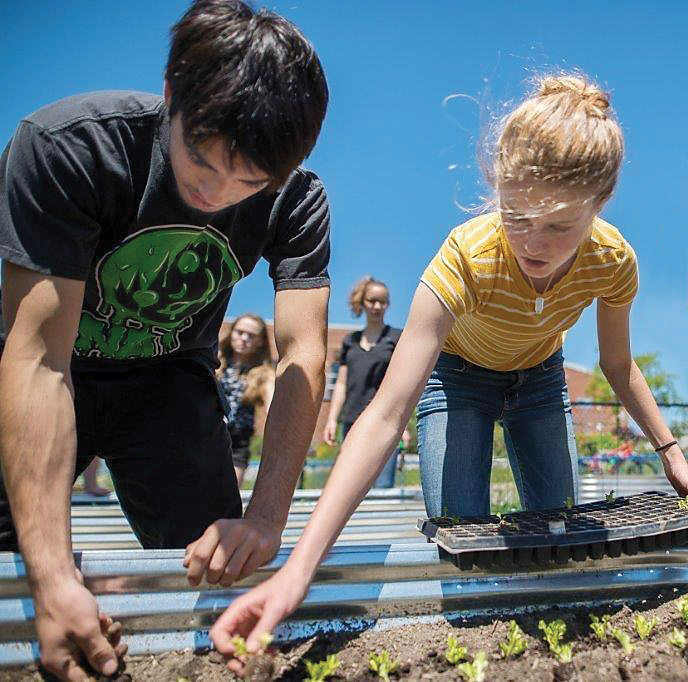
Student work bees were organized during Friday lunch periods on a section of land owned by the school board, across from the library area of Centre 2000. Three-foot high metal enclosures were erected and filled with soil to create raised beds, which improve drainage and make crops easier to manage.
Erin District High School students planted the first raised beds last year.
 “We wanted to make it like a farm park,” said Everdale co-founder and youth director Karen Campbell. 
The idea was to create links to the community, potentially selling some produce to local businesses or restaurants, or donating some to the food bank. The micro-farm is also intended to as a teaching space, supporting areas of the curriculum such as literacy, numeracy and the development of work and leadership skills.
Everdale staff are also creating a comprehensive “Start a Micro Farm at Your School” teaching module to help other schools replicate the project, including advice on soil composition and sample crop plans.
Everdale is a non-profit organic farm near Hillsburgh celebrating its 20th year. Their endeavours include the Harvest Share program that provides weekly produce for members, sales at farmers’ markets, events such as Carrotfest, farmer training programs and internships, and farm school programs designed for various interests and grade levels.
More raised beds have now been constructed at EDHS and there are plans for an area of ground-level planting. 
Since students are away from school in the summer, the strategy is to plant quick-growing crops like lettuce and spinach that can be harvested in late spring, then planting seeds for longer term crops like carrots, kale and potatoes that can be harvested in the fall.
It is a continuation of a longer-term effort at the high school to bring more healthy alternatives to the cafeteria, where students from the hospitality program cook and serve food.
Students with interests in farming, food and environmental issues have been involved. The art department is decorating the new picnic tables and tech students are working on a sign.
The school has received EcoSchool certification for its efforts to reduce energy consumption in the building, the installation of water bottle filling stations and the use of composting bins for the cafeteria. 
The Environmental Club, under the supervision of teacher Ross Watson, planted an herb garden in 2013 on the far side of the parking lot to supply some fresh greens to the cafeteria.
Brainstorming on possible future developments ranges from an outdoor classroom to establishment of nut trees or perennials such as raspberry plants.
Erin is part of the Wellington County Local Food Initiative known as Taste Real. As part of the county’s economic development strategy, it is building a network that includes farms, restaurants, food retailers and the growing farm tourism sector.
“By increasing access to local food and drink, and supporting innovation in processing, we are strengthening rural and urban economies, creating good jobs, and building a more sustainable future,” said Jeff Leal, Minister of Agriculture, Food and Rural Affairs.

February 15, 2018

Businesses get innovation grants

Two Erin businesses are among 24 in southern Ontario to receive seed funding last year to expand their operations, access new markets, attract investment and create jobs in the region.
Heartwood Farm and Cidery in Ospringe and Fanjoy Restaurant in Hillsburgh each received $30,000 grants, in the third round of funding from the Bioenterprise Corporation and its partner, Innovation Guelph.  Erin pet food company Bold Canine received a first-round grant in 2016.
Recipients use the money, along with their matching funds, for branding and marketing; prototyping and product piloting; business-to-business (B2B) sales, business development, process optimization, and to help advance market opportunities. 
“Seed funding and mentorship can play a crucial role in assisting early-stage businesses,” said Dave Smardon, Bioenterprise Corporation President and CEO.
Bioenterprise is a national, non-profit agency designed to boost the agricultural technology sector. The Federal Economic Development Agency for Southern Ontario (FedDev Ontario) has provided Bioenterprise with up to $4.84 million for the program.
Funding is delivered through Innovation Guelph’s Fuel Injection program, assisting start-ups and promoting the growth of small and medium-sized businesses. Support services including mentoring/coaching, market and competitive analysis, financial and marketing strategy, investment preparation, and introductions to strategic partners.
At a recent Innovation Showcase, Bioenterprise and Innovation Guelph announced that the 32 recipient companies from the first round of seed funding have raised more than $21 million in follow-up private investment, generated more than $6 million in revenues, created more than 45 jobs, and launched more than 50 products, processes, and technologies.
The funding program supports innovative southern Ontario businesses in the agriculture and agri-food, sustainable and environmental technology, advanced manufacturing and social innovation sectors.
Brent Klassen and Val Steinmann started making hard cider at Heartwood Farm last year, selling three varieties at farmers’ markets and at their retail farm store, just north of Ospringe on Second Line.
It’s a business model promoted by Wellington County’s Economic Development Department through the Taste Real program, encouraging organic farmers and other businesses to welcome day-tripping city dwellers.
Chef Pam Fanjoy (a 2015 Chopped Canada winner) is also tapping into the trend, using seasonal local ingredients for “farm-to-table” cuisine. The Fanjoy restaurant and bar (formerly Friendly Chef Adventures), just across from the Hillsburgh Community Centre, offers special activities such as PD day camps for kids, and cooking classes for kids and adults.
Her experience as a social worker has led to a Mindfullness Eating course as a support group for women, and in January and February, a common table Community Luncheon, Tuesdays, noon to 2 p.m. She also offers a catering service and operates a retail kitchen store, with fully prepared meals to take home.
“The partnership between Bioenterprise and Innovation Guelph has been successful in assisting innovative businesses with early-stage support to help them grow,” said Anne Toner Fung, Innovation Guelph’s Executive Director. 
“We believe it is to everyone’s benefit when innovative Canadian businesses are able to grow and create quality jobs,” said Guelph MP Lloyd Longfield, on behalf of Navdeep Bains, Minister of Innovation, Science and Economic Development and minister responsible for FedDev Ontario. 

February 08, 2018

Angelstone zoning approved by OMB

A challenge to the zoning of the Angelstone Farms show jumping facility on Wellington Road 50 has been rejected by the Ontario Municipal Board (OMB).
Frederick and Nancy Gilbert who live next to the facility complained about the disruption of their rural lifestyle caused by an annual series of tournaments, attracting up to 1,000 spectators.
They argued at a five-day OMB hearing that the entertainment aspect of the events was not a proper agricultural use of the property.
Angelstone and the Town of Erin argued successfully that the farm’s primary use is horse training, and the events are a permissible secondary “value added” activity within the bylaw. They said adequate measures had been taken, as demanded by the town, to offset complaints about noise, traffic, trespassing and bright light.
The hearing was conducted by OMB member Sharyn Vincent. She ruled that the “innovative techniques” used by the Angelstone business are in the public interest, do not hinder neighbouring agricultural operations, and conform to the official plan, provincial policy and Ontario’s growth plan.
She ordered that the maximum number of event days be limited to 25 per year.
Angelstone originally held its equestrian events without proper zoning, but was allowed to continue under a series of temporary zoning bylaws. Last April, Erin council approved permanent zoning for the operation.

Former County Planning Director Gary Cousins told council he believes the show jumping, plus musical entertainment and the sale of merchandise, food and beverages, qualifies as a permitted use in an agricultural area.

February 01, 2018

Farmers taking action to improve water quality


Everyone benefits when water quality is improved, and the Wellington Rural Water Quality Program is helping farmers do their part.
Wellington County provided $425,000 for the program in 2017 to support farmers on a wide range of projects that not only enhance their operations but safeguard or improve local water and soil. Similar programs with different levels of funding are available in other areas.
“The counties and regions provide this money voluntarily, because they see the benefit to the community,” said Louise Heyming, Supervisor of Conservation Outreach with the Grand River Conservation Authority (GRCA).
The benefits of improved water quality, according to the program terms of reference, include a safe, secure water supply, a healthy aquatic ecosystem, increased recreational opportunities, sustainable agricultural operations and a vibrant economy.
Buffer zones next to waterways reduce erosion and the runoff of fertilzers and pesticides, 
and help create a better habitat for fish and other wildlife.
Photo - Grand River Conservation Authority
The program promotes a positive attitude in the farm community, encouraging the adoption of best management practices.
To qualify for support, farmers must attend a one-day educational workshop to create an Environmental Farm Plan. If their applications for specific projects are approved by a review committee, they can proceed with the work and receive compensation when it is complete.
The committee has representatives from local farm organisations, as well as the county and the Ministry of Agriculture. Priority is given to projects with the greatest potential to improve or protect water quality.
“The Rural Water Quality Program (RWQP) has provided a sustainable source of funding to assist the Wellington farm community for 18 years,” said Gary Cousins, former Wellington Planning Director, in a report last year. “Demand for the program remains high with an average of nearly 200 projects completed annually.”
The largest grants are up to $25,000, covering half the cost of manure storage structures. These reduce contamination of surface water and runoff into waterways.
Farms can be hard on the land, and the water that flows through it. The necessities of farming, from land clearing and fertilizer storage to the grazing of cattle have put a lot of stress on the environment. Farmers and conservation authorities are trying to strike a better balance on agricultural land, and reverse some of the damage done in the past.
Within the Grand River watershed, which includes the west half of the Town of Erin, the program not only improves the local environment but also reduces the nutrient impact on Lake Erie. All of the money provided by Wellington taxpayers goes to projects within the county.
Some funding is in the form of a “performance incentive”, based on the size of the project. For example, a farmer can receive $100 per acre for planting cover crops, which enrich the soil and reduce erosion. There is $350 per acre for planting trees on up to 10 acres, to create stream buffers, retire fragile land or create field windbreaks; and $500 per acre to plant living snow fences that retain moisture on the land and protect roadways from drifting snow.
The program stimulates private investment, since landowners often contribute an amount in cash, materials or labour. Since 1999, the program has funded more than 2,600 projects valued at more than $21.5 million. County farmers have contributed $13.5 million and the County of Wellington $5.1 million, with the remainder from other funding sources.
Some highlights include: 172 manure storage facilities, 46 kilometres of watercourse fences, 58 kilometres of stream bank buffers, 177 kilometres of windbreak, 12 kilometres of living snow fence, 408 wells decommissioned, 407 wells upgraded and 1,200 acres of marginal land retired.
The program is not just for farmers – there is $50,000 set aside for grants of up to $2,500 to cover 100 per cent of the cost to decommission old wells on any county property.
Other grants available include $5,000 for water diversion, $10,000 for livestock restriction, $10,000 for erosion control structures, $4,000 for fuel storage and handling, $5,000 for machinery crossings and $2,000 for wellhead protection. These cover 50-80 per cent of costs, but can be combined with other funding. Staff can assist with planning and the application process.
The Region of Peel started its own Rural Water Quality Program in 2005, working with Credit Valley Conservation (CVC) and the Metro Toronto and Region Conservation Authority.
“Our family is proud of our contribution to protecting water quality,” said Sharon Rowe of Shallow Brook Farms, on the CVC website. “Every year, we’ll be able to watch the trees and shrubs we helped plant mature, enjoy the increased wildlife on our farm and appreciate the beauty of our naturalization project.”
For more information on the Peel program, contact Mark Eastman at CVC, meastman@creditvalleyca.ca.
 “The application process was surprisingly user-friendly and expedient. We received great support from program staff,” said Randal Ugolini, of Highpoint Farms in Caledon.
Funding from Dufferin County has been sporadic, but was recently renewed with a commitment of $20,000. For more information on the Wellington or Dufferin programs, go to grandriver.ca or email ruralwater@grandriver.ca.

December 30, 2015

Measuring the quality of a semi-rural lifestyle

As published in The Erin Advocate

No doubt there is a price to be paid for living in an uncrowded area with plenty of fresh air, fresh water and fresh food. But senior governments need to be reminded of the value that rural communities provide to the economic and environmental welfare of city dwellers.

The Canadian Rural Revitalization Foundation released a report this year that says small towns and Aboriginal communities have been getting the short end of the stick when it comes to services that all Canadians should enjoy.

“We have been neglecting rural Canada,” the report says. “Despite the vital role of rural places in this country, and despite their partnership with urban Canada, we have been neglecting rural places and permitting the erosion of an important community development foundation of Canadian society and economy. Fundamentally, we have forgotten how to re-invest in rural and small town places, preferring instead to simply run down the capital invested by previous generations.”

Erin may be relatively affluent, but most of our money is generated elsewhere, so there is a lack of motivation to invest in the local community. We need to demand a fair share of the wealth that comes from the offices and factories of the Greater Toronto Area, but the Foundation also urges us to be innovative in developing our own economy with local action.

“As we approach a re-imagined rural Canada we need to listen to rural peoples,” the report says. “We cannot re-imagine places and economies without the vision and experience of those who live and work every day in these places.”

Another report with more local information was released this year by Credit Valley Conservation (CVC), analyzing the changing use of farmland within our watershed based on the 2011 Census of Agriculture.

“Agricultural producers are key stakeholders in protecting environmental resources such as water, air, soil and biodiversity,” said Mike Puddister, Deputy CAO and Director of Watershed Transformation at CVC.

CVC provides financial incentives for farmers, stressing that conservation and improvement of environmental resources benefits everyone, including densely populated areas like Brampton and Mississauga.

“Adopting conservation practices is increasingly important with climate change,” said Mark Eastman, Agricultural Program Coordinator at CVC. “For example, planting buffer zones along streams protects fields from erosion, filters nutrients and pollutants, and shades water keeping it cool for fish.”

Ontario’s prime farmland is concentrated in the southern part of the province, where there is huge pressure for new homes, roads and businesses. So it is no surprise that from 1956 to 2011, Ontario lost 36% of its farmland – compared to an 8% decline in Canada as a whole.

The census data for the West Credit Subwatershed (most of the eastern half of the Town of Erin) show a 26% drop in the number of farms, from 1996 to 2011 (88 farms down to 65), with most of the decline from 1996 to 2001.

The total acreage, however, was down only 9.2%, since average farm size was increasing. Most of the farms are in the 10-69 acre category (25 of them) or 70-129 acres (15). While farm acreage was down, the total number of acres in the subwatershed being sprayed with herbicides was up 43% in 15 years, and acres sprayed with insecticide were up 32%.

Other trends in the larger watershed include more acreage in field crops and less in natural land for pasture. The number of farms producing fruit, berries and nuts was down by more than 50% in the 1996-2011 period. The number of farms producing vegetables was stable, but the acreage was down 34%.

The CVC study found that 50 per cent of farms in the watershed are rotating their crops, 28 per cent are using rotational grazing, 25 per cent have buffer zones around water bodies and 30 per cent have windbreaks and/or shelterbreaks within their fields. Of all the farmland, 48% was rented – up 14% over 15 years.

November 11, 2015

Nodwells important in Hillsburgh history

As published in The Erin Advocate

Plans to preserve the Nodwell farmhouse in Hillsburgh have been in the news lately, so it is a good time to provide some background on the family and the homestead that has been part of the local landscape since before Confederation. Jeff Duncan of the Heritage Committee assembled the documentation.

A Family History written in 1936 by Robert D. Nodwell notes that the original family name had been Nedwill, but it was changed before they moved to Canada. William Nodwell’s family were Presbyterian Scots from the town of Anaghmore in County Londonderry, Ireland.

Loss of a valuable stock of horses due to anthrax influenced their decision to emigrate, and much of the family landed in Quebec in 1838. They travelled by oxen-drawn wagons and settled on 200 acres at Lot 24, Con 8 in Hillsburgh, including the current site of Ross R. MacKay School and Meadowview Place Seniors Apartments.

Within a year, their house and belongings were destroyed by fire. William sold the north-east half of his land to Angus McMurchy, and they built a new log house. Robert D. says his grandfather William was: “A Free Mason, and held strong views re Democratic forms of Govt., Free speech, Govt. by properly constituted authority, etc.”

William died in 1845, and the land was divided between his sons Robert and Thomas. Robert bought a farm in East Garafraxa, and then traded it for his brother’s share of the family farm. A new frame barn and shed were built in 1857. Some later sources say the red brick and limestone farmhouse was built in 1868, but architectural professionals said in 2004 it appears to be from about 1865. The 1936 history says:

“A new brick house was built in 1864 and is now occupied by Mungo Carrick Nodwell a great grandson who is now directing the business of the old farm.”

William’s son Andrew had moved from Ireland to Philadelphia in 1836, then to Hillsburgh three years later. They lived 27 years in a log cabin at Lot 22, Con 8. One of his nine children, Robert C. born in 1857, was 92 when interviewed in 1949 by the Guelph Mercury. He recalled working as a potato farmer, selling the farm and retiring in Hillsburgh in 1923.

“Mr. Nodwell has been for many years an ardent Christian gentleman, a forceful protagonist for the prohibition of intoxicating liquors and a Liberal of no mean calibre,” said the Mercury.

The Nodwells were known for breeding Short-Horn Cattle in the 1890s. Family members were leaders at St. Andrew’s Church, and Robert D. was President of the Hillsburgh Branch of the Upper Canada Bible Society. His son, Lieutenant William E. Nodwell of the 30th Wellington Rifles, was a recruiter during World War I. Robert C.’s wife was active with the Hillsburgh Women’s Institute.

Dr. R.J. Nodwell served in the Medical Corps in World War II, was appointed Deputy Director General of Medical Services for the Army in 1953 and Medical Director of Toronto Western Hospital in 1960.

In a 2009 collection called Shades of the Past, Hillsburgh native Francis Gray Currie wrote that Mungo and Lillian Nodwell created a social hub for the community at Homestead Farm. They grew seed potatoes, working the land with horses from 1926 into the 1950s, had a large dairy herd and delivered milk door-to-door by horse and wagon. Lillian was known for her art and her cooking.

The Great Room had a massive harvest plank table that could seat 12, a huge stone fireplace and almost floor-to-ceiling windows, making it “the heart and soul of the farm”.

Advocate columnist Joyce Graham wrote about the end of an era in 2004 when Mungo’s daughter Nina Nodwell and Les Richards moved to Markdale after selling the farm to Manuel Tavares. They had raised sheep since 1985 and operated Hillsburgh WoolWorks.

A lamb roast, with a campfire, games and fireworks, was held at Everdale Environmental Farm to bid them farewell.

May 20, 2015

Property tax rebates deplete Town revenue

As published in The Erin Advocate

When Erin politicians get tired of complaining about the property assessment system, which forces us to pay higher county taxes, they can turn their attention to a variety of other alleged injustices inflicted by the provincial government.

There’s the ever-popular “infrastructure deficit”, in which municipalities have built way more stuff than they could ever afford to maintain, especially with residents forever fantasizing about less taxation.

The Association of Municipalities of Ontario estimates that actually fixing all the roads, bridges, sewers etc. would cost $60 billion. If property taxes alone were to maintain existing obligations, plus eliminate this deficit, the AMO estimates that municipal taxes would have to increase 19% per year for 10 years.

So do we let some of our infrastructure crumble, and ultimately make do with less? Do we pay up through higher taxes and debt charges? Do we invite private enterprise to wave its magic wand? Like good Canadians, we’ll probably compromise and do a little bit of all of that.

Faced with a problem that cannot be solved within the term of one government, the province just chips away at it. They dole out infrastructure funding erratically and upload some of the costs previously dumped on municipalities, but it is never even close to enough.

Erin is at a disadvantage in this game, being labeled a wealthy community. We have low debt, high taxes and very little income from industry. We have lots of farms and natural areas, but the tax revenue they could generate is severely curtailed by provincial policy.

The latest complaints at the Erin council table have been about the 75% property tax reduction the Town is required to provide for qualified farmland (846 properties) and managed forests (117 properties), as well as a 100% exemption for 721 pieces of conservation land.

Farmland qualifies for the rebate if it is actually farmed, generating at least $7,000 in gross income per year. Farm residents still pay the regular rate on their homes, plus one acre, but obviously their fields do not use municipal services. With farmland values increasing faster than residential values, the Ontario Federation of Agriculture is lobbying for a larger percentage reduction.

The benefit used to be a rebate paid by the province and shared through income taxes. It started in the early 1970s when farmers were being hit hard by huge increases in the cost of education – another service not used by the land.

The Progressive Conservative government of Mike Harris did download many costs to municipalities, but it also assumed a greater share of education costs and took over setting education property taxes. These remain a much lower share than they once were, now just 17.2% of the Erin tax bill, with a 0% increase this year.

When Harris shifted the farm rebate to municipalities in 1998, provincial grants were supposed to cover the cost, but they now only cover about one third. Throughout Wellington County, that is lost local tax revenue of $25.5 million per year, at a net cost of $487 per household.

Finance Director Sharon Marshall estimates that if the province took back responsibility for the rebates and Erin could charge regular taxes on all property, the Town tax rate could decline by 11.6%.

Mayor Al Alls says city dwellers are reaping the benefits of protecting the water, air and local food production, but that the burden of supporting the system falls unfairly on rural municipalities.

“It’s a big hit on our budget ­– we’re paying for it,” said Alls, noting that a large share of electoral support for the Liberal government comes from large urban centres.

“The current provincial government doesn’t get their power from us,” he said at a recent council meeting. “Nothing’s going to change until that changes.”