March 28, 2012

Official town crier appointed

As published in The Erin Advocate

Hear Yea, Here Yea! The Town of Erin now has an official town crier.

Andrew Welch was appointed by council on March 20. The tradition of criers goes back to medieval times when there were no newspapers and many people could not read. Criers were hired by royal courts or towns to make proclamations and be a reliable source of news.

There's no salary for the position or any cost to the town. He will be available to be hired by local groups to add a dramatic touch to various events, though his services may be offered free for charities. He appeared at the recent Upside Down Sale put on by the Business Improvement Area, and the St. Patrick's Day gathering at McMillan Park.

He will occupy the position until the end of the current term of council in 2014. Last September the Alton resident was appointed Town Crier for Caledon for the same term.

At the council meeting he added some pageantry for the good-will tour visit of Wellington County Warden Chris White and senior staff. He whipped up a poetic proclamation on short notice, which included this description of his duties:

"A crier is a photo-friendly way
to greet folks from far and near.
A splendid way the Town can say
we have both fun and history here.
A simple thing to add some zing to fairs and such,
to lead parades or open things,
a crier adds that special touch.
Town criers give a welcome face
to all that makes a town unique.
They gather crowds, create the space,
and introduce the folks who speak."

Welch is a member of the Criers Guild and was featured in the last summer's edition of Sideroads Magazine for Caledon and Erin.

He has broad experience as a performer, including various films and TV series, radio projects, live theatre, audio books and motivational/educational speaking engagements. He is also a software developer. For more information, go to www.andrewwelch.ca.


Photo (L-R): Mayor Lou Maieron, Warden Chris White, Welch

Station Road dam repair could be costly

As published in The Erin Advocate

Town council has authorized an estimated $15,000 in engineering work to plan repairs to the Station Road dam in Hillsburgh, despite concerns about the high cost of the entire project.

The road over the earthen dam and causeway started to subside last fall, and was closed after damage and unstable ground was detected in an underground culvert, west of the main spillway.

Closure of the route, which is next to the fire hall, means that emergency vehicles must travel an additional 6 km around the block to serve residents on the west side of the ponds.

The Town had been requesting direction from the Ministry of Natural Resources (MNR) on how to proceed with repairs, but there was no reply for four weeks. After the fire department had a delay in reaching a resident suffering a heart attack, there was pressure from the Town and MPP Ted Arnott, and a response arrived on March 13.

The MNR assessment creates a problem for councillors, since any option other than restoring the functions of the dam to their recently existing state could constitute a change to the area environment and fish habitat. That might involve a long design and approval process that could leave the road closed for an extended time.

"We have to get on with it – let's get it fixed," said Councillor Barb Tocher.

Another problem is that the approval agencies have used "assumptions and unconfirmed information" to determine flood elevations, according to Road Superintendent Larry Van Wyck. This has resulted in a "High" hazard classification, referring to the consequences (not the probability) of a dam failure.

The MNR points out that, based on Credit Valley Conservation (CVC) floodline mapping, the minimum "Regulatory Flood" depth is more than half a metre higher than the existing road level, meaning that the dam would be inadequate even if restored to its normal condition. Van Wyck believes the mapping is inaccurate, but that the Town must do a survey of the pond to prove it.

"They have some old information that is incorrect, and it's not based on a topographic survey," he said. "They have no idea how much water is being held on the north side of the road [or] on the south side of the road. The elevations of the floodplain used in the correspondence we received is higher than the elevation of the floodplain for which they approved the design of the fire hall."

In the next few weeks the Town will assess the volume and capacity of the pond, which could lower the hazard rating. A detailed design will also be created for full replacement of the existing culvert.

At the council meeting, Mayor Lou Maieron speculated that rebuilding the culvert area could cost between $250,000 and $500,000. While supporting restoration of the road, he questions the need to rebuild the culvert at its present location. Still, he voted with all other councillors in favour of the engineering work.

"I want to get it fixed, but I don't really want to go to all this trouble and expense for a pipe that doesn't serve the road," he said after the meeting. "If it doesn't serve the taxpayer, if there's no purpose for it, why have it go under the road?"

The culvert is considered part of the hydraulic function of the whole dam, increasing safety by adding an extra passageway for water, and the MNR requires that this function be maintained. Maieron raised the possibility of rebuilding the culvert away from the causeway, but was told this would take too long.

The quicker and less expensive possibility of repairing the existing culvert with an insert and grout would not be approved by the MNR. In his report to council, Van Wyck said that option "will not be acceptable as there is not sufficient bearing strength in the soil" according to current dam standards.

The water level in the pond has been lowered to reduce pressure on the dam by removing some boards in the control structure. If they stay out, it would increase the dam's ability to resist a flood peak and could reduce the hazard rating.

Van Wyck told council that if the pond level is lowered by removal of all the boards in the control structure, which would require removal of the sediment behind them, the MNR might not permit re-installation of the boards.

Marcy Quayle, who owns the land on the north (upper) side of the dam, does not want to see the pond drained.

"I am not interested in the removal of the dam structure, this includes the spillway under the bridge and the raceway. Now or in the near future. Nor am I bearing any costs that this may bring as the land owner," she said in a letter to Van Wyck.

John Kinkead, Director of Water Resources Management & Restoration for CVC said in a letter to the mayor that although CVC has no budget for helping remove the dam, that could be the best option.

"We all understand that the most fundamental requirement in moving forward is to ensure public safety," he said. "In light of the apparent cost and technical uncertainties around addressing hazard considerations should the dam remain in place, the preferred solution might in fact be the appropriate 'decommissioning' of the dam."

A 2002 fisheries plan authored by the CVC and the MNR identified the Hillsburgh dams as potential targets for "mitigation or removal" to benefit overall fisheries health. Dams block fish movement and result in higher water temperatures due to the ponds.

In a letter to council, Ron Moore, who recently moved to the area, said draining the pond would be a "detriment to the wildlife that inhabit the pond and the wetlands surrounding it" and that higher property taxes could be justified to preserve it.

"No one likes to pay more taxes, but I believe many in the area, not just those whose property backs onto the pond, would support keeping the pond as it is," he said.

Town struggles to keep gravel roads open

As published in The Erin Advocate

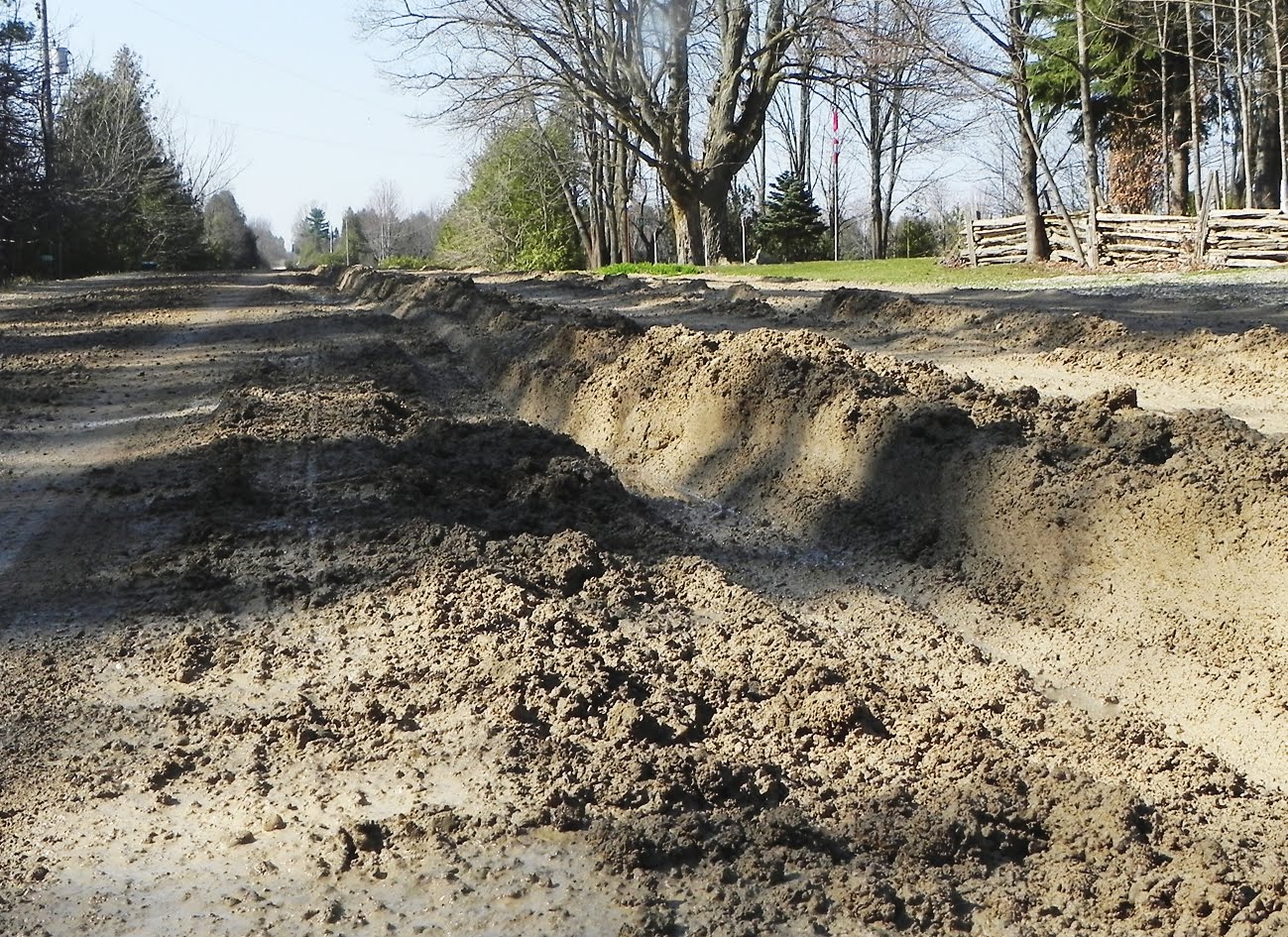
Town crews have been scrambling to keep gravel roads passable during a spring thaw that Road Superintendent Larry Van Wyck called "the worst on record".


(Second Line)

He reported to council last week on the impact of unseasonably warm weather, which has made small sections of many roads dangerously soft and muddy. One short-term strategy is to scrape off the top layer and put down a layer of large crushed stone, ideally filling the mud hole down to a firmer base and bridging the weak spot.

"It is a band-aid at best, but there is no other solution," he told council. "A large number of houses will be inaccessible if we don't do this. We're having limited success, and if it rains it may be worse."


(Fourth Line)

School buses are getting through, using caution, he said. Crews are trying to spread the wet gravel out over longer distances, hoping the wind will dry it out. There is no tally on the cost yet, but loads of stone are more expensive than gravel. The Town has three graders, each responsible for 65 km of roads.

Mayor Lou Maieron said people should call the roads department so the Town will be aware of all problem areas. He noted that it is not feasible to simply pave the surface of existing roads – they need to be built with a proper base and drainage, sometimes with a higher road level, which is an expensive process.

"There has been an evolution of rural roads, moving on from paths or country trails to roads, and probably there are sections that were not properly constructed," said Maieron.

Van Wyck said many of Erin's rural roads were built as one-lane dirt roads suitable for public needs 100 years ago. Residential traffic volumes on gravel roads have increased dramatically with the increased popularity of country living, and the agriculture traffic has steadily increased in size and weight, he said.

"It is a fact of life, if you live in the country," said Councillor Josie Wintersinger.

Resident Karen Seitz wrote to council to say that sideroad conditions near Hillsburgh have gotten steadily worse over the last eight years.

"I have been told that there is nothing to be done at this time, but that is not good enough," she said. "This is a safety issue, and injury or death is not an option. You need to at least try something to make these roads drivable. We pay our taxes to have these things taken care of for us, so that is what we expect to be done.

"Not only are our vehicles being ruined, but our lives are in danger. My tire got caught in a mud rut last evening and it almost pulled me into a ditch. This is ridiculous and something needs to be done right away."

Another resident reported seeing pieces of logs from the original corduroy-style construction emerging from the mud.

"Each year the number of problem areas varies, but this does seem to be particularly bad relative to other years," said Van Wyck. "Spring thaw starts from the top down, which leaves an expanded, saturated layer of mud over a barrier layer of frost and ice...that prevents moisture from draining down or away from the surface."

This annual problem was made worse by a large amount of rainfall in the fall, followed by unseasonable freeze/thaw cycles in January and February.

"Typically, we don't see this kind of freeze/thaw until later in the year," said Van Wyck. "There is little we can do to smooth a road when it thaws, turns to mud, gets rutted, and then quickly freezes again (we can't grade a frozen road or a road that is mud). We faced a seesaw of freeze/thaw, which made any type of road maintenance virtually impossible. In addition subsequent rain further eroded the already rough gravel roads."

The Town will have access to a supply of low-cost gravel this year when Hydro crews finish the new line of transmission towers through Erin, and the temporary roads needed for that construction are removed. Those 4,000 truck loads may end up being stored temporarily on a section of Barbour field that is not being used for sports, said Van Wyck.

Local property taxes up 8.48 per cent

As published in The Erin Advocate

Town council unanimously approved its budget bylaw last week, thanking Wellington County for a low tax increase. This has allowed the town to raise extra revenue for road improvements without hitting residents with a large overall tax increase.

Based on estimates approved at the final budget meeting on March 7, Town taxes will increase by 8.48% for 2012. For an average house assessed at $363,750, that will mean an extra $74 per year on the town section of the tax bill, bringing the payment up to $946.

Most of that increase ($41) will go to an "infrastructure renewal" reserve fund, with $200,000 to be used mainly for improving roads.

The total property tax bill for an average house will now be $4,293. The Town budget accounts for 22% of that bill. The education tax, accounting for 18.8% of the bill, is up only 1.4% to an average of $804. The county tax, accounting for 59.2% of the bill, is up only 1.9% to an average of $2,543.

When these rates are blended in proportion, the overall increase is estimated at 3.19%, or an average of $133.

"We tried to keep the [county] tax increase down to give the lower tier municipalities more capacity," said Warden Chris White, who was visiting Erin council on a good will tour with senior county staff. "There's one taxpayer, so it's good if we can work together."

Councillor John Brennan offered his thanks to the county for the "budget room", and Mayor Lou Maieron said, "We get a lot for our tax dollars, so it is important to let people know."

The Town's total budget of $13.3 million is up almost 22 per cent compared to 2011, but increased revenue from grants, reserves, fees, permits and new debt have offset the tax requirements. Regular Town operations will cost $8.3 million, while capital projects will cost $5 million.

Levies for the Grand River and Credit Valley Conservation Authorities will cost the Town $135,804 this year (up 3.5%), and CVC got an extra grant of $5,000 towards the purchase of park lands in Erin.

Director of Finance Sharon Marshall noted that the budget only approves the first year of a five-year Capital Investment Plan for renewing local infrastructure, as required by the province. Council will have to consider the rest of the plan this year.

The Fire Department accounts for a large share of 2012 capital spending, with $1.5 million for the new Hillsburgh fire station, funded mainly by new debt. The total project cost will be about $2.2 million. There is also $408,700 for a new Hillsburgh pumper/rescue truck to replace a 1984 pumper, and $33,000 for a new pickup truck.

Reconstruction of bridge #2046 on the Fifth Line will cost $449,126, funded by Federal Gas Tax revenues. Reconstruction and resurfacing on the Erin/Halton Townline will cost $456,339, partially funded by the gas tax, reserves and development charges. Reconstruction of a section of the First Line will cost $175,000.

A new roads department truck and plow will cost $219,310 (half of which was paid last year), while repairs and painting of the Erin water tower will cost water ratepayers $110,000.

Completion of three watermain projects for $259,600 this year will get two-thirds funding from a provincial grant. Completion of the multi-year construction of the Hillsburgh Pumping Station has been allocated $769,208 in provincial funding.

Construction of the new Erin skatepark is in the budget for $100,000, with substantial fundraising, donations and grants offsetting the cost.

A sampling of other smaller projects includes:
• Shower tiles in the old dressing rooms at the Erin arena, $26,000;
• Computer hardware and software upgrades, $33,000
• Financial software, $25,000
• Streetlight improvements, $15,000
• Replacement of retaining walls, $52,875
• Trail system upgrades, $7,300

March 21, 2012

A heartwarming journey of love and friendship

As published in The Erin Advocate

Romantic Comedy is perhaps the ideal title for a funny play about love – everyone knows what to expect, from that awkward first meeting, to the witty dialogue and those unexpected twists of fate.

The script is by Bernard Slade, a writer from St. Catharines who gave us The Partridge Family and The Flying Nun on TV, and Same Time, Next Year on stage and the big screen. The current production is by Century Theatre Guild in Hillsburgh, opening for a two-weekend run this Friday.

After dropping in to observe a rehearsal recently, I can report that there is some very funny material, both verbal and visual. I wouldn't review something before it is ready for the public, and I cannot claim to be totally unbiased, since I have acted in small roles with this group. But still it is clear that the lead actors are skilled, confident and having a good time.

Titillating and heartwarming – it is a sure-fire combination for audiences when everything comes together well. That's the challenge for Dale Jones, an experienced actor now directing his second show for Century Church. The first was last year's Farndale Murder Mystery.

"To direct a play is to take words on a page and make them come to life," said Jones, after watching his cast run through a scene without scripts in hand, fine tuning expressions, stage positions and sound cues.

"It's got all the human emotions," he said. "What is marriage? That's what he (Slade) is talking about, and it's really well done. Everyone has had mucked up relationships or knows someone who has, so they can relate."

Jones has never seen the play done elsewhere; he just read a series of scripts and picked his favourite.

"It's the one you can't put down," said Frank Rempel, who plays Jason, a playwright who, on the day of his marriage to Alison, meets and falls in love with the fascinating Phoebe. He happens to be naked at the time, since he was expecting a massage therapist, not an admirer who would become his playwriting partner, with each married to someone else. The roles of Jason and Phoebe were premiered on Broadway in 1979 by Anthony Perkins and Mia Farrow.

The story spans 14 years of failure and success in both writing and relationships, as Phoebe, played by Stephanie Baird, goes off to Paris with her new husband Leo, played by Martyn Worsnop.

Jennifer Bartrum is Jason's agent Blanche, Lindsey Papp is Alison and Sharon Ching is Kate, who plays a key role in the breakup of Jason's marriage. The Stage Manager for the production is Charlotte Sue.

The racy bits of this show are mainly in the innuendo, but it's not really suitable for younger kids. Performances are March 23, 24, 30 and 31 at 8 p.m. and Sunday afternoons March 25 and April 1 at 2:30 p.m. Admission is $18, and the box office number is 519-855-4586.

Forests offer escape from noise and straight lines

As published in Erin Country Routes

Do you ever need to escape the well-trodden sidewalks, the din of cars and trucks and the straight lines of buildings? There are public tracts of forest in the Erin area set aside for just that purpose.

In addition to popular routes such as the Woollen Mills loop (off Millwood Road) and the Elora Cataract Trailway, there are trails on parcels of rural land maintained by Wellington County and the Grand River Conservation Authority. No hunting, no dirt bikes, no snowmobiles, no bicycles – just walkers, and dogs.


There are no spectacular views of the escarpment, and the trails don't lead anywhere special. They are simple loops winding through half-concession lots where the terrain is too irregular for farming.

The Peacock Tract is a Wellington County Forest, near the communications tower on Trafalgar Road, 1.3 km north of County Road 50 (the former Peacock Sideroad). The trail goes past wetlands and mossy rock outcrops, as it cuts behind neighbouring properties.

Initially there are stands of spruce and cedar, but further in there is a wide open maple bush. The whole loop takes about 40 minutes, or a bit longer if you are walking an unruly hound, with a tendency to dash off after scents and wrap her leash line around trees.

The Ospringe Tract, managed by the Grand River Conservation Authority (GRCA), is located on the Fourth Line of Erin, .7 km south of County Road 124 (turn at Denny's).

On a sunny winter's day you can hear the water gurgling under the ice as it drains away from the cattails. You can hear the trees crackling in the cold and see the trails of deer and coyote tracks in the snowy fields nearby, with sweeping views of undulating farmland and scrubland.


Most of it is natural growth forest, but a small section was reforested many years ago, with the conifers towering over 80 feet tall. This hike also takes about 40 minutes.

Another forest managed by the GRCA is the Johnson Tract, located on the Second Line of Erin, just south of the Garafraxa Town Line. For more details, see the Erin Insight column from May 4, 2011, at erininsight.blogspot.com.

Also worth a visit is Scotsdale Farm, a beautiful piece of land just south of Ballinafad, which has been open to the public since 1982. Stewart and Violet Bennett lived there for 40 years, raising Arabian horses and Shorthorn cattle. Stewart was President of the Beardmore Tannery in Acton, Vice-President at Canada Packers and President of the Royal Agricultural Winter Fair.

The couple bequeathed their 219 hectare farm to the Ontario Heritage Foundation to ensure its protection. (They also donated $1.3 million to the Georgetown Hospital, which created the Bennett Centre for seniors.)

Archeological evidence of an Iroquoian village from the 1500s has been found on the land. The original farm homestead was built in 1836 and the barn is at least 130 years old. The farm has been used as the setting for several movies and The Campbells TV series, and as a conference centre. The Bruce Trail runs through the property, which features a moraine, escarpment outcrops, forests, wetlands and pastures.

The farm is suitable for picnics, exploring with children and hiking. The 3.9 km Bennett Heritage Side Trail branches off from the Bruce Trail just south of the entrance to Scotsdale, and goes between the farm buildings. It crosses a small dam on Snow's Creek, which flows south and east from Ballinafad. All streams in this area drain to the Credit River at Norval.

The Bennett trail meets the Eighth Line, where you could cut south, and use the Maureen Smith Side Trail join the main Bruce Trail, and loop back to Trafalgar. Or you could follow the Bennett trail farther east as it crosses Owl Creek, then runs beside Silver Creek, ending up at 27 Sideroad. This creates a much longer loop back to Trafalgar, so check the posted maps, or download one (Google "bruce trail bennett") before you set out.

There are hiking videos available on YouTube for Scotsdale, the Peacock Tract and the Johnson Tract, courtesy of foottrek.com.

In other trail news, the Bruce Trail Conservancy is celebrating its 50th anniversary. The Caledon Hills Club will mark the occasion at its annual meeting and potluck dinner on April 1 at Caledon Village Place, starting with a hike at 10 am.

The afternoon meeting will include a presentation to Dr. Phil Gosling, the club's first president. In 1962, he took a year off work to lay out the Bruce Trail from Niagara to Tobermory, meeting with landowners and organizing local clubs. For more information, go to caledonbrucetrail.org.

March 14, 2012

Big Shamrock monument could be a lucky charm

As published in The Erin Advocate

Looking through the 2012 Festivals and Events Guide produced by Wellington County, I could not help but wonder what Erin might do to really stand out above the crowd among local tourist destinations.

The County is quite proud of its 2011 tourism promotion, since both the events guide and website won top honours for their categories in the Marketing Canada Awards.

Distribution of this year's printed material was mainly to populations further west, such as Kitchener and London, but for the on-line version, go to www.wellingtonfestivals.ca. Check out the mini-vacations and events there, including video clips, or download a guide – hopefully they'll have the 2012 one posted soon.

The profile of Erin says: "Please come and visit our amazing downtown shopping area, unique local restaurants, play a round of golf, attend our Fall Fair, or enjoy a stroll or ride along our beautiful trails."

Our events include the Upside Down Sale, with a Town Crier hired by the Business Improvement Area (BIA), this Saturday on St. Patrick's Day.

We have the Quilt Festival, Made of Wood Show and Home & Lifestyle Show in April, the Summer Celebration & Sale in May, the Garden Tour in July, the Rhythm & Ribs Fest and Spirit in the Hills Fun Day in August, the Studio Tour and Carrot Fest in September, the Fall Fair in October and the Window Wonderland, Tree Lightings and Santa Claus Parade in November.

These are all good events, but with the exception of the Fall Fair, they do not attract really large numbers of visitors. We could do more, but it would require coordination and funding by the Town or private investors, not relying primarily on organizations such as service clubs or the BIA.

Erin's Marketing Department should focus public attention on our most recognizable asset – the Irish aspect of the town name. Erin, of course, is a form of the Gaelic work Éire, meaning Ireland. The famous phrase "Erin go Bragh" means Ireland Forever.

Surveyors back about 1820 called it Erin Township, to balance the Townships of Caledon (named after Scotland) and Albion (named after England). No matter that our early settlers were Scottish.

Irish is the 4th largest ethnic background in Canada, numbering over 4 million, so the emotional connection (and tourism hook) could be very strong. In the tradition of St. Patrick's Day celebrations, Irish can be a state of mind available to all.

We already have the Shamrocks hockey team, and a Shamrock Room from which to watch them. We have shamrocks on our town welcome signs and streetlight banners. That's not much, really, in the marketing game. Mayor Lou Maieron has the right idea in proposing a St. Patrick's Day Parade – he's even bought a kelly green suit for the occasion.

How about a Shamrock Festival, with lots of good food, high-quality entertainment and all the Irish-themed events we could come up with?

How about building a Big Shamrock, a huge, green icon of our identity that could be known around the world – in the same way that the Big Nickel has put Sudbury on the map?

That 30-foot replica of a 1951 nickel, which overlooks a mining slag dump, was built in 1964 through the efforts of a community-minded entrepreneur, despite the opposition of Sudbury City Council. It included education facilities about mining and coins, and is now known as Dynamic Earth, operated by Science North.

I checked through the more than 300 monuments erected in Canadian municipalities, catalogued on the website www.bigthings.ca, and it seems no one has yet built a Big Shamrock.

Vegreville in Alberta has a big pysanka (Ukrainian easter egg). Glover's Harbour in Newfoundland has a replica of the world's largest giant squid. Leamington has a huge tomato.

A shamrock is not such a radical idea, since it would have broader appeal. It could be funded by the sale of commemorative medallions. It could become a destination for pilgrims – if we make sure there's plenty of parking.

The marketing pitch could include: "It is said that anyone who has their picture taken with Erin's Big Shamrock will have good luck for the next three days." It's blarney, not rocket science.

Could Erin become known as that town with the nice stores, excellent fall fair, beautiful scenery AND the Big Shamrock? Does anyone have a better idea?

March 07, 2012

Terry speaks his mind to councillors

As published in The Erin Advocate

When Terry Hryhor sees something around town that is not quite right, he is more than glad to point it out to Erin politicians and staff.

After Mayor Lou Maieron recently urged people to get more involved in municipal affairs, Hryhor made an appointment to speak as a delegation before the regular meeting of Town Council on February 21.

He told the politicians that Erin needs to do a better job of communicating with residents, and of promoting the town as a great place to live and do business.


He wasn't happy with the amount of information on the notice board at McMillan Park, which for some time simply had "Happy 2012" and a request from last fall for people to bag their leaves. Hryhor would like to see that board actively managed as a source for a current community information.

The Town website, www.erin.ca, does have a lot of details about municipal business and community events, including various ways to make contact. The What's On section has both an event listing and a monthly calendar view. There are also sections for local Facts, History, Council, Departments, Public Notices, a Photo Gallery, a Community Directory, a Business Directory, and links to documents and to other public agenciess.

Not everyone is in the habit of checking the town website, however, and Hryhor suggested the Town reach out to people by putting more information in The Advocate, and publishing its calendar on paper for people to have handy.

He said there are various unresolved issues where the Town should be actively seeking solutions, noting for example that he first heard the discussion of a truck bypass for Erin village back in 1974.

He would like to see more affordable housing, along with a sewer system that would make it possible. He was surprised to see a country house for rent recently, at $4,000 per month.

"How many condos or apartments or semis have been built in the last 20 years? You could count them on one finger," he said, adding that the Town should promote basement apartments, making the regulations clear for homeowners.

"There was also a suggestion that you were going to try to bring industry to Erin, and if you look around there are several opportunities."

As for community celebrations, he feels the Town leaves too much of the burden on service clubs and other community groups. He recalled the big party at the Erin Village Centennial, but was disappointed see nothing similar on the 125th birthday in 2005. He lamented that, compared to other Wellington County communities, there is very little in Erin for Canada Day (other than the Orton fireworks) or the rest of July.

Erin has "great facilities" that are not getting enough use, noting that Stanley Park (which is privately owned) could be the site of some public events.

He also promoted the idea of a highly visible Farmers' Market (which the Agricultural Society is actively considering).

Hryhor is no stranger to community involvement. As a builder, he developed the Valu-Mart store and plaza. He was on the board of directors at East Wellington Community Services (formerly EWAG) and contributed significant time and materials for renovation of their building at 45 Main Street. In 2008, he was honoured with a spot on Erin's Wall of Fame.

There are many ways to get your opinions, questions or information to the Town. You can phone or email the mayor, councillors, town manager or departments heads. You can write a letter to council, that will appear as correspondence on the council agenda and be available for other members of the public to read – be sure to include your name.

To appear before council, you must fill out a form (by noon on the Thursday before the meeting), stating your purpose – which could be a specific request for action, or simply general information. This enables your issue to be put on the meeting agenda, normally a requirement for anyone addressing council. People make their presentations or present petitions at the start of council meetings, and then can leave if they wish.

Delegations are limited to 15 minutes, but if there are two speakers from a group, each can speak for up to 10 minutes if they have something different to say. Members of council can ask questions of the delegations, but are not supposed to enter into debate with them. Questions from deputations to council are addressed to the chair, normally the mayor.

Sometimes after a delegation is finished, council may vote on a motion related to the presentation. Sometimes they may refer an issue to staff or a committee for further investigation, or they may simply take the information and opinions into consideration for future decisions.

Free e-book downloads popular at libraries

As published in The Erin Advocate

Wellington County libraries are reaching out to an increasingly on-line public with an expanding selection of audiobooks and e-books that can be downloaded at no cost.

"In 2011 the library circulated approximately 10,000 e‐book titles and that number will increase in 2012 as e‐readers become more prevalent and collections of e‐titles are increased," said Chief Librarian Murray McCabe in a report to the County Information, Heritage and Seniors’ Committee.

He said the current level of e‐book technology is still far from user friendly, but that e-book vendors are working to simplify downloading procedures.

"The public library continues to fulfill its role as a guide to the use of information technology, a service much valued by the public."

Many patrons, especially seniors, are not familiar with installing software, setting up on-line search criteria or downloading files.

"Lots of people got e-readers at Christmas," said librarian Janine Morin, who has been teaching people how to use their devices with seminars at the Erin branch. "Kobo seems to be the most popular."


In January, there were 2,157 e-books borrowed county-wide, compared to 85,135 physical items such as books, magazines, DVDs and CDs. But the e-book total is almost six times the total for January 2011, and up about 54 per cent from December 2011.

There are some restrictions compared to a regular book: when your 7 or 14-day borrowing period is over, your copy of the material goes dormant and is unusable. There are never any late fines, and if no one else has reserved it, you can download it again. You cannot lend your library files to someone else. Some e-book publishers allow you to burn a copy of their digital files to a CD to keep, while others do not.

Wellington has only 150 titles of its own, but through a partnership with the Southern Ontario Library Service, local residents have access to 18,000 titles. Libraries buy the rights to a limited number of materials, so if someone else has "borrowed" the digital item you want, you have to wait – just as with a regular book.

The category of e-books includes not only downloadable books, but also audiobooks, newspapers, videos and music. Audiobooks were originally in cassette tape format, and can still be borrowed on CDs instead of downloading.

A new audio product available free at the Erin library is the Playaway book, with selections for both children and adults. It is a small, battery-powered, plastic device weighing only two ounces, with only one book on it. Just plug in headphones or link it to a car audio system, then push buttons to play, pause, skip chapters or change the speed of narration. Essentially, it saves you the trouble of using a CD player or loading book files onto an MP3 player. There are also video productions loaded into Playbook View devices – only five ounces, with a small screen that looks like a smart phone.


To download library materials, go to the library website, which is a section of www.wellington.ca, and click on the download icon. Click on Getting Started for advice. You'll need to install Adobe Digital Editions on your computer, to manage books like iTunes manages music. You may need to install Overdrive Media Console to enable reading on various devices.

Log in to the Overdrive system of the Ontario Library Service with a valid library card (they expire every two years), browse the material, put items in your cart, then check out (download) up to five of them. You can read them on your computer, or transfer material to devices ranging from an under-$100 e-reader to and over-$500 iPad. Some devices, especially the Kindle, are not compatible with Canadian library e-books. Call or visit the library if you need help.

Wellington is also researching the 3m Cloud Library, which will compete with the Overdrive system. It includes in-library discovery stations, lendable e-reader units, a simplified set-up and log-in process and an option to either check out or buy an e-book. You could start reading a book on one device, then add bookmarks and continue reading on other devices, including computers, smart phones, tablets and some e-readers. Your digital "bookshelf" would reside in the internet "cloud", instead of on your computer.

A new Wellington County website will be launched this year, including a new base page for the library. It will have links to the on-line catalogue, advanced search features and improved navigation. The library subscribes to various databases that are especially valuable for students.
They provide reliable and reputable information not available through Google or Wikipedia, all available for free with a library card.

The current website provides access to the main iBistro catalogue, allowing you to search and to manage your own account. It also has branch details, the LINK newsletter, and information on book clubs and programs for pre-schoolers, older kids and teens.

February 29, 2012

Population drop boosts risk of school closure

As published in The Erin Advocate

For the first time since the Great Depression, the population of Erin has gone down.

Statistics Canada results from the 2011 census show the town with 10,770 residents, a decline of 378 (-3.4%) since 2006. If the trend continues, including a relatively low number of families with young children, at least one of Erin's public elementary schools could close in the next few years.

The possibility was raised last month by Matt Pearson, Project Manager of the Servicing and Settlement Master Plan (SSMP), in a presentation to town council. He highlighted the fact that there were already population declines in the age 0-14 and age 20-29 groups before 2006.

"Eventually, you are going to say, why are we running two arenas?" he said. The largest segment is in the 40-59 age range – many of whom would like to see their kids have the opportunity to live and work in Erin.

"They can't afford to live in town if there's no jobs," he said, pointing out that the average value of a house in Erin went from $276,000 in 2001 to $410,000 in 2006, and is likely over $500,000 now. He also noted that many seniors cannot afford to downsize here.

"Fifteen per cent of the labour force works in town. It's not what you wanted. This is why we're losing school age youth. You're going to get one of these studies, one of these days, that's going to tell you you've got two schools too many.

"That's a really hard thing when a small community loses a school. It takes jobs away, it takes community focus away. How do you keep your schools? You've got to have more people."

Upper Grand School Trustee Kathryn Cooper confirmed that low enrollment is a serious concern that could lead a school closure. No changes are expected in the next couple of years as the board assesses the impact of added students in full-day kindergarten and possible changes in class sizes.

"Schools are our community hubs," she said. "We need more kids in Erin if we want to keep our schools. Boards are paid on a per student basis. Fewer students means fewer dollars."

She said that Ross R. Mackay School in Hillsburgh is at risk because the board's 2011 Identified Schools Report showed a projected enrollment of 130 students, while the school can accommodate 213. The occupancy rate of 61% is the third lowest among the board's 59 elementary schools.

Brisbane was projected to have 349 students, at 84% of capacity, while Erin Public was projected to have 438, at 74% of capacity. A new projection report will be done in the next few months.
St. John Brebeuf Catholic School has a capacity of 302, and enrollment is down slightly at 93%, with 282 students. Brebeuf and Erin Public both have full-day kindergarten, with Brisbane scheduled to get it this fall, and Mackay in September 2014.

Cooper said the current controversy over transfer of French Immersion students to Brisbane is not directly related to the low enrollment issue. French Immersion accounts for about 57% of students at Brisbane and 11% at Erin Public.

From 1901 to 1941, the combined population of Erin Township and Erin Village declined steadily, from 4,098 to 3,104. Then there were increases for each 10-year census period (including a 42% increase during the 1970s) until the downturn in 2011.

But while total population has declined since 2006, the number of private dwellings is virtually unchanged at 3,939, and up slightly from the 2001 count of 3,892.

"We have a mature population of long-term residents," said Town of Erin Planner Sally Stull. "The kids have gone someplace else, so what you are seeing is an emptying out of homes."
She does not see the population decline as an economic threat to the Town, since the tax base continues to expand, with people continuing to buy properties and add value to them.

"The community faces changes as the demographics change," she said. "We're going to see less demand for sports facilities and more for seniors centres. Even with sewage treatment, I am not convinced that we're going to see more young families."

Lack of sewers has put a hold on new subdivisions since 2007, pending completion of the ongoing SSMP Environmental Assessment.

The population of Ontario stands at 12.9 million, making up 38.4% of Canada's 33.5 million people. But the provincial growth rate of 5.7% is the lowest since the early 1980s. With today's parents having fewer children than previous generations, Canada relies on immigration for 67% of its population growth – considered essential to fuel the economy. By 2031, immigration is expected to account for 80% of population growth.

Ontario's immigration minister Charles Sousa has complained that the federal government has shifted some its funding for settlement of newcomers away from Ontario, to the booming economies of Alberta and Saskatchewan.

Erin receives very few immigrants. As well, the ratio of Canadians living in rural areas has declined steadily from 86% in 1851 to 17% in 2011.

The 2011 census shows population increases since 2006 in the neighbouring municipalities of Caledon (+4.2%), East Garafraxa (+8.6%), Guelph Eramosa (+2.6%), Centre Wellington (+2.5%), and Halton Hills (+6.7%). Brampton was up by 20.8% to 523,911, while Milton had the fast growth in Canada, rising 56.5% to 84,362.

Population figures published by Statistics Canada do not include people missed in the census count, but the agency later provides an estimate of the rate of "undercount". For Wellington in 2001, that rate was 4.75%, so when provincial planners put population estimates in the Places to Grow charts, to be used by the county, they bumped up the census figures by 4.75%.

So while the census says Erin had 11,148 people in 2006, the planning estimate is 11,680. For 2011, planners had estimated 11,930, but that turned out to be too high. The census reported 10,770, but an extra 4.75% only brings that up to 11,281. Instead of the small increase that was predicted, Erin had a small decline.

Plan endorses intensified housing – eventually

As published in The Erin Advocate

Erin Town Council has unanimously approved a series of changes to its Official Plan that would allow for higher-density housing in future subdivisions, but only if the Town gets some form of wastewater servicing.

The amendment is required to bring the Erin Official Plan in line with the Wellington County Official Plan and the Ontario Places to Grow legislation. The County has been mandated to grow significantly by 2031, in both households and jobs, and expects Erin to handle a share of that.

The new parts of the Official Plan include an affordable housing policy, a "culture of conservation", targets for residential intensification, a jobs-to-residents ratio and density targets for "greenfield" lands (previously undeveloped land within the urban boundaries). The public was invited to an information session on the changes last November.

"The Town needs to ensure that new growth helps retain the small town and rural character of the Town of Erin," the preamble to the Plan says, noting the provincial objective of curbing urban sprawl and building "complete" communities.

Most of the changes are subject to "wastewater servicing constraints", meaning that without a sewer system, no major development can take place. Sewers cannot be built until the ongoing Servicing and Settlement Master Plan (SSMP) is approved, and incorporated into the Official Plan.

The recent revisions to the Official Plan include the County Growth Forecast for Erin, 2006 to 2031. Total households are predicted to rise from 3,810 to 5,460. Total employment is predicted to rise from 3,550 to 5,460.

Population projections show an additional 3,850 people in the town by 2031 (1,380 more in Erin village, 840 more in Hillsburgh, and 1,630 more in the hamlets and rural areas). The predictions were made with the assumption that sewer service would be in place by 2016. But it is now clear that it will take much longer, and that substantial new housing is likely to be built later than predicted.

Also, it was expected that the population would remain stable or increase slightly without sewers. But the 2011 census shows a 3.4 per cent population decline since 2006, making it even more difficult to predict future levels.

Still, it is significant to note that the Official Plan predicts growth of 33% over 25 years, with the fastest growth of 15% between 2021 and 2031. That is far lower than the growth rate of 42% that the town experienced from 1971 to 1981 (combined township and village).

At the January 24 council meeting, Mayor Lou Maieron questioned the accuracy of the projected growth forecast, and as noted in the minutes, had a concern that "the numbers being considered would not promote economically feasible development". Erin Planner Sally Stull said the population figures are only rough estimates, which will be revised every five years.

Council had been considering two changes to the Plan that were not approved. A provision for mandatory hookup to municipal water, where a watermain is adjacent to a property, is not included. The other omitted section would have required anyone wanting to install a "communal water treatment plant" to prove to the Town's satisfaction that it was a fail-safe system.

Instead, it simply says "roads, water and utilities will be provided to all new developments wherever feasible". It says the effect is "to clarify that the Town of Erin is reluctant to accept communal septic systems as a viable long term method of sanitary waste disposal until sufficient proof of long-term sustainability is established."

The policy of council when considering development will be to promote a "culture of conservation" that includes water, energy, air quality, waste management and existing cultural heritage features.

The Plan says the Town "will conform" to the County's overall growth strategy, which includes 20% of all residential development each year being within the already built-up parts of the urban areas. Revitalization of downtown areas will include more housing above commercial units.

Development in greenfield areas will have a minimum density of at least 40 residents and jobs per hectare (16 per acre). That could mean six housing units per acre in new subdivisions.

Developers with subdivisions approved, but not yet built, will be asked to consider revising their plans to add more homes per acre. Hamlet expansions will be limited to five residential lots.
A minimum of 25% of new housing, county-wide, must be affordable to low and moderate income households.

"The Town will contribute to the achievement of these targets, subject to servicing constraints," the Plan says. "Accessory residences will provide the bulk of affordable housing opportunities until such time as municipal wastewater servicing is provided."

Medium density housing for Erin is likely to take the form of small lot single family dwellings, townhouses or low rise apartments (4-6 stories). Institutional uses could also boost density, but high rise development is very unlikely, according to Stull.

February 22, 2012

New Hillsburgh group would protest well renewal

As published in The Erin Advocate

People who are concerned about the impact of water extraction by the Nestlé company are gearing up to oppose renewal of a permit for its Hillsburgh well, and are hoping to form a local group affiliated with Wellington Water Watchers.

A range of water issues was discussed last week after the latest film in the 2012 Fast Forward series, organized by the Climate Change Action Group of Erin (CCAGE) and sponsored by Credit Valley Conservation (CVC).

The film was Water on the Table, a profile of Council of Canadians National Chair Maude Barlow, who has authored 16 books and been a prominent critic of the North American Free Trade Agreement (NAFTA), the World Trade Organization and oil sands development. As senior advisor on water to the president of the United Nations in 2009, she addressed the General Assembly:

"The problem is that we humans have seen the Earth and its water resources as something that exists for our benefit and economic advancement rather than as a living ecological system that needs to be safeguarded if it is to survive. The human water footprint surpasses all others and endangers life on Earth itself," she said.

"Water must be seen as a commons that belongs to the Earth and all species alike. It must be declared a public trust that belongs to the people, the ecosystem and the future. Clean water must be delivered as a public service, not a profitable commodity. We need to assert once and for all that access to clean, affordable water is a fundamental human right."

The assembly endorsed the right to clean water and sanitation in 2010, with 122 countries voting in favour, and 41 (including Canada) abstaining. The vote carries no legal force and does not affect Canada's sovereign rights over its water.

Nora Chaloner, Chair of the Guelph chapter of the Council of Canadians, said at the meeting that Barlow's work means a lot in the Global South. Almost 900 million people in the world lack safe drinking water and 2.6 billion have no access to basic sanitation.

"Unfortunately the countries that did not sign on to it are in the Global North, the big, prosperous countries, the developed countries, who don't really want to have water as a human right," she said.

Groups such as the Council of Canadians and the National Farmers' Union are also concerned that a trade deal known as CETA, now being negotiated between Canada and Europe, could affect municipal water. If towns and cities end up having to seek private investment to maintain their water and waste systems, they may be obliged to accept bids from foreign corporations. This could lead to rate hikes, cut-offs for low-income households, poorer environmental protection and lack of accountability.

Bottled water, of course, is already a commercial business. Nestlé's Hillsburgh permit comes up for renewal in August. There has been no identified harm to the local water supply to date, but there is concern because the MoE is underfunded and allows Nestlé to do the monitoring. A well protection agreement between Nestlé and Erin is designed to provide rapid response to any complaints by well owners.

The Ministry of the Environment (MoE) deals with a range of issues, including the length of the license period, the opportunities for public input, the monitoring of local water levels by the company and the fee that it pays – currently just $3.74 per million litres of water.

The issue is complex, because if water is taxed as a resource (like oil), it becomes more of a commodity – one that the US could claim is tradable on a larger scale under NAFTA.
The renewal for the Aberfoyle well was approved last year with no new restrictions on volume or time period, but with extensive monitoring of other wells in the area.

Wellington Water Watchers has promoted the safety of tap water and led the local fight against bottled water and high-volume water taking. Chair Mike Nagy, a speaker after the film last week, said the group hopes to persuade the MoE to take a broader view with a "water budget" for the region, and to consider all aspects of the bottled water, such as the harm caused by plastic bottles and extensive trucking.

"We don't want to be known as the anti-Nestlé group, that's not who the Water Watchers are, but that is one of our highest profile projects," he said. "We have lost faith in the Environmental Bill Registry for the permit to take water, we feel it is a flawed process...We had 8,000 people comment in 2007 on the Aberfoyle permit – that was basically dismissed by the Ministry."

Nagy said a new strategy is being developed for the Hillsburgh renewal, but it is not being made public yet. "It's all hands on deck, we need all resources, talents, anybody that can come forward," he said.

"I'd like to see a group of people in Hillsburgh and Erin get together and hammer out the issues," said teacher Chris Green, a Hillsburgh native.

"There is power in numbers," said Chaloner. "It starts by you talking to your neighbours and your friends, and groups getting together."

If you would like to get involved, or just get more information, contact Liz Armstrong of CCAGE at liz@ican.net or 519-833-4676, or Wellington Water Watchers at www.wellingtonwaterwatchers.ca, or 519-780-5030.

Holly Nadalin of Credit Valley Conservation, which will be offering its comments on the impact of the Nestlé well, also announced a new stewardship program, with details available soon on their website, www.creditvalleyca.ca. Rural landowners will be able to apply for 65-100 per cent funding for property improvements that will enhance water quality and other aspects of the local ecology.

February 15, 2012

Cuba is a harsh lesson in conservation

As published in The Erin Advocate

To those who hope for a society that does not rely excessively on fossil fuels, may I recommend a visit to Cuba – a land with plenty of roads and very few cars.

I have been doing some mid-winter research here, scribbling my notes diligently despite the pulsating salsa music and a parade of scantily-clad distractions. There are key decisions to be made every day: Beach or pool? Buffet or à la carte? Relaxing for days at a time can drive you crazy.

I am not sure whether to feel like an upper class citizen of the world, thanks to Canada's high-value currency, or a slab of meat being grilled on the huge conveyor belt of the tourism industry. I also get a chill, knowing that if a Cuban wrote a column like mine, with mild criticism of their government, they would soon be in prison.

Cuba is a great place to meet people from other cultures, especially French Canadians. Almost half of the 2 million tourists who visit Cuba every year are Canadians, with many from Québec. Then there are the Brits, Italians, Germans and a variety of Latin tourists. Just no obvious Americans, which seems to suit everybody just fine.

The Cold War, of course, is not over here. It simmers constantly with the US, which has enforced a punishing economic embargo since 1962 and continues to levy fines on companies that do business with Cuba.

While there, I read Prisoner of Tehran, a memoir by Marina Nemat, who escaped the political repression of Iran and made it to Canada. It is important for us to remember that there are many places in the world where ordinary people live in fear of their own police and government.

Iran and Cuba are among the nations criticized by Amnesty International for severe repression of civil and political rights, with prisoners detained solely for peaceful criticism of their government.

Many nations are glad to invest in Cuba – I saw a huge nickel mine operated by the Canadian firm Sherritt – but it was Russian subsidies and trade that the country relied on for many years to build up a modern infrastructure. The collapse of the Soviet Union was an economic disaster, plunging a poor nation into deeper poverty during the 1990s.

There were severe shortages of food and fuel, and cars became a luxury that very few could afford. People had to eat less and walk more, resulting in a significant decline in deaths due to diabetes, coronary heart disease and stroke.

Even now, when the economy is in somewhat better shape, most of the motorized vehicles I see on the roads are taxis and buses carrying tourists. Most cars are still refurbished American models from before the embargo, or Russian Ladas used by police and others with elite status.

To buy a car is simply out of the question for most Cuban workers – it could take 10 to 100 times their annual salary, most of which is already used up for rent and other payments.

It is impossible to make direct comparisons between Cuba and Canada, but it is worth wondering just what we would do for transportation if we had a major economic meltdown, a new Depression. There would certainly be no money for fancy public transit.

Many of Cuba's roads still have washed out sections from Hurricane Ike in 2008 (reminding me of springtime gravel roads in Erin). They are busy with pedestrians, horseback riders, bicycles, tricycle taxis, horse and buggy rigs with old car axles, and public transit buses.

Groups of workers are often hauled about in old troop transports or on flatbed trucks. Instead of tractors, farm carts are drawn by small horses (they eat less) and oxen, like the ones that did the heavy work when areas like Erin were settled in the 1800s.


It is a reminder that people are generally driven to conserve by necessity, not idealism. When we run out of oil and gas, could Canada turn to tourism as its leading industry?

In Cuba, the push to open resorts to draw in foreign cash has created a situation where a good bartender with a steady flow of tips can enjoy a higher standard of living than a doctor or an engineer.

Cubans are very friendly and courteous, from the professionals to the beggars. They will complain about their low salaries if you ask them, but they are fiercely proud of their independence, their music and dance, and their universal free health care and education.

There is an underlying reserve, however. Maybe it is because until recently, just speaking with foreigners could get Cubans into hot water. Maybe when they look at me, they wonder what I ever did to deserve the privileges and opportunities of being a Canadian citizen.

February 08, 2012

County will not redevelop landfill site

As published in The Erin Advocate

It is unlikely that Wellington County would ever consider recreational redevelopment of the old Erin Village landfill site, or even allow a walking trail to pass through it, according to the Manager of Solid Waste Services.

"When it's closed, it's closed forever," said Doug Konrad. "It is to be maintained as grass only."

The County took over the site, just west of the Credit River near Church Street, about ten years ago. It was closed in 2003 under a Certificate of Approval from the Ministry of the Environment (MOE).

Konrad said it would be an expensive process to re-open and alter the terms of that certificate, which would be required even for a trail, and it could expose the county to the risk of more stringent requirements from the MOE. If formal walking trails had existed in the area in 2003, there could have been provision for them in the closure plan.

Before Christmas, the county spent about $40,000 to install a 427-meter chain link fence along the south-east border of the landfill, starting at the river. About half that cost was to reinforce it with welded cross-beams, to deter vandals who have repeatedly torn down fences in the area.

The hilly countryside has been damaged by dirt bike and all-terrain vehicle riders, with resulting erosion on both county and private property.

The Ministry of Municipal Affairs and Housing encourages municipalities to redevelop "brownfield" properties, such as former commercial, industrial or landfill sites, for more active use.

That is a costly process as well, but a brochure from that ministry says such redevelopment can support economic development and job creation, contribute to revitalization and "increase community pride and quality of life".

Other communities have successfully turned old landfills into nature parks. That option should at least be open for discussion and investigation in Erin. Research is being conducted on various uses for closed sites, even the growing of crops to be used as biofuel.

Machine traffic on the hills still has to be stopped, and maybe more fencing is inevitable. But hiker traffic carries a very low risk and it should be accommodated, even if it involves some cost. Monitor wells on the site need to be protected, but maybe there are ways to do this without turning the entire area into a fortress.

Konrad said that the MOE prefers chain link fencing at old landfills, but does not absolutely require it if the site is not being disturbed. The vandalism made it necessary to replace the old broken farm-style fences with chain link, he said. There is no immediate plan to replace the farm fences on the other sides of the landfill.

"We'll monitor the site and see what happens," he said. "Within a couple of years, it will probably be all fenced in."